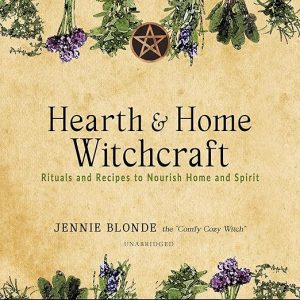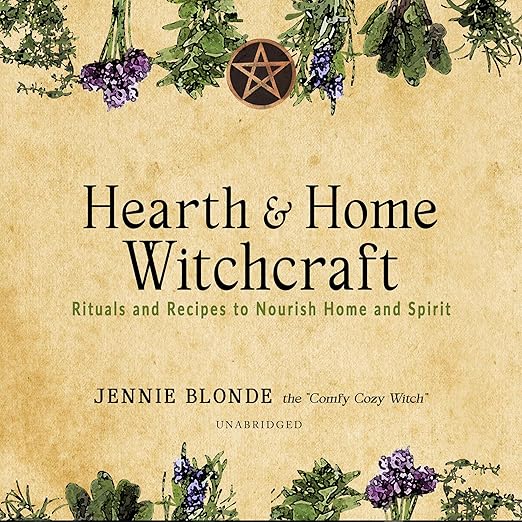
Jennie Blonde's Hearth & Home Witchcraft does what its title promises and does it without apology: this is an audiobook about bringing witchcraft into the rhythms of ordinary domestic life, narrated by Liisa Ivary, and it approaches that project with warmth rather than mystification. Blonde, known to her large online following as the @comfycozywitch, built her audience around the premise that magical practice does not require drama or esoteric inaccessibility, it can live in the stockpot, in the bath salt preparation, in the small rituals that shape a morning. The book is the extended, more intimate version of that premise.
What We Made of It
The book organizes itself around the home as a whole: hearth and protection rituals, kitchen witchery and the altar built around cooking, the sacred space created wherever you live regardless of square footage, grounding work with herbs and earth, and self-care as spiritual practice. That last category, bath salts, oils, balms, mindful movement, is where the wellness and witchcraft traditions overlap most explicitly, and Blonde navigates that overlap with confidence. She is not arguing for the medical efficacy of her practices. She is arguing for their meaning and their grounding function in a life that modern busyness tends to fragment.
One reviewer described the book as getting them out of stagnancy in their craft, the sense of having a practice but losing the felt connection to it. That is a specific problem Hearth & Home Witchcraft addresses well. Blonde's approach is less about initiating beginners into witchcraft than about deepening daily connection for people who already identify with the practice but have let it become abstract or occasional. She writes about what she returns to in times of anxiety, the tarot cards, the journaling, the quiet meditation in a sacred space, with the specificity of someone describing actual routine rather than theoretical prescription. The shadow work she mentions, working with that which holds you back, is not the book's center, but it is acknowledged as real and not sentimentalized away.
Another reviewer came to the book through Blonde's podcast, The Comfy Cozy Witch Podcast, and described it as amplifying the warmth of that format in a more developed form. That observation captures something accurate about the book's relationship to its own media ecosystem: listeners who know Blonde's voice from audio will find the book's written content, in audio form, a natural extension and deepening rather than a repetition. The podcast introduces ideas in short-form; the book has room to develop the daily ritual architecture that the shorter format can only sketch.
Why Hearth & Home Witchcraft Works as an Audiobook
Liisa Ivary's narration is one of the best arguments for the audio format here. Hearth & Home Witchcraft is the kind of book that works best when it feels like conversation rather than instruction, and Ivary's delivery, warm, unhurried, present, creates that conversational quality across the 6 hours and 15 minutes of runtime. The meditation passages in particular benefit from audio: hearing them read aloud by a narrator with genuine attentiveness is a different experience from reading them on a page, and closer to the experience of an actual guided practice.
The recipes for bath salts, oils, and kitchen preparations require the visual detail of the print edition for their full practical use. The audio conveys the intent, the ingredients, and the ritual framing well, but listeners who want to cook or craft alongside the book will want the print version accessible. For listeners primarily interested in the practice philosophy, how to build daily magical ritual into ordinary domestic time, the audio is fully self-contained and genuinely rewarding.
What Might Not Land
The book's strongest material is in the kitchen witchery and self-care chapters, where Blonde's voice is most specific and personal. The protection and cleansing rituals chapter is solid but covers ground that any number of witchcraft primers also cover; what distinguishes Blonde's treatment is the domestic framing and the emphasis on practices that can be maintained daily rather than performed as special occasions. A practice you can sustain is worth more than a practice that demands ceremony, and that conviction runs through the book's structure consistently.
Listeners expecting a historically grounded or theologically rigorous treatment of witchcraft will not find that here. Hearth & Home Witchcraft is practice-oriented and personal, drawing on Blonde's own experience and on the eclectic tradition of contemporary witchcraft that mixes folk magic, herbalism, and modern wellness. For listeners whose practice lives in that eclectic space, the book offers genuine companionship. For those seeking more formal grounding in specific magical traditions, it will feel light on historical or ceremonial context.
Should You Listen to Hearth & Home Witchcraft?
This audiobook is for practitioners of contemporary witchcraft who want to deepen their daily practice, for people curious about kitchen witchery and domestic ritual who want an accessible entry point, and for listeners already familiar with Jennie Blonde's online presence who want more of her approach in a longer form. The book is genuinely inclusive in its framing, it acknowledges practitioners across different living situations, family structures, and time constraints. Those expecting ceremonial magic or historically specific tradition will want to look elsewhere. At 6 hours and 15 minutes, it is compact enough to return to seasonally, which is exactly how Blonde's domestic witchcraft is designed to be used: not consumed once, but revisited as the rhythms of the year turn and the practice needs refreshing.