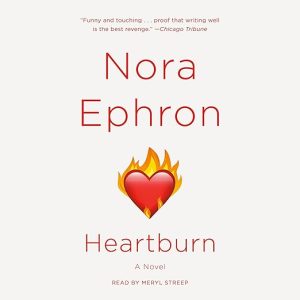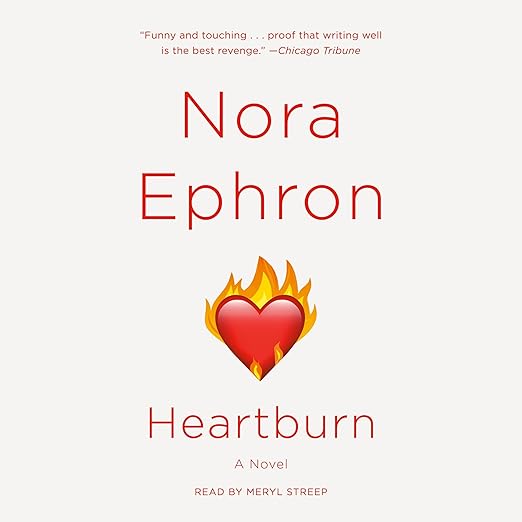
- Narration: Meryl Streep gives one of the more legendary audiobook performances on record, her ability to hold comedy and devastation simultaneously is exactly what Ephron's voice requires.
- Themes: betrayal as raw material for narrative control, food as both comfort and displacement, the relationship between storytelling and survival
- Mood: Bittersweet, acerbic, and surprisingly tender beneath the wit
- Verdict: Ephron's semi-autobiographical novel of infidelity and survival is funnier and sadder than either quality alone would justify, and Streep's performance makes it something genuinely essential.
I first listened to Heartburn on a night when I needed to laugh at something without knowing quite what. I found what I was looking for, and also something else, a kind of clarity about the relationship between humor and pain that I hadn't encountered so honestly before. Nora Ephron wrote this novel in 1983, two years after her divorce from Carl Bernstein, and the story of Rachel Samstat discovering her husband Mark's affair at seven months pregnant is thin biographical disguise. The thinness is intentional. Ephron knew that fiction about one's own life is most powerful when it doesn't pretend too hard to be anything else.
Published in 2013 in this audio format with Meryl Streep as narrator, Heartburn is a short, dense novel, five and a half hours, that moves with the speed and timing of its heroine's internal monologue. Rachel is a cookbook author, which gives Ephron license to interrupt the narrative at its most devastating moments with recipes. The pot roast recipe. The vinaigrette. The pasta carbonara. These are not distractions; they are the novel's emotional logic made visible. Food is what Rachel reaches for when words about feeling would be too much, and the interruption pattern creates a rhythm that is comic and devastating in alternating measures.
What Ephron understood, which many writers about heartbreak have not, is that the funniest things in a marriage are also often the most revealing ones. The way she dissects the social performance of the Washington marriage, the dinner parties, the friends who take sides before any sides have been announced, these observations are precise in the way that only someone who was there could make them. Reviewer Jill-Elizabeth calls it "a cleverly written story of what happens when things go all to hell, and how it is possible to pick up the pieces and move on," which is accurate but also undersells the anger that runs underneath the wit.
Rachel's relationship to her own storytelling is the novel's deepest subject. Reviewer Liz Lezcano quotes the passage where Rachel explains why she turns everything into a story: "Because if I tell the story, I control the version. Because if I tell the story, I can make you laugh, and I would rather have you laugh at me than feel sorry for me." That's Ephron explaining her own novel to us, and the self-awareness in that move is considerable. She is not performing resilience; she is being honest about what storytelling actually does for the person doing it. It doesn't undo the damage. It gives you something to do with it.
The Best Parts of Heartburn
Meryl Streep. Full stop, and then more words, because the casting here is genuinely extraordinary. Streep has the range to hold comedy and devastation in the same breath, she can make a recipe sound funny and then make the laughter catch in your throat with a single shift of register. The performance is often described as one of the definitive audiobook performances of its era, and having now spent five and a half hours with it, I understand why. Ephron's voice is a specific thing, sardonic, warm, precise, occasionally furious, always intelligent, and Streep inhabits it without appearing to perform the inhabiting.
This is also a case where the relative brevity of the source material works in the audiobook's favor. At five and a half hours, Heartburn is not asking for your week. It is asking for a long afternoon or two commutes. That compactness means the emotional accumulation lands harder than it would in a sprawling narrative, each recipe interruption, each piece of social observation, each moment of Rachel's barely-maintained composure carries more weight per minute than most longer novels manage.
Before You Commit to Heartburn
Reviewer leeharrison, who loves Ephron's later essay collection I Feel Bad About My Neck, finds Heartburn less satisfying than her later non-fiction work and attributes this to Ephron being "a little too freshly wounded" at the time of writing. This is a fair observation, and it names a real quality of the book: there are moments where the wit is laboring under the weight of genuine anger that hasn't fully metabolized into the kind of wisdom Ephron would later achieve. The zingers land, but occasionally they feel like they're covering something rather than illuminating it.
This is also very much a novel of its social moment, early 1980s Washington, a particular class of media and political people, a specific set of assumptions about marriage and infidelity and what you do about them. These elements date some of the social satire in ways that are interesting rather than limiting, but listeners expecting the timelessness of her essay work should know this is a more period-specific text than Ephron's reputation as a universal writer might suggest.
Should You Listen to Heartburn?
Anyone who has read Nora Ephron's essays and wants to hear what she sounded like when the material was personal to the point of pain. Listeners who appreciate dark comedy about relationships, the kind that is actually about something larger than the relationship, will find this works in the tradition of books like Mary Karr's memoirs or Lorrie Moore's fiction, where the humor is inseparable from the hurt. The Meryl Streep narration alone makes this worth the five-and-a-half-hour commitment for anyone interested in audiobook performance as an art form. It is, quite simply, one of the best narrator-to-material matches in the medium.