Quick Take
- Narration: Elijah Alexander’s warm, measured delivery suits the meditative material, creating a listening environment that mirrors the stillness the book is trying to cultivate.
- Themes: Loving-kindness as practice, the Tibetan Buddhist tradition in Western life, healing through visualization
- Mood: Quiet and luminous, genuinely calming in audio
- Verdict: A rare Buddhist listening experience that is both rigorously traditional and immediately usable, suited to practitioners and total beginners alike.
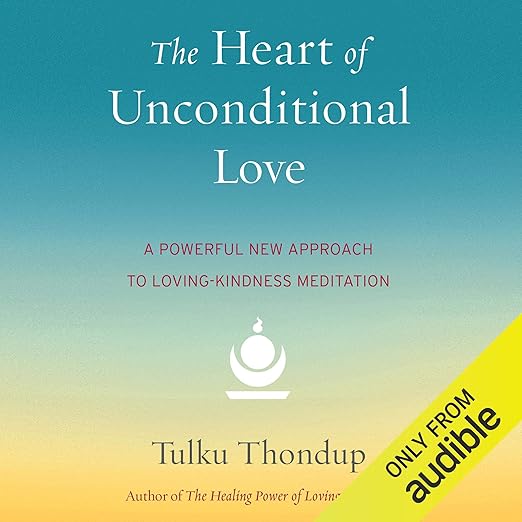
I came to Heart of Unconditional Love during a particularly difficult stretch last winter, the kind where the standard self-help stack felt hollow and the meditation apps felt mechanical. A friend who practices Tibetan Buddhism recommended Tulku Thondup Rinpoche, and I started this audiobook on a weekday evening without much expectation. Within the first chapter, I understood why the book has stayed in print and in circulation for a decade. There is a quality in Thondup’s writing that is rare in spiritual instruction: it is simultaneously exact and open, scholarly without being distant.
Tulku Thondup is a scholar and practitioner who trained in Tibet and has spent decades working with Western students. Heart of Unconditional Love presents a four-stage approach to loving-kindness meditation drawn from traditional Tibetan Buddhist teachings, distilled into sessions that can be as brief as thirty minutes. The four-stage format is presented as a new structural arrangement being offered for the first time in English, rather than a new invention, which is an important distinction: Thondup is translating and organizing, not improvising.
Our Take on Heart of Unconditional Love
What distinguishes this book from the overcrowded field of Western mindfulness guides is its grounding in authentic lineage. Thondup is not a wellness writer who has read about loving-kindness meditation; he is a scholar who has lived inside the tradition for his entire adult life. Reviewers praise the book for offering something to both absolute beginners and experienced Buddhist practitioners without condescending to either, which is genuinely difficult to achieve. The writing has been described by multiple readers as having “the fire of absolute truth and simplicity,” which I find accurate: it is not flowery or overwritten, and it does not soften its ideas into vagueness for a popular audience.
Why Listen to Heart of Unconditional Love
Elijah Alexander’s narration is a significant asset for this material. His voice is warm without being saccharine, and his pacing gives each idea space to settle before the next arrives. Listening to this book creates a different experience than reading it: the slower absorption that audio enforces is, for a meditation guide, actually the right format. The five-hour runtime is short enough to listen through entirely in a day, but the book is designed to be returned to repeatedly. Reviewers describe going back to the beginning immediately after finishing, which is unusual for any audiobook but appropriate here.
What to Watch For in Heart of Unconditional Love
The book assumes a degree of openness to visualization practice and Buddhist cosmology that purely secular mindfulness listeners may find unfamiliar. Thondup writes about celestial abodes, blessing energies of the Buddhas, and the environment becoming a display of unconditional love. These are not metaphors softened for a secular audience but direct expressions of Tibetan Buddhist teaching. For listeners who want the science-backed, stripped-down loving-kindness practice that has entered mainstream wellness culture, this book goes considerably further into tradition. That depth is its distinction; whether it is a feature or a friction point depends entirely on the listener coming to it.
Who Should Listen to Heart of Unconditional Love
This book works exceptionally well for listeners curious about Tibetan Buddhism who want something beyond an introductory overview, as well as for experienced meditators who have plateaued with secular mindfulness practices and want contact with a deeper tradition. It also works for anyone going through a period of emotional difficulty who needs a practice that addresses relationship, self-compassion, and perception of the world simultaneously rather than in sequence. It is not the right starting point for listeners who want a strictly secular, evidence-based mindfulness introduction: the spiritual framework here is not optional, and Thondup does not apologize for it. The book rewards patience and return visits: the five-hour runtime is not the full measure of what it offers, because the meditations change in texture as your own practice deepens. Think of it as a companion rather than a one-time read.
Frequently Asked Questions
Do you need to be a Buddhist to benefit from this audiobook?
Thondup explicitly addresses both beginners and experienced practitioners, and reviewers with no prior Buddhist background report finding the book accessible and immediately useful. However, the Tibetan Buddhist cosmological framework is present throughout and not reduced to secular metaphor, so some openness to that worldview is helpful.
How does Elijah Alexander’s narration affect the meditative practice sections?
Alexander’s pacing is slow and deliberate in the guided sections, which suits the material well. The audio format is arguably better suited to this book than print for precisely this reason: the enforced pace of listening matches the contemplative intention of the text.
Can the four-stage meditation be practiced using only the audiobook, or is additional reading required?
The audiobook contains all the guidance needed to begin the practice. Thondup walks through each stage in sufficient detail for a listener to begin without supplementary materials, though some readers choose to pair it with the print edition to annotate passages they return to.
How does this compare to other loving-kindness audiobooks like those drawn from Jon Kabat-Zinn or Sharon Salzberg?
Thondup’s approach is more explicitly grounded in Tibetan Buddhist lineage and cosmology than Kabat-Zinn’s secular MBSR framework or Salzberg’s accessible introductions to metta. It is less adjusted for a secular Western audience and more committed to the traditional teaching. Listeners who have found the secular versions useful but thin may find Thondup’s depth a significant step forward.