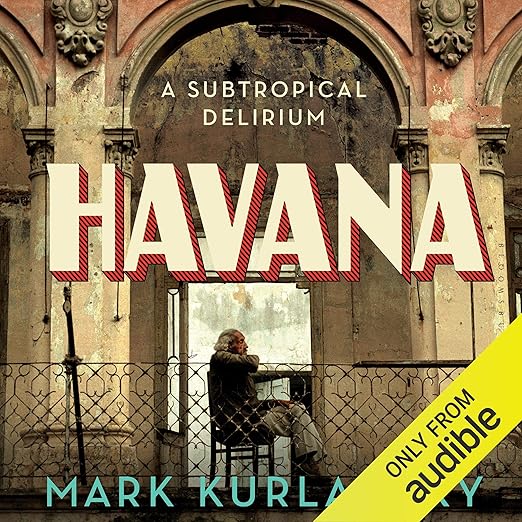
Quick Take
- Narration: Fleet Cooper brings warmth and rhythm to Kurlansky’s prose, handling the multilingual cultural references with a natural ease that suits the book’s travelogue-meets-cultural-history register.
- Themes: Colonial legacy and Caribbean identity, the relationship between architecture and memory, food as cultural record
- Mood: Vivid, layered, and tinged with the particular elegiac quality of writing about a city that is always in the process of becoming something else
- Verdict: Kurlansky at his characteristic best, dense with historical curiosity, physically grounded, and deeply respectful of the city he has spent thirty years learning.
I first encountered Mark Kurlansky through Cod, which is the book that made me understand what the best popular history can do, take an object so familiar it has become invisible and use it to illuminate an entire world. Havana works differently. Here the subject is a city rather than a commodity, but the instinct is the same: to let the specific reveal the general, and to let thirty years of accumulative attention speak where a shorter acquaintance could only skim.
Havana is, in Kurlansky’s own framing, part cultural history, part travelogue, with recipes throughout. That combination sounds eccentric but works, in part because Havana itself resists neat categorization. The book’s subject is a city that has absorbed Taino heritage, Spanish colonialism, American protectorate status, Soviet presence, and tourist capitalism into something that remains stubbornly, distinctly itself. Describing that through a single lens, political history, food writing, architectural survey, would falsify it. Kurlansky’s approach mirrors the subject.
Our Take on Havana
The book’s organizing argument, to the extent it has one, is that Havana should be understood through its writers, musicians, baseball fans, and cooks as much as through its politicians and revolutionaries. Alejo Carpentier and José Martí appear alongside Graham Greene and Hemingway. The rhythm of Son pulses through descriptions of the city’s music scene. Baseball and its fiercely opinionated fans get sustained attention. This is not incidental color, it is Kurlansky’s method of arguing that a city is its culture more than its governance.
What strikes me most on reflection is the quality of the architectural writing. Havana is physically described as a city of extremes: a beautifully restored colonial district whose cobblestone streets give way to blocks that have not been painted or repaired since before the revolution. Kurlansky captures this duality without sentimentalizing it. He does not ask readers to find the decay romantic, nor does he reduce it to simple deprivation. The architecture is a record of everything that has happened, and he reads it as such.
Why Listen to Havana
Fleet Cooper’s narration is genuinely well-suited to this material. Kurlansky’s prose has a conversational authority, you feel you are being walked around a city by someone who has been there many times and knows which corners have stories, and Cooper sustains that quality without overselling it. The six-hour runtime is well-matched to the book’s scope: substantive without overstaying its welcome.
One reviewer described the experience of reading Kurlansky as not being able to put the book down and “zipping through it in a few sessions.” I had a similar experience in audio form, the book has the forward momentum of good travel writing, even as it pauses regularly for historical depth. The recipes woven throughout are a pleasing interruption; they ground the historical narrative in sensory specificity.
What to Watch For in Havana
Readers who come looking for a conventional travel guide will find this is something different and richer. One review described it accurately as “a cultural guide, not a travel guide,” and the distinction matters. Practical visitor information is not the book’s project. What it offers instead is the kind of deep contextual understanding that makes every detail of a place more visible once you have it.
The book was published in 2017, and the Cuba it describes has continued to evolve since. The political and economic conditions Kurlansky captures are historically grounded rather than journalistically current, which means the core cultural and historical material ages better than a more news-adjacent account would. Listeners going to Havana should supplement with current information, but the historical and cultural foundation this book builds will not have dated.
Who Should Listen to Havana
Anyone planning to visit Cuba, anyone who has visited and wants to deepen their understanding retroactively, and anyone with a general interest in Caribbean history and culture will find Havana rewarding. Fans of Kurlansky’s earlier cultural histories will recognize the method and the quality immediately. The combination of food writing, literary history, and political context is also a natural match for listeners who have enjoyed books like Anthony Bourdain’s travel essays or Pico Iyer’s travel writing.
This is not the book for someone who wants a fast political overview of Cuba’s twentieth century, though that material is present as scaffolding. The book’s pleasures are textural and accumulative, and they reward patient, curious listening.
Frequently Asked Questions
Does Havana require any prior knowledge of Cuban history to appreciate?
No. Kurlansky builds historical context as he goes, and the book is explicitly designed for readers coming to Havana’s history without deep background. He traces the arc from Taino settlement through Columbus, the US protectorate period, Batista, Castro, and Soviet influence in a way that illuminates rather than assumes.
What role do the recipes play in the audiobook, are they practical or more symbolic?
They are genuinely both. Kurlansky’s food writing is always functional as well as cultural, and the recipes woven throughout are real. In audio form they are memorable narrative interruptions that ground the historical material in physical, sensory terms. A companion PDF or print version would be useful if you actually want to cook from them.
How does Fleet Cooper’s narration compare to the experience of reading Kurlansky in print?
Cooper suits Kurlansky’s style well, he maintains the conversational authority that makes Kurlansky’s prose feel like being guided through a place by a knowledgeable friend. Listeners familiar with Kurlansky’s books in print will find the audio translation faithful to the reading experience.
Is the book sympathetic to Castro’s revolution, critical of it, or something more nuanced?
Kurlansky is a historian rather than a polemicist, and his treatment of the revolution and its aftermath is characteristically layered. He documents the genuine reforms alongside the genuine deprivations without reducing either to ideology. Several reviewers noted his willingness to complicate received narratives in both directions.