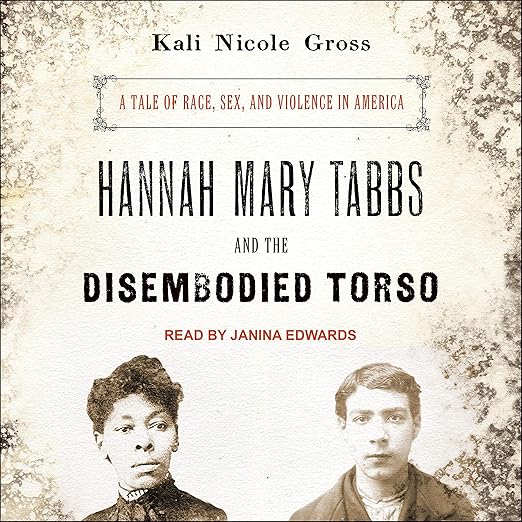
Quick Take
- Narration: Janina Edwards handles Gross’s blend of archival scholarship and crime narrative with authority, keeping the academic framing accessible without softening its intellectual rigor.
- Themes: Race in post-Reconstruction America, criminalized Black womanhood, the archive’s silences
- Mood: Scholarly but propulsive, the sensation of watching a historian think in real time
- Verdict: Gross’s reconstruction of this 1887 Philadelphia murder case is a model of what engaged historical scholarship can do, and Edwards’s narration matches the book’s intelligence.
I had never heard of Hannah Mary Tabbs before picking this up, which says something about how history gets curated and what falls through the cracks when the standard narratives operate primarily through respectability. I was halfway through a quiet Wednesday afternoon when Kali Nicole Gross described the discovery of a dismembered torso in a pond outside Philadelphia in 1887, and the entire texture of the book shifted. What had begun as a careful scholarly introduction suddenly felt urgent.
Gross is a historian specializing in Black women and criminal justice, and this book is an extension of that larger project. But she has also made a structurally bold choice: to reconstruct a specific crime through archival materials, including detectives’ notes, trial and prison records, and newspaper coverage, in a way that reads as narrative rather than analysis. The result sits somewhere between creative nonfiction and academic history, and it is more effective than either genre alone would have been.
Our Take on Hannah Mary Tabbs and the Disembodied Torso
The case itself is genuinely strange. Hannah Mary Tabbs, a married working-class Black woman, was implicated in the murder and dismemberment of a mixed-race man named Wakefield Gaines. She implicated her former neighbor, George Wilson, after her arrest. The trial stretched across several months and generated national press coverage that, Gross argues, served specific ideological functions: bringing otherwise private matters of illicit sex, adultery, and domestic violence in the Black community into public scrutiny, while also inflaming anxieties about racial mixing in the post-Reconstruction moment.
What makes Tabbs a genuinely difficult historical subject is that she does not fit the frameworks that Black women’s history has most often organized around. She is not a victim of white violence. She is not a figure of political resistance. She is violent, self-interested, and willing to sacrifice others to protect herself. Gross is direct about this complexity, and she examines it without either condemning Tabbs or constructing her into a symbol. One reviewer noted that Tabbs does not fit the politics of respectability, which is exactly the point Gross makes throughout. The book’s value is partly in its refusal to make Tabbs more legible or more sympathetic than the record supports.
Why Listen to Hannah Mary Tabbs and the Disembodied Torso
Janina Edwards’s narration is well calibrated to Gross’s voice. The book shifts regularly between narrative recreation and analytical commentary, and Edwards manages those transitions without losing the momentum of either register. When Gross moves from describing the crime scene to analyzing how the press framed the case through racial ideology, Edwards makes that shift feel natural rather than jarring. That is a harder technical achievement than it sounds in a book that moves between so many different kinds of evidence and argument.
One reviewer, who happened to be staying at a hotel near where the events took place while reading the book, described being caught between the historical and physical reality of the story in a way that felt unusually alive. That kind of specificity, where the history has not been abstracted but returned to its actual location and texture, is what Gross’s methodology produces, and it comes through in audio form.
What to Watch For in Hannah Mary Tabbs and the Disembodied Torso
This is a relatively short audiobook at five hours and twenty minutes, and the brevity reflects Gross’s commitment to staying close to what the archival record supports rather than speculating beyond it. There are moments where the historian’s caution creates small distances in the narrative, places where a more novelistic approach might have pushed further. But those restraints are also a form of integrity: Gross is not inventing where the record is silent. Readers coming for a true crime thrill ride may find the scholarly framework occasionally moderating. Readers who appreciate seeing how a historian works with incomplete evidence will find those moments the most interesting parts.
Who Should Listen to Hannah Mary Tabbs and the Disembodied Torso
This is for listeners who want history that illuminates the present by making specific, evidenced arguments rather than broad generalizations. It works particularly well for anyone interested in the intersection of race, gender, and criminal justice in American history, or in the history of post-Reconstruction Black life that rarely makes it into the standard narrative. Skip it if you are looking for a traditional crime narrative that follows the investigative arc to a neat conclusion. Gross is not interested in satisfying true crime conventions; she is interested in what one woman’s case can reveal about the systems that surrounded her.
Frequently Asked Questions
Is this audiobook more academic history or narrative nonfiction?
It is genuinely both, which is part of what makes it interesting. Gross writes with the rigor of academic history but the pacing and attention to detail of narrative nonfiction. Edwards’s narration helps maintain momentum across both registers.
Does Janina Edwards handle the shift between Gross’s scholarly analysis and the narrative crime sections effectively?
Yes. Edwards has a clean, engaged reading style that keeps the analytical sections from feeling like footnotes to the story. The transitions between Gross’s historical argument and the recreation of the crime itself feel natural rather than disjointed.
Does the book reach a satisfying conclusion about what actually happened?
The historical record is incomplete, and Gross is honest about that. The basic facts of the case are reconstructed from trial records and press coverage, but some aspects remain uncertain. Gross uses those gaps deliberately, to show what the archive chose to preserve and what it did not.
Why is this case historically significant beyond the crime itself?
Gross argues that the Tabbs trial was significant as a public spectacle that brought taboo subjects about Black domestic and sexual life into national print, and that the mixed-race identity of the victim intensified anxieties about racial purity in the post-Reconstruction moment. The crime becomes a lens for understanding the broader ideological climate of the era.