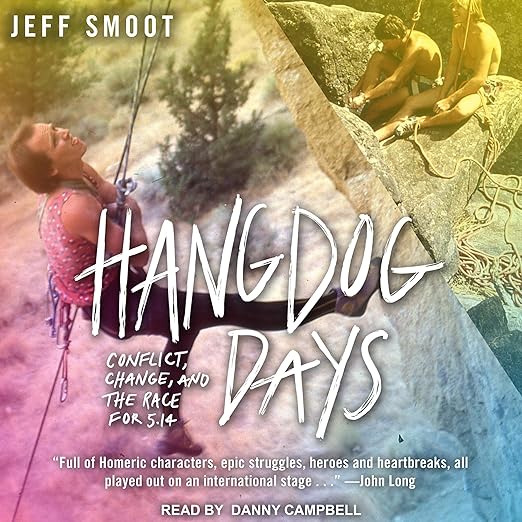
Hangdogging was an insult before it became a technique. Hanging on your gear to rehearse a sequence, then coming back to climb it clean, looked to the old guard like cheating with extra steps, and the copy on this listing is blunt about how the traditional rules got enforced: peer pressure first, intimidation and sabotage after that. That argument is the entire subject of this audiobook, and Jeff Smoot was standing in the middle of it with a rope in his hands.
A Closer Look at Hangdog Days
Jim C, writing two weeks after release, describes the exact conversation the book reconstructs: nights at a campsite in California arguing about ethics, style, bolt wars and hangdogging with a partner who had pioneered ground-up ascents on terrifying terrain. That five-star's point is that Smoot was present for many of the events he covers, and it is the right point. This is a participant's history, not a survey, and twelve and a half hours of it moves because the author has skin in the argument he is refereeing.
Shelving is the next problem, because this listing files a history of American rock climbing under travel and tourism, with adventure travel as its only tag. Nothing here is a travel book. It is a sport history about technique, ethics and a generational fight over what counts as a legitimate ascent, and the mislabeling matters practically: a browser looking for climbing writing will not find it in the travel aisle, and a browser looking for a trip narrative will open it and hit a discussion of whether preplacing bolts on rappel is defensible.
What Makes Hangdog Days Worth Hearing
Sabotage is not a metaphor in this story. A five-star from late June 2019 lists the details that stick: the old guard greasing holds so a climber could not complete a route, the old Yosemite crowd throwing bags of excrement at people to make life harder, an era after the stone masters that most climbing history skips straight past. That reader's framing is useful, because the standard telling of American climbing jumps from one golden age to the next, and Smoot parks himself in the ugly interval between them.
Smoot organizes the era around three climbers, John Bachar, Todd Skinner and Alan Watts, without letting Ray Jardine, Lynn Hill, Mark Hudon, Tony Yaniro or Peter Croft slide out of the frame. The technical arc runs from 5.12 to 5.13 as the gymnastic approach took hold, and it arrives at Jean-Baptiste Tribout climbing To Bolt or Not to Be at Smith Rock in 1986, a 5.14a that cracked a barrier plenty of people had written off as impassable. What the book is really tracking is how sport climbing, climbing gyms and competition all came out of an argument about cheating.
That argument reads as current rather than nostalgic, because the side that won won completely. Sport climbing, climbing gyms and competitive climbing all came out of this fight, and the copy is right that the transformation was permanent. Smoot's own position inside the fight is what saves it from smugness: he was one of the brash young climbers pushing the new tactics, so the history comes from a partisan who understands precisely what the other side thought it was defending. He gives the traditionalists their argument at full strength before he dismantles it, which is rarer in sports writing than it should be.
Things to Know Before Starting Hangdog Days
Fifteen days before the recording was published, a four-star response was already on the page. It calls the book required reading for anyone who considers themselves a climber, then registers the honest complaint: the narrative deviates from its central theme and drifts toward topics and personalities close to the author personally. That is a fair warning about a memoir-history hybrid. It is also a response written about the printed edition by definition, since the audio did not exist on the date it was filed.
Reading this aloud poses a problem the page never addresses. The book runs on a numeric grading scale, and 5.12, 5.13 and 5.14a have to be spoken dozens of times without turning into noise, alongside route names, crag names and a cast of surnames that recur across two decades. A listener who does not already know the scale needs the reader to keep those numbers crisp and separate. Anyone unsure should sample the recording specifically for how the grades sound rather than for tone, because tone is not the risk here.
Display quirk worth flagging: two of the five written responses carry the same generic account name, so the page looks as though a single reader came back twice when the dates, grades and arguments are plainly different people. Ninety-two ratings sit behind five readable ones, and that ratio is worth remembering before treating the 4.7 as a verdict from the climbing community rather than from ninety-two anonymous clicks.
Who Jeff Smoot Is Writing For
One reader found the book through the Enormocast podcast and calls it their favorite climbing book to date, singling out the transition to modern climbing, the arrival of cams and the practice of redpointing. That is the ideal listener: somebody who already knows the vocabulary and wants the connective tissue between eras they have heard about in pieces. The November 2019 five-star is also the clearest signal that the book plays well to people arriving from climbing media rather than from general nonfiction.
Climbers get the most from it, obviously, and anyone who has argued about style in any sport will recognize the shape of the fight. Skip it if you want summit narrative and scenery, because the drama here happens on twenty-meter sport routes and in magazine letters columns. Hold off as well if you are new to the sport entirely; the book assumes you know what a bolt is, what a redpoint costs, and why anybody would care who hung on the rope. Learn that first and this becomes one of the richest twelve hours in the genre. Everyone else, including people who have never touched rock, will still recognize a story about a small community deciding who gets to define excellence, and losing the vote.
- Performance: Danny Campbell has to keep a numeric grading scale and two decades of recurring surnames legible by voice alone.
- What it covers: Climbing ethics and sabotage, the birth of sport climbing, a generational fight over what counts as cheating.
- Feel: Argumentative, gossipy and deeply informed.
- Our call: The best available account of the era between climbing's famous golden ages, badly filed and worth finding anyway.
Does this audiobook assume you already climb?
It assumes a working vocabulary. Grades, bolts, redpoints and ground-up ascents are used rather than explained, and one five-star reader who had already read widely in climbing history describes it as filling a critical gap in that reading. Newcomers can follow the human story, but the technical argument will pass them by.
Why is a rock climbing history filed under travel and tourism?
No good reason. Adventure travel appears as the sole tag here, and the book is a sport history about technique and ethics, not a destination narrative. The mislabeling is worth knowing because it changes which recommendations surface it and which browsers ever see it at all.
Which climbers get the most attention in this audiobook?
John Bachar, Todd Skinner and Alan Watts carry the narrative, with Ray Jardine, Lynn Hill, Mark Hudon, Tony Yaniro and Peter Croft in supporting roles. Jean-Baptiste Tribout's 1986 ascent of To Bolt or Not to Be at Smith Rock functions as the book's climax.
Is twelve and a half hours too long for one era of climbing history?
Twelve and a half hours is generous for a single decade, and the length goes on people rather than on chronology, which is what keeps it from dragging. The structure helps too: the profiles are largely self-contained, so two or three sessions carry you through without losing the thread.