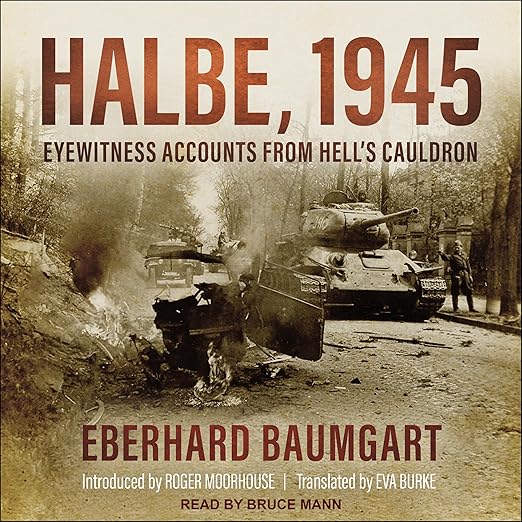
Quick Take
- Narration: Bruce Mann handles the translated first-person testimonies with a measured gravity that respects both the horror of the events and the complicated perspective of the witnesses.
- Themes: The chaos of defeat, civilian survival, the moral weight of unmediated testimony
- Mood: Haunted and unflinching, with the texture of primary evidence rather than polished narrative
- Verdict: A sobering primary source collection about a little-known battle that will stay with readers drawn to the granular, unfiltered experience of World War II’s final weeks in Europe.
I came to Halbe, 1945 through a route that probably describes a lot of listeners: I knew the broad contours of the Eastern Front’s endgame but had never encountered the specific catastrophe that unfolded near this small town south of Berlin in April 1945. I had about forty-five minutes free on a weekday afternoon and opened the audiobook expecting something I could dip into and set aside. What I encountered instead was testimony so specific and so raw that I kept listening well past when I’d planned to stop, not because it was pleasurable but because it demanded a kind of witnessing that felt wrong to abandon partway through.
This is not a narrative history. It is an edited collection of first-hand accounts from German soldiers, SS men, Panzer division veterans, and civilians caught in the Soviet encirclement of retreating German forces near Halbe. The distinction matters enormously and shapes everything about the listening experience, from structure to emotional register to what the book can and cannot offer.
Primary Source as Its Own Kind of Evidence
The editor Eberhard Baumgart has assembled testimonies that span the full range of those who survived this particular catastrophe: ordinary soldiers without strong ideological investment in what remained of the Reich, hardline SS men, tank crewmen, and townspeople trying to flee westward ahead of the advancing Soviet armies. The result is, as one reviewer put it, more akin to hearing war stories in a veterans’ lodge than following a unified narrative. That description is accurate and it captures both the collection’s greatest strength and its primary structural limitation.
The fragmented, individual quality of the testimony gives you something that polished military history almost never provides: the actual phenomenology of military collapse. You understand, reading across these accounts, what it feels like from the inside to be part of an army that has ceased to function as a coherent entity and has become instead a mass of individual men trying not to die. The chaos that emerges is not a failure of Baumgart’s curation but an accurate rendering of what Halbe was. A Soviet sergeant quoted in one account reportedly said the carnage was worse than Stalingrad, and the testimony accumulates until you believe him.
The estimated death toll, 30,000 German and 20,000 Soviet soldiers along with thousands of civilians, makes this one of World War II’s most lethal single engagements, and its near-absence from English-language historiography makes the translation genuinely significant. Baumgart’s decision to translate these accounts into English for the first time gives access to a set of experiences that scholarship alone cannot reproduce.
The Problem of Perspective This Collection Does Not Pretend Away
One thoughtful reviewer noted, and it’s worth addressing directly, that the testimonies contain the bitterness and racism of defeated German forces. Nazi-era attitudes toward the Soviet enemy are preserved in the accounts rather than filtered out for a contemporary audience. Baumgart does not sanitize his sources, which is historiographically correct and also means this is not a comfortable document. Listeners should understand going in that they are reading what these men actually believed and felt in 1945, not a retrospective accounting that has had its uglier elements excised for palatability.
The Soviet perspective is entirely absent. This is a deliberate editorial choice that limits the book’s scope and which the title honestly represents: this is the German experience of Halbe, not the history of Halbe in its full dimension. Readers looking for a comprehensive account of the battle from multiple sides will need to supplement this collection with other sources. What Baumgart offers is irreplaceable within its stated scope, but that scope is specific and should be understood as such before you begin.
Bruce Mann and the Challenge of Multi-Voice Testimony
Narrating a primary source collection presents a different technical challenge than narrating conventional nonfiction, because the narrator is essentially serving as the conduit for many different individual voices without wholly becoming each of them. Making each account theatrically distinct would risk a performative overlay on material that carries its own weight and needs no enhancement. Bruce Mann’s approach is consistent and measured throughout, which is the correct instinct. His tone is that of a reader who takes the testimony seriously without endorsing its perspective, and that’s the appropriate register for material this morally complex.
At under five hours, the audiobook is the right length for what it accomplishes. The density and emotional weight of the testimony means that longer would risk exhaustion rather than additional understanding. Mann keeps the pace steady enough that the listening doesn’t feel rushed, while trusting the material to land without dramatic emphasis.
For Readers Who Want the Unmediated Experience of History’s Worst Days
This collection will mean most to listeners with a serious interest in the Eastern Front and specifically in the disintegration of German forces in the war’s final weeks. The relative obscurity of Halbe in English-language accounts of World War II means that Baumgart’s work fills a genuine gap, and the primary source format gives it a value that no secondary synthesis can fully replicate. You come away from it understanding the particular texture of this catastrophe in a way that reading about it in conventional military history doesn’t provide.
Casual readers of popular military history may find the fragmented testimony structure less satisfying than a conventionally narrated account with a clear through-line and an authorial interpretation. But for those willing to meet the material on its own terms, which is partly bewildering, partly devastating, and entirely devoid of the retrospective clarity that narrative history imposes on chaos, Halbe, 1945 offers something rarer: history that hasn’t been made comfortable. One reviewer described feeling haunted by it for weeks afterward, and that response seems proportionate to what the book actually contains.
Frequently Asked Questions
Does Halbe, 1945 present a balanced view of the battle that includes Soviet perspectives?
No, and this is a deliberate editorial choice clearly represented by the title. The collection presents exclusively German testimonies and should be understood as a primary source document from one side of the conflict, not a comprehensive historical account of the battle.
How does Bruce Mann’s narration handle the ideologically troubling content in some of the testimonies?
Mann reads with a steady, non-endorsing gravity that lets the testimonies speak for themselves without theatrical amplification of their more disturbing elements. It’s a restrained and appropriate performance for this kind of archival material.
Is this a useful introduction to the Halbe battle for someone who knows nothing about it, or does it assume prior knowledge?
The editorial framing provides enough context to orient new readers, but those entirely unfamiliar with the Eastern Front’s final campaigns may benefit from some background reading before or alongside this collection. It is rich testimony rather than explanatory narrative.
Does the book include accounts from civilians as well as military personnel?
Yes, and the civilian accounts are among the collection’s most striking testimonies. Baumgart includes perspectives from townspeople attempting to flee westward, which adds a dimension of the battle’s human cost that purely military accounts would miss.