Before You Press Play
- Narrator: Brian Nishii brings appropriate gravity and a measured cadence to Tsunetomo's aphorisms, letting the stillness in the text breathe rather than pushing for dramatic emphasis.
- Subjects: Bushido, mortality and ego dissolution, duty and loyalty
- Tone: Austere and contemplative
- Bottom line: William Scott Wilson's translation delivered by Brian Nishii makes this the audiobook edition for anyone serious about Tsunetomo's text rather than its popular cultural echo.
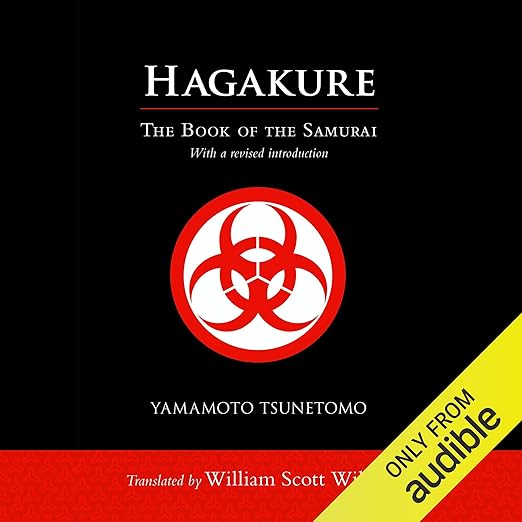
Yamamoto Tsunetomo's Hagakure occupies an unusual position in the literature of honor and conduct. This audiobook, narrated by Brian Nishii and working from William Scott Wilson's acclaimed translation, runs just over five hours and presents 300 of the most representative passages from a manuscript that was originally kept secret, known only to the warrior vassals of the Nabeshima clan for decades after Tsunetomo dictated it. The text's emergence from secrecy into wide circulation is part of what makes it philosophically interesting: these observations about loyalty, death, and the dissolution of ego were not written for a public audience but for a specific community of people who already shared the framework they articulate.
The Review
Wilson's translation is the critical foundation here, and Nishii trusts it. His performance resists the temptation to import dramatic tension or motivational energy into Tsunetomo's aphorisms; instead he delivers them as what they are, precise observations made by a man who had given up active samurai life after his lord's death and was processing the meaning of loyalty and sacrifice through dictation to a younger generation. The text's famous characterization of bushido as the Way of death arrives with real weight in the audio version precisely because Nishii does not editorialize around it.
Wilson's revised introduction, included in this edition, reframes that phrase significantly. Rather than reading bushido's death-orientation as straightforward morbidity, Wilson connects it to the Zen concept of muga, the dissolution of the ego. In that reading, the samurai who has already accepted death is freed from the distortions of self-preservation and status anxiety, able to act with complete clarity and commitment. That framing opens the text to a much wider readership than the martial history alone would support. For listeners coming to Hagakure after encountering it through popular culture, including the Jim Jarmusch film Ghost Dog: Way of the Samurai that introduced it to many Western listeners, Wilson's introduction provides the philosophical scaffolding the film references but never fully explains.
The selection itself is worth examining. Wilson chose 300 passages from over 1,300, and his editorial judgment tends toward the most philosophically durable material: observations about conduct in the face of uncertainty, about loyalty that extends beyond the death of the person being served, about the specific kind of attentiveness required to act well under pressure. The passages are short by design, often just a few sentences, and they are built for reflection rather than sequential argument. Nishii's delivery enforces natural pauses between them that the audio format makes particularly effective.
What Makes Hagakure Worth Hearing
The audiobook format suits the aphoristic structure of Hagakure well. Listening allows individual passages to settle in a way that continuous reading sometimes prevents. A reader can skip over a sentence in print without noticing what was lost; a listener who is paying attention hears the gap between Tsunetomo's observation and the next one and has a moment to sit with it. Nishii's measured cadence builds that space intentionally.
Readers who have come to Hagakure through leadership literature, stoic philosophy, or martial arts training consistently report that its counsel operates at a conceptual level that cuts across its origins in eighteenth-century Japan. The observation that a man who has not fully committed to a course of action is essentially already defeated; the point that excessive self-consciousness about one's performance corrupts the performance itself; the argument that genuine loyalty does not wait for instructions: these translate out of their historical context more readily than the samurai framing suggests. The comparison to Stoic practice is one that Wilson acknowledges, and it is useful for listeners trying to locate Hagakure within a broader philosophical tradition.
The Caveats
The text frustrates listeners expecting systematic argument. Tsunetomo does not build a sequential case; he observes, instructs, and occasionally contradicts himself across the 300 passages Wilson has selected. Listeners accustomed to non-fiction that builds toward a conclusion may find the aphoristic format disorienting. The audio version does nothing to impose a false narrative arc, which is the right call but worth knowing in advance.
The full Hagakure contains considerably more practically specific guidance about samurai conduct in particular historical circumstances, much of it useful only to readers interested in the specifics of Nabeshima clan politics. What Wilson has selected is the most transferable material, and for audio listeners with five hours rather than a scholarly month, that selection is genuinely useful. But readers who want to engage the complete text should seek out a full unabridged scholarly edition rather than this curated distillation.
The Right Listener for Hagakure
This audiobook works for listeners interested in samurai philosophy as a serious intellectual subject rather than a popular culture reference, martial artists at any level looking for conceptual grounding, and readers of stoic philosophy who want to encounter a parallel tradition from a different cultural and historical context. It is less suited to listeners who want narrative history, those expecting a comprehensive guide to conduct organized by category, or anyone put off by philosophical ambiguity and aphoristic structure. The five-hour runtime makes this one of the more accessible entry points to a text that has sustained centuries of serious engagement. For listeners who find the audiobook prompts deeper interest, Wilson has also produced a more comprehensive scholarly edition of the Hagakure that includes a larger selection of passages and more detailed annotation. This audio version is the right starting point, but it does not have to be the ending point for those who find the material genuinely useful in their own thinking about commitment, action, and the relationship between ego and performance.
A Few Questions About Hagakure
Is this audiobook a complete translation of the Hagakure?
No. Wilson has selected 300 of the most representative passages from an original text of over 1,300 sections. The selection concentrates on the most philosophically enduring material, but it is a curated distillation, not the complete manuscript.
Do I need background knowledge of samurai history to follow this audiobook?
Wilson's introduction provides the historical and philosophical context needed to follow the text. Some familiarity with Zen Buddhism deepens the experience, but the audiobook does not assume specialist knowledge.