- Subjects: prose style as moral stance, the mechanics of first-person voice, crime fiction as serious craft, style analysis as a teachable discipline
- Tone: Analytical and confident, closer to a workshop than a tribute
- Bottom line: A genuinely specific craft book on a great stylist, sold with a synthetic reading and a description whose six parts do not reconcile.
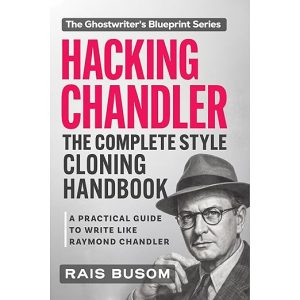
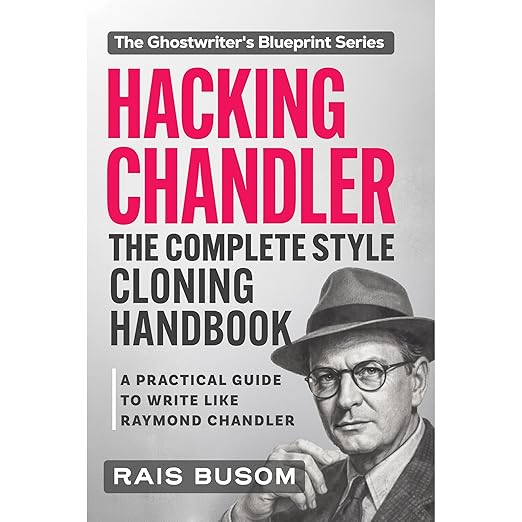
Somewhere in this audiobook a Raymond Chandler sentence gets quoted, and then immediately taken apart, and you will have to work out by ear where the quotation stops and Rais Busom's analysis begins. Every chapter is built that way, worked examples from Chandler's novels paired with a reading that runs the process backwards to show why the choice works. In print, typography does that job silently. Here the credited reader is Virtual Voice, the label a listing carries when synthetic narration stands in for a person, and a synthetic voice cannot lean on a quotation to mark it as somebody else's.
Busom's premise is stated without hedging and I like it for that. Chandler proved that popular fiction and beautiful prose are partners rather than enemies, that crime writing could carry moral intelligence, and that his sentences function as blueprints for what language can be made to do. What follows is explicitly not a book about Philip Marlowe. It is a book about how Marlowe was built, about observable patterns in the prose, and about the architecture that lets a detective become a moral consciousness inside a corrupt city.
The lone written notice, filed from Spain the day after release, reads it the same way. It calls the book "a surgical breakdown of what makes Raymond Chandler's prose so iconic" and credits Busom with "moving past the 'noir' tropes to focus on the actual mechanics of the writing". It also singles out "the practical exercises and the deep dive into The Long Goodbye" as the parts a working writer will want. One review, one rating, one five-star score: that is the entire evidence base, and the timing means it arrived before anyone could plausibly have worked through the whole recording and done the exercises.
Rhythm as the Sound of Thought Itself
For anybody who writes, the value proposition is unusually concrete. Not inspiration, not a life of the author, but four categories of technique: prose fingerprints, structural principles, character introduction, and the handling of dialogue. Busom then applies the whole apparatus to one complete novel. A style-analysis book that commits to a single extended reading is doing something harder than one that grazes across a career, because the claims have to survive contact with a text the reader can check.
The framing sentence I keep coming back to is the description's own list of what it wants you to internalize: concrete specificity as moral judgment, attitude encoded in image, and "rhythm as the sound of thought itself". That third item is the one an audio edition ought to own outright. Rhythm is a property you hear rather than see. A reader hearing a Chandler cadence delivered aloud, then hearing it explained, is closer to the phenomenon than a reader looking at it on a page. It is the strongest argument this particular listing has, and the reading arrangement is what puts it most at risk.
Do the arithmetic on the runtime and the ambition comes into focus. Four hours and forty-seven minutes divided across six announced parts leaves roughly three quarters of an hour each, and one of those parts is a reference section rather than an argument. This is a compact book making large claims, closer in scale to a long weekend seminar than to a doorstop of academic literary criticism, and the compression is either its discipline or its limit. Whether that reads as discipline or as thinness depends on how much Chandler you have already thought about, and the single response on the page comes from somebody who evidently arrived with plenty.
Machine Narration Can't Signal a Quotation's Edge
Start with the structure, because the description does not add up. It announces six parts. Part One is context. Parts Two through Five are named as the core, covering four topics. Then Part Five is described again, this time as the applied deep reading of a complete novel. Part Six is the reference section. Whichever way you count, one part is doing two jobs in the publisher's own summary, and a buyer cannot tell from the page whether the analysis of dialogue and the extended reading share a part or whether the numbering simply slipped.
Synthetic reading is the second thing to weigh, and I want to be precise about it rather than dismissive. Machine narration handles exposition competently. What it cannot do is signal a boundary by performance: dropping into a quoted sentence, holding a beat, then coming back up into commentary. On a book whose every chapter alternates between Chandler's sentences and Busom's dissection of them, that boundary is not decoration. It is the thing that tells you whose sentence you are hearing. Sample a chapter and listen specifically for whether the quotations announce themselves.
Consider the shape of the book as an object too. Part Six is written to be returned to, a reference you consult when you are stuck on a character introduction or a scene. Exercises run throughout, and the description is explicit that reading about a technique and doing it are different experiences. Neither of those uses is served by a linear recording. Finally, the series line names a handbook series but publishes no number for this volume, even though the text itself places two earlier books in the sequence, and the publisher credit is a bare web address. Beyond those, the page offers a single line of biography, a credit in a literary journal, which is thin as a credential but at least checkable against a public archive.
Crime Writers Get Mechanics Over Mythology
Crime, thriller and noir writers who want the mechanics rather than the mythology are the target audience, especially those who already know Chandler well enough to hear a pastiche coming. Anyone who has read the novels and wondered how the trick is performed will find the analysis worth the price on its own. As a first pass, the audio does an honest job: an orientation run in which you absorb the argument and mark the passages you intend to work through properly later.
A biography or a critical history was never on offer, and the book announces that refusal in its own description before you buy. The audio edition specifically is the wrong choice if you plan to do the exercises as you go, or to use the reference section the way it was designed to be used, since neither survives a linear file. Weigh the evidence honestly too: a single notice filed the day after publication is not a track record, however warm it is.
Who narrates the HACKING CHANDLER audiobook?
The reading is credited to Virtual Voice, which is the label used when synthetic narration replaces a human performer rather than the name of a person. That matters more than usual here, because every chapter alternates between quoted Chandler sentences and Busom's analysis of them, and a machine reading cannot mark that boundary by performance.
Do I need to have read Raymond Chandler before starting this audiobook?
You will get far more from it if you have. The book works from worked examples out of Chandler's novels and devotes a full part to an extended reading of The Long Goodbye, so a listener who knows the prose can test each claim against memory. A newcomer gets the argument but not the pleasure of verification.
Is this book about Philip Marlowe?
Explicitly not. The description draws the line itself: this is about how Marlowe was constructed rather than about the detective or the cases. The subject is sentence structure, scene architecture, character introduction and dialogue, with Marlowe treated as the outcome of those techniques rather than as a character to be discussed.