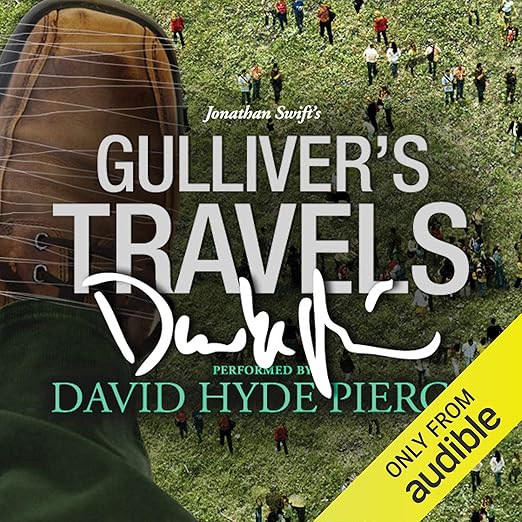
Nine hours and fifty-two minutes of eighteenth-century satire is an odd package to hand a sitcom actor, and this listing does not hide the gamble. The performer's name sits inside the title, ahead of Swift's, and the description opens on a television role before it opens on the book. Whatever else this audiobook is, it is sold on casting first and on the satire second. I went in expecting the casting to be the interesting part. The stranger story turned out to be the page around it.
Start with the score, because it comes apart cleanly. The listing posts 4.2 stars across six ratings, and only one total produces that figure: twenty-five out of a possible thirty, since twenty-four would display as 4.0 and twenty-six rounds up to 4.3. Five written responses are visible, carrying four fives and a four, which accounts for twenty-four of those twenty-five points on its own. The sixth vote, the one nobody can read, has to be a single star. One silent grader is holding the entire gap between a pool that reads at 4.8 and the number a browser sees first.
That visible four-star, filed in October 2009, is barely about Swift at all. Its opening half appraises a hardbound Sterling Unabridged Classics printing: type large enough to read without strain, a satin bookmark ribbon sewn into the binding, the kind of build a collector wants on a shelf. All of it useful, none of it downloadable. A three-hundred-year-old satire, several print editions and a December 2010 recording sit pooled under one average here, and nothing in the display separates them. That matters more on a public-domain classic than on almost anything else, because a browser comparing three versions of the same text has no way to tell which version each star belongs to.
Why It Works in Audio
Swift's method still lands because it never winks. Gulliver reports his voyages in the flat, measuring tone of a ship's surgeon filing paperwork, and the absurdity accumulates underneath that tone rather than on top of it. The publisher's copy calls the book a character study and a social satire aimed at politics, science, religion, philosophy and pretentiousness, which is accurate and a little tidy. The sharper pleasure is watching a hero who never once suspects that he is the joke. A five-star from April 2009 gets at this sideways, spending its space on Isaac Asimov's guess that Lilliput is a corruption of little bit, and on whether the invented languages are nonsense or cipher.
Read aloud, that deadpan is the one thing an actor can genuinely work with. The prose runs long-sentenced and formal, thick with measurements, inventories and earnest diplomatic protocol, and it pays out for a reader willing to keep a straight face through all of it. Nine hours and fifty-two minutes is also a humane length for a book most people meet in excerpt: the first voyage is the one everyone can name, and three more follow it. Comedy and literary fiction are both shelved on this listing, and for once both labels earn their place.
Length is the quiet argument for hearing it rather than reading it. Swift builds his jokes across paragraphs, not sentences, and a reader skimming a dense page tends to clip the setup and land on the punchline with nothing under it. A voice cannot skim. Every solemn measurement of a tiny wardrobe, every diplomatic formality performed at knee height, arrives at full length and in order, which is where the comedy actually lives. The satire also keeps its shape better when somebody has to decide, sentence by sentence, how seriously to take it.
Before You Commit to Gulliver's Travels
Composition is the trap on this page. The October 2017 five-star, written in French, praises a parcel that arrived on time and in perfect condition plus a bookmark that came as a surprise, then admits in a closing parenthesis that the writer is halfway through the book and considerably less enthusiastic about that part. The grade went to the seller. That one short response matters more than its length suggests, because it shows exactly how a five star here can attach to shipping rather than to anything Swift or the performer did.
Two of the five responses were filed in April and October 2009, more than a year before this recording was published in December 2010, so the oldest verdicts on the page were written about paper by definition. The description is no more help: it opens on the performer's television career and closes by advertising three other actors whose work appears nowhere on this file. What it sells, start to finish, is the casting.
Who Will Get the Most From It
October 2023 produced the most practical response on the page, a five-star from the United Kingdom that hands the review over to the writer's fifteen-year-old son. He walks the voyages in order, beginning with the island where everyone is tiny and Gulliver is the giant, and reports learning the language while being housed and regularly visited by the king. That is a fair map of what the book offers a young listener who is not tracking eighteenth-century political allegory: an adventure with escalating rules, delivered by somebody taking every absurd detail completely seriously. Plenty of adults come to it the same way and lose nothing by it.
Anyone who wants the satire whole, students meeting it on a syllabus, and listeners who enjoy a comic actor playing material dead straight will get their money's worth from these ten hours. Pass on it if you need a recording that somebody has actually vouched for, because the grades collected here belong to other editions and other formats. Pass as well if you are expecting the tidied-up children's Gulliver; the copy is upfront that the target list runs to politics, science, religion and pretentiousness, and it means it. Between those two positions sits the listener this file was made for: somebody who already trusts the book and is curious what a comic actor does with a man who has no sense of humor at all.
Common Questions
Why does the narrator's name sit inside this audiobook's title?
Because the recording belongs to a Signature Classics line built around name casting rather than around new translations or scholarly editions. The title field carries the marketing pitch, which is unusual and worth knowing: you are buying a performance concept, and the credit is the headline rather than a footnote below it.
Are the reviews on this audiobook listing all written in English?
Not all of them. One October 2025 entry, submitted from Brazil, runs to two words and is not in English, and further responses arrive from France and the United Kingdom. Every market feeds one shared score with no filter on the display, so a browser cannot tell which country or which edition a given grade came from.
Do the other performers named at the end of the description appear on this audiobook?
No. The closing paragraph advertises upcoming recordings by three other actors in the same series, and none of them read a word of this file. It is a trailer for the line rather than a cast list, and it is easy to misread as one on a quick scan.