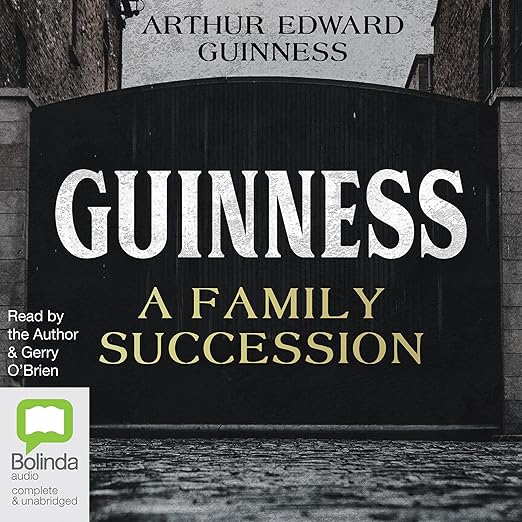
Picture a drawing room at Farmleigh, the country house outside Dublin where Arthur Edward Guinness grew up, surrounded by portraits of ancestors who had moved from Kildare obscurity to the absolute summit of Irish and British society within a handful of generations. That ascent, which Ned Guinness writes about from the inside, is the subject of this audiobook: not a corporate history, not an authorized promotional account, but something more intimate and therefore more complicated. The author is himself a member of the dynasty, writing about his own great-great-grandfather's financial gamble that floated the brewery on the stock exchange and made Edward Cecil Guinness Ireland's richest man overnight. That insider position is both the book's greatest asset and the source of its most interesting limitations.
O'Brien's Voice Carries Genuine Dublin Rhythms
Gerry O'Brien is ideally cast here. His voice carries the right weight of Dublin in it, not stage-Irish but genuinely inflected with the city's rhythms, and he handles the sweep of historical narrative with a storyteller's sense of pace. The book moves through Catholic Emancipation, the Famine, the Home Rule movement, the Dublin Lockout, and ultimately Irish independence, and O'Brien never lets the political set-pieces overwhelm the family story at the center. His reading of the sibling rivalry chapters, where the brewing genius of one generation set against the social glamour of another, has particular texture. Seven and a half hours is the right length for this material: long enough for the history to breathe, short enough to keep the biographical through-line in view.
One reviewer notes that the book is biased toward the family in comparison to the television documentary series it contextualizes, and that observation is worth sitting with. Ned Guinness is not a neutral party. He has emotional investments in how his ancestors are understood, and those investments shape the narrative in ways that are sometimes transparent and occasionally less so. The philanthropic chapters, which cover the family's substantial charitable work in Dublin, read with particular warmth. The chapters touching on labor relations and the brewery's relationship with its workers during periods of industrial conflict are somewhat more elliptical. That is not a disqualifying flaw but it is a reading posture worth adopting: this is a family member's account, not an independent historian's assessment.
Stonemasons Drank Several Pints a Day at Work
What Ned Guinness can offer that no outside historian can is the texture of memory and family oral tradition. The story of stonemasons drinking an average of several pints a day as part of their working arrangements at St. Patrick's Cathedral in Dublin is cited by one reviewer as the kind of detail that makes the book genuinely entertaining rather than merely informative. Those incidental facts, the ones that survive in family telling rather than official documents, are where the inside perspective pays off. The sense of Irish and British history seen from the perspective of a family that was simultaneously Catholic and Protestant, Irish and British, philanthropist and industrialist, adds a genuinely unusual angle to the familiar period material.
Readers who watched the television series about the family and wanted more depth will find this a satisfying complement. The book provides historical grounding that the visual medium cannot sustain, and Ned's personal connection to the subject gives moments of genuine emotion that a purely academic treatment would not generate. The interwoven political history, the Act of Union, the Famine, the labor unrest, all get enough space to feel consequential rather than perfunctory.
A Brother Bought Out, a Fortune Transformed Overnight
The most intellectually interesting section involves the dramatic events around the stock exchange flotation, when Ned's great-great-grandfather bought out his brother and created an almost instantaneous transformation in the family's financial status. The sibling rivalry between the glamorous older brother and the brewing-focused younger one cuts against the pure success narrative and gives the history some of the ambivalence it needs. Brewing genius versus social ambition is a theme that recurs across generations of the family, and O'Brien reads those passages with the right level of ironic appreciation.
The book assumes some familiarity with Irish history, and listeners who do not know the basic outlines of Catholic Emancipation or the Home Rule debates may find some sections move through context too quickly. A brief preparatory read on nineteenth-century Irish political history would make those passages considerably richer. The philanthropic chapters, which cover extensive work in Dublin tenements and hospitals, are particularly well-documented and give the family portrait genuine moral complexity rather than reducing the Guinnesses to either capitalist villains or benevolent aristocrats.
The final chapters, covering the period leading to Irish independence and the complex position the Guinness family occupied in a nation remaking itself politically and culturally, are among the most interesting in the book. A family that had simultaneously served British imperial structures and contributed enormously to Irish civic life had no easy identity in the new state. Ned Guinness writes about that negotiation with the specificity of personal family history, which gives the period material a human texture that political histories of the independence era often lack.
A Personal Account, With Warmth and Partiality
This audiobook will reward listeners with existing interest in Irish history, family memoir, or the social history of brewing and industry. People who have watched the television documentary and want the fuller picture are an obvious fit. Anyone curious about how a single Irish family navigated the convulsive century from the Act of Union through independence, maintaining prosperity and social standing while the country around them transformed completely, will find this absorbing. Academic historians looking for original archival research may find the family-memoir framing limiting. Listeners expecting a neutral corporate history should know they are getting a personal account, with all the warmth and partiality that entails.
Is this audiobook written by someone outside the family or is it an insider account?
Arthur Edward Guinness, known as Ned, is himself a member of the family dynasty. He grew up at Farmleigh, the family estate outside Dublin, and writes explicitly from an insider position. One reviewer notes this creates a family-favorable bias compared to independent documentaries on the same subject.
How much does the audiobook cover Irish political history versus the family story itself?
Both threads are woven together throughout. Major events including Catholic Emancipation, the Famine, the Home Rule movement, the Dublin Lockout, and independence all appear as context for the family's successive generations. The political history gives each chapter its backdrop without overwhelming the biographical narrative.
Does the audiobook require prior knowledge of nineteenth-century Irish history to follow?
Some familiarity helps, particularly for the Catholic Emancipation and Home Rule chapters. The book moves through these contexts with the assumption that readers have a basic grounding in the period. Listeners without that background may find those sections move quickly.