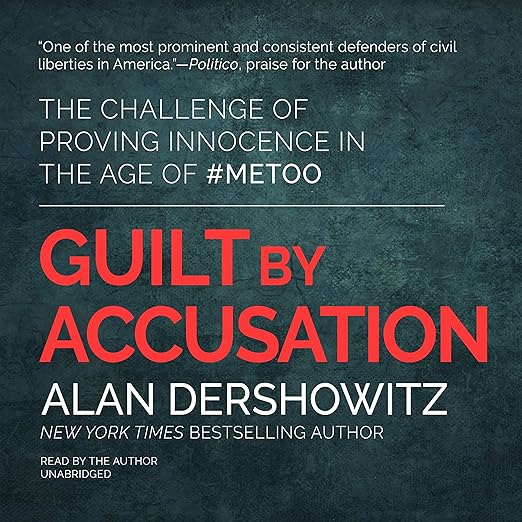
Quick Take
- Narration: Dershowitz narrating his own defense is intense and immediate, the self-narration is inseparable from the argument; you are not hearing an interpretation, you are hearing the man himself make his case.
- Themes: Due process versus public accusation, the mechanics of legal and media manipulation, civil liberties principles under social pressure
- Mood: Urgent and combative, the quality of a closing argument delivered to a jury of one
- Verdict: A document of a specific legal and cultural moment that makes its arguments with force, essential listening for due process questions regardless of your prior opinion of Dershowitz.
I came to Guilt by Accusation having followed the case against Alan Dershowitz from a distance, the way most readers did, through fragmentary news coverage, the Jeffrey Epstein connections, the accusations from Virginia Roberts Giuffre, the counterclaims. What I had not encountered was Dershowitz’s complete evidentiary rebuttal in one place. Listening to him deliver it in his own voice, at three and a half hours, is an experience quite different from reading about it.
Dershowitz has spent his career arguing that civil liberties principles are not selective, that due process applies to unpopular defendants as well as sympathetic ones. He has made that argument for accused terrorists, for accused murderers, for O.J. Simpson. Guilt by Accusation is his application of the same principle to himself, and whether that feels self-serving or logically consistent depends on how you read the underlying philosophy.
Our Take on Guilt by Accusation
The book operates on two parallel tracks. The first is the direct evidentiary case: Dershowitz presents what he calls incontrovertible evidence of his innocence, including emails from his accuser and, most significantly, what he describes as an admission of his innocence from her lawyer David Boies. The specificity here is the book’s strongest element. This is not a general character defense, it is a detailed account of specific evidence and why he believes it has been suppressed or ignored in public discourse.
The second track is the broader cultural argument about MeToo and due process. Dershowitz is careful to say the MeToo movement has generally been a force for good, but that, like many good movements, it is being exploited by bad actors who understand that public accusation now functions as conviction in the court of social media. This argument is not unique to Dershowitz, civil libertarians across the political spectrum have raised similar concerns, but his position as both an advocate and an accused gives it a specific weight.
Why Listen to Guilt by Accusation
The self-narration is not incidental to the experience, it is the experience. Hearing Dershowitz make his evidentiary arguments in his own voice produces a different engagement than reading a summary or an account by someone else. One reviewer compared it to Paul Harvey’s The Rest of the Story format, there is a specific quality of hearing someone present their own case directly that either convinces or fails to convince, and that confrontation cannot be delegated to a hired narrator.
A UK reviewer who called the book The Epstein Code described it as untangling checkbook journalism, civil court exploitation, and media manipulation with useful specificity. The Epstein connections that form the backdrop of the accusations are addressed directly, and Dershowitz’s account of how the legal machinery around Epstein was used to generate accusations against peripheral figures is one of the book’s more instructive passages for readers interested in how civil litigation can be weaponized.
What to Watch For in Guilt by Accusation
This is a pointed caveat: the book is Dershowitz’s account of Dershowitz’s innocence, narrated by Dershowitz. It is not balanced in the way a journalism account would be. The other side of the evidentiary dispute is not given equal space, and listeners who want to evaluate the case fully would need to seek out other accounts of the same events. The book should be approached as a primary document, what Dershowitz says, in his own words, rather than as a neutral adjudication.
One reviewer who described himself as not liking Dershowitz came away finding the evidence compelling and called it a very good book. That is a meaningful data point. It suggests the argument has force for at least some skeptical readers, but the starting disposition you bring to the listening will shape what you hear.
Who Should Listen to Guilt by Accusation
Readers interested in due process questions and how accusations function in the MeToo era will find this a well-argued and directly relevant case study. Legal observers who want Dershowitz’s complete account of the accusations against him in one place, rather than assembled from fragmentary news coverage, will find the self-narrated format particularly useful.
Listeners who have already made firm judgments about Dershowitz’s guilt will find little here to shift that view, not because the arguments are weak but because they will approach the evidence through a different frame. The book rewards readers who are genuinely uncertain and want to understand the full shape of his defense.
Frequently Asked Questions
Does Guilt by Accusation include Dershowitz’s evidence of innocence, or is it primarily a philosophical argument about due process?
Both. The book devotes substantial time to specific evidence Dershowitz says demonstrates his innocence, including emails from his accuser and what he describes as an admission of innocence from her lawyer David Boies. It also makes the broader philosophical argument about due process in the MeToo era, but the evidentiary section is specific rather than abstract.
Is the self-narration distracting, or does it serve the material?
Reviews that address the narration find it an asset rather than a distraction. Hearing the accused make his own case in his own voice creates a directness that a hired narrator could not replicate. The listening experience is closer to hearing a legal argument than to a conventional audiobook, which is appropriate given the subject.
Does the book address the Jeffrey Epstein connections that form the backdrop of the accusations?
Yes, directly. Dershowitz addresses how his professional relationship with Epstein generated the accusations against him and describes in detail how he believes the legal machinery around the Epstein case was used to generate accusations against peripheral figures. The Epstein context is central to his account rather than peripheral to it.
Does Guilt by Accusation present the accuser’s perspective fairly, or is it entirely one-sided?
It is Dershowitz’s account of Dershowitz’s innocence, and should be approached as such. The accuser’s perspective is not given equal space; Dershowitz presents the evidence as he interprets it, and the argument is his argument. Readers who want a balanced account of the full dispute would need to seek out additional sources alongside this one.