Quick Take
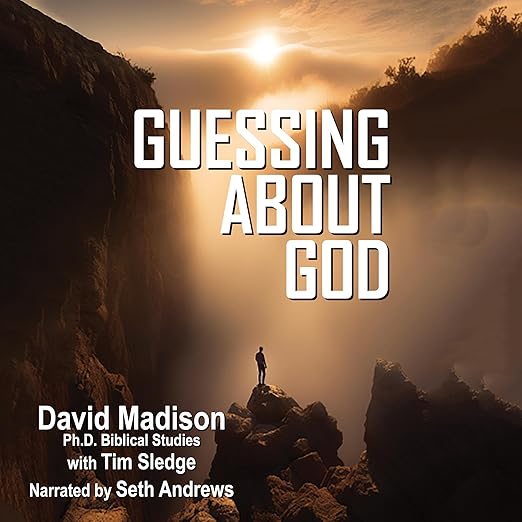
- Narration: Seth Andrews, known for his own atheist podcast The Thinking Atheist, brings unmistakable familiarity and dry wit to Madison’s arguments, the casting feels intentional and works well.
- Themes: Biblical criticism and contradiction, the epistemology of religious belief, deconstruction and post-faith identity
- Mood: Intellectually bracing and methodical, like a calm, thorough court brief rather than a polemic
- Verdict: A rigorous and compassionate entry point into critical biblical scholarship, best suited for listeners actively questioning faith or seeking to understand why others do.
I listened to most of Guessing About God over two evenings during a week when I had been reading about the history of biblical criticism for an unrelated project. David Madison’s framing, three discrete problems laid out like legal arguments, dropped into that context with unusual clarity. This is a book that knows exactly what it is trying to do and organizes itself to do it efficiently.
Madison is not writing a memoir of doubt. He is making a case. The book is structured around three challenges to Christian belief: that God’s invisibility and silence force reliance on unreliable epistemic sources, that two centuries of scholarly biblical criticism have undermined any confidence in scriptural revelation, and that the four Gospels contradict one another so thoroughly that a coherent portrait of the historical Jesus becomes impossible to assemble. He has the credentials to make these arguments, former pastor, PhD in Biblical Studies from Boston University, and he uses them with the confidence of someone who has spent decades working through the implications.
Our Take on Guessing About God
What distinguishes this book from the more polemical tradition of atheist writing is its tone. Madison is not contemptuous of faith or of believers. He is genuinely interested in the epistemological question: how do we know what we know about God, and what happens when we scrutinize those sources carefully? His argument in the first chapter, that the diversity of Christian belief worldwide is itself evidence of the unreliability of the knowledge sources Christians use, is tight and well-constructed. You can disagree with the conclusion, but you have to engage with the reasoning rather than dismissing it.
The second chapter on biblical criticism is the most detailed and probably the most useful for listeners who have heard claims about scriptural authority without ever being exposed to the academic field that has studied the Bible as a historical document for two centuries. Madison makes this scholarship accessible without dumbing it down. He is doing real intellectual work here, and it shows.
Why Listen to Guessing About God
Seth Andrews’s narration is one of the best casting decisions in this genre. Andrews hosts The Thinking Atheist podcast and is himself a former evangelical Christian who left the faith, his delivery of Madison’s arguments carries the weight of personal recognition rather than outside-looking-in analysis. The narration has a dry, measured quality that suits the book’s analytical structure. When Madison’s writing gets more pointed, Andrews’s tone stays even, which actually makes the arguments land harder.
Several reviewers noted that this book helped them articulate doubts they had carried for years. One described it as connecting dots that had always been there but never organized. That is perhaps the most useful function this kind of book can serve: not necessarily to convince, but to give language and structure to questions that have been circulating without a framework.
What to Watch For in Guessing About God
This is not a balanced treatment. Madison is building a critical case against Christian belief, and the book does not present counterarguments in depth or steelman the opposition. Readers looking for a genuine dialogue between faith and skepticism will need to look elsewhere for the other half of the conversation. Madison acknowledges this implicitly but the book functions as advocacy, not neutral inquiry.
Some reviewers who came from evangelical traditions also found a dragon analogy Madison uses early in the book somewhat flippant, and at least one review noted a reader abandoned the book over it. The analogy is clarified as the book develops, but listeners who find that kind of rhetorical move condescending may need to push through the opening to reach the more substantive arguments in chapters two and three.
Who Should Listen to Guessing About God
This is a strong listen for: people in active deconstruction who want scholarly scaffolding for questions they have been carrying, secular listeners curious about what rigorous biblical criticism actually argues, and anyone who has been told the Bible is internally consistent and wants to understand why that claim is contested.
It is not the right fit for: listeners who want a balanced dialogue rather than a single-perspective argument, people of faith who are not in a questioning phase, and anyone looking for emotional warmth rather than intellectual rigor. Madison is a precise thinker, and this is a precise book, its pleasures are analytical rather than narrative.
Frequently Asked Questions
Does this audiobook require prior knowledge of biblical criticism or theology to follow the arguments?
No. Madison specifically writes for listeners who have not been exposed to two centuries of academic biblical scholarship, and he explains the key findings clearly. Some familiarity with the Gospels or Christian belief helps contextualize the arguments, but it is not required to follow them.
Why is Seth Andrews a particularly meaningful choice as narrator for this audiobook?
Andrews is the host of The Thinking Atheist podcast and a former evangelical Christian. His personal history with faith and subsequent departure gives his narration an insider quality that a neutral voice actor could not replicate. He sounds like someone who has worked through these questions himself, which adds weight to Madison’s arguments.
Is this the first book in the Ten Tough Problems series, and do the volumes need to be heard in order?
Yes, this is book one of the series. The three problems Madison covers here, God’s invisibility, biblical self-contradiction, and the historical Jesus question, are framed as the opening arguments in a larger sustained case. Later volumes develop additional problems, but this one works as a complete unit on its own.
How does Guessing About God compare to other atheist audiobooks like The God Delusion or God Is Not Great?
Madison’s approach is more structured and less polemical than Dawkins or Hitchens. Where those books are often rhetorical and confrontational, Madison organizes his arguments like legal chapters and maintains a more measured tone. Listeners who found Dawkins or Hitchens too combative may find Madison more persuasive for that reason.