Quick Take
- Narration: Marian Keyes reads her own novel with warmth, comic timing, and an Irish lilt that suits the material perfectly, character voices are distinct enough to follow without confusion.
- Themes: Family dysfunction, secrets and revelations, female friendship under pressure
- Mood: Warm and wickedly funny, with emotional gut-punches you don’t see coming
- Verdict: If you enjoy domestic fiction with genuine comedic bite and a cast of women you want to argue with at dinner, this 17-hour listen rewards the slow start.
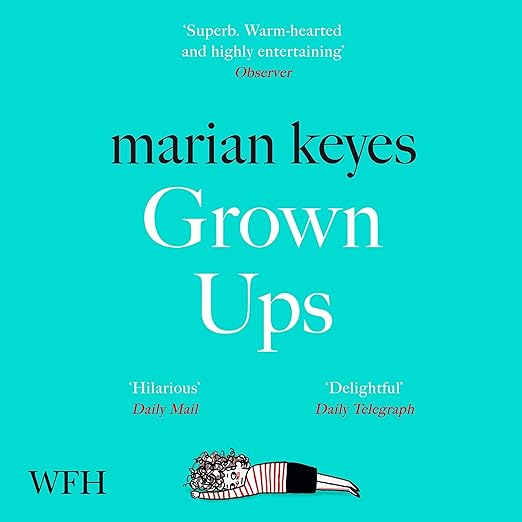
I picked up Grown Ups on a long train journey where I had nothing but countryside and coffee, expecting something breezy to pass the miles. What I did not expect was to be leaning into my headphones by hour four, completely invested in whether Cara was going to implode before the family dinner or during it. Marian Keyes reads her own novel, which is either a gamble or the only logical choice depending on how you feel about author narrations, and in this case it lands squarely in the latter category.
Keyes has been one of the most distinctive voices in Irish women’s fiction for decades, and Grown Ups represents her at full stretch. It is longer and more architecturally complex than some of her earlier work, and that ambition occasionally shows in the pacing. One reviewer noted it is a slowish start that does not find its momentum until around the sixty percent mark, and that is a fair read. But the setup is load-bearing. You need to know these three women before the secrets start spilling, or the consequences land flat.
Three Women, Three Marriages, One Family Pressure Cooker
Jessie, Cara, and Nell are married to brothers Johnny, Ed, and Liam Casey. That is the premise, and it is deceptively simple. Keyes uses the structure to explore how differently three women can perform the same social role while privately unraveling. Jessie is the polished, high-functioning one who has everyone fooled, including herself. Cara is trying to hold together a marriage that has more gaps than she lets on. Nell is the most openly struggling, but also the one who radiates the most warmth. The novel asks whose version of a good life is real and whose is theatre.
Liam, the youngest brother, earns the consistent contempt of readers in the reviews here, and Keyes writes him with such precise, studied awfulness that you almost admire the craft. He is not a villain in any dramatic sense. He is just the kind of man who makes rooms smaller and conversations shorter, and Keyes renders that kind of ordinary damage with unusual clarity.
The Self-Narration That Actually Earns Its Keep
Author-narrated novels are a mixed proposition. When writers read their own fiction, the results can range from illuminating to something that sounds like a slightly panicked table read. Keyes belongs to a smaller, more confident class of author-performers. She has spent years on panels, in podcasts, and in interviews speaking publicly about her own life and work, and that ease translates directly into how she inhabits these characters. The Casey family occasions, the dinners, the birthdays, the catastrophic gatherings, have a rhythm to them that feels genuinely performed rather than simply recited.
Her Irish inflections give the dialogue a musicality that a different narrator might have flattened into generic accent work. There are moments of comic timing, particularly in Jessie’s internal monologue chapters, that suggest Keyes knew exactly where she wanted the listener to laugh before she finished the sentence. One reader who came to the book after hearing Keyes discuss it on BBC Radio 4 described it as a comforting companion during a difficult week, and I think that captures something real about the experience of listening rather than reading it.
What the Slow Build Eventually Delivers
The criticism about pacing is legitimate and worth naming clearly. Grown Ups is 17 hours long, and it takes its time establishing the family geography before it starts detonating anything. Some listeners will find that investment repaid handsomely. Others, particularly those who prefer plot-first fiction, may find the early chapters more work than they expected from something categorized as comedy-humor.
But the second half of this novel operates on a different register entirely. The secrets that unspool through the Casey family are not the melodramatic revelations of soap opera, but the kind of quieter, more persistent truths that families spend decades avoiding. The comedy does not disappear in the third act so much as it deepens, becoming the mechanism by which these characters survive what they are learning about each other. One reviewer said they hated finishing it. I understand that feeling. There is a quality to Keyes’s endings that feels earned rather than resolved, which is a harder trick than it looks.
Who Should Listen / Who Should Skip
Listen if you love domestic fiction with genuine comedic intelligence, have patience for an ensemble setup that needs room to breathe, and enjoy the particular texture of Irish family dynamics. If you have not read Keyes before, this is not a bad entry point, though Rachel’s Holiday remains her most celebrated work and might orient you better.
Skip if you need a narrative that moves fast from the opening chapter, or if lengthy character studies without early plot momentum tend to lose you. This is fundamentally character-driven fiction wearing the lightest coat of comedy-drama, and it asks for your patience in exchange for real emotional return.
Frequently Asked Questions
Does Marian Keyes narrating her own novel create any confusion between character voices?
Largely no. The character voices are distinct enough through tone and inflection that following Jessie, Cara, and Nell is manageable throughout the 17-hour runtime. Where it occasionally thins is in the male characters, but Keyes’s comic timing compensates for any flatness there.
At 17 hours, is Grown Ups a commitment that pays off?
It depends on your tolerance for a slow build. The novel is widely noted to find its momentum around the sixty percent mark, with the final third significantly more propulsive. Listeners who invest in the character establishment tend to find the ending very satisfying.
Is this a standalone novel or does it connect to Keyes’s earlier books?
Grown Ups is a standalone novel with no connections to Keyes’s earlier series. You need no prior familiarity with her work to follow the Casey family story from beginning to end.
How explicit is the humor, is this appropriate for listeners who prefer clean comedy?
The humor is adult and occasionally bawdy but never gratuitous. It is wry, character-based comedy that derives from observation and embarrassment rather than shock, which makes it accessible to a fairly broad adult audience.