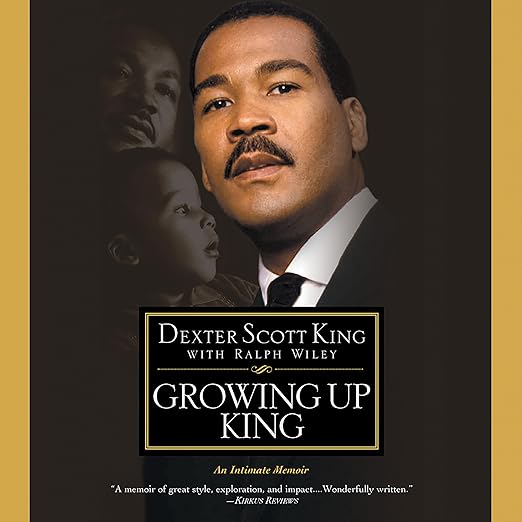
- Narration: Dexter Scott King's self-narration carries the weight and restraint of someone who spent a lifetime living inside a story that was also history; the delivery is understated in ways that honor the material.
- Themes: grief and legacy, growing up in a famous family's shadow, identity and self-discovery
- Mood: Reflective and candid, with emotional restraint that reads as dignity rather than distance
- Verdict: A quietly essential memoir in the King family's literary record, most valuable for listeners interested in the personal cost of living inside public greatness.
A Voice Carrying Grief From Before Language
Dexter Scott King narrating his own memoir about growing up as Martin Luther King Jr.'s youngest son is an act that carries weight beyond the standard argument for author narration. King was seven years old when his father was assassinated. He carries in his voice the specific timbre of someone who experienced that loss at an age before the brain has the language to process it, and who has spent the decades since living inside the shadow of a name that belongs simultaneously to his father, to history, and to him. This audiobook is worth the six-plus hours for that reason alone, and the memoir itself gives that narration enough to do.
King structures the account around the central tension of his life: what it means to grow up as the son of a man who has been claimed entirely by history before you are old enough to know him as a father. He was seven at the assassination. He stumbled through adolescence carrying both the grief and the weight of a legacy he had not chosen and could not refuse. Undiagnosed ADD complicated his schooling; his grandmother's murder in 1974 at Ebenezer Baptist Church added another layer of loss to a family already defined by it. When he eventually turned, in his early thirties, to his father's own teachings as a source of recovery, that choice had a complexity that King narrates without sentimentality.
Earning the Right to Claim a Father's Teachings
The memoir occupies a specific and genuinely rare perspective. Dexter Scott King is not writing biography of his father, which exists in abundance. He is writing the interior account of what it is like to grow up inside the absence created by an iconic presence. The King that Dexter King describes is not the public figure but the father he knew for seven years and then lost, and the way that specific private grief intersects with the public weight of 'the King legacy' is where the book is most valuable.
The section on undiagnosed ADD is one of the memoir's more illuminating passages. King describes the emotional isolation of academic and social struggle without the framework that a diagnosis might have provided, and the way that isolation intersected with the grief and the expectation of greatness creates a portrait of adolescence that is more complicated than the inspiring-son-of-a-great-man narrative most readers might expect. Reviewers note the book as 'well written' and 'very moving,' and the candor about those years is what earns those descriptions.
King's eventual engagement with his father's teachings as a personal resource rather than a public inheritance is the arc that closes the memoir, and his narration of that shift carries the authority of someone who came to it genuinely rather than inherited it automatically. The book does not present Martin Luther King Jr.'s legacy as a gift freely given; it presents it as something Dexter King had to earn the right to claim for himself, which gives the resolution depth rather than comfort.
The memoir's account of how Dexter King eventually found his way to his father's teachings as a personal resource is one of the quieter reversals in the book. For most of his early life, as he describes it, his father's legacy was something external and demanding rather than something he could use. The process of finding MLK's ideas useful rather than merely obligatory is not framed as conversion but as gradual recognition: the discovery that the framework his father built for public moral action also had tools for private emotional navigation, and that accessing those tools was something Dexter King had to choose rather than something his lineage automatically provided.
No Private Space to Be a Bereaved Child
The memoir is candid but not confessional in the mode of contemporary trauma memoir. King keeps a certain emotional restraint throughout, which is consistent with how he describes his own processing of loss and identity, but it means the book will not satisfy listeners looking for the kind of unguarded emotional exposure that defines more recent autobiographical writing. The account covers specific periods and episodes rather than building a comprehensive biographical record, which leaves certain questions about the family and the King Center answered only in outline.
The book was originally published in 2003, and its perspective on race in America, on legacy, and on public grief reflects that moment rather than the present. Listeners approaching it in 2026 will find those passages illuminating as historical testimony without necessarily reflecting the language or frameworks current to how similar conversations are conducted now.
The grandmother's murder deserves more attention than it typically receives in summaries of this book. Alberta Williams King was shot and killed at Ebenezer Baptist Church in Atlanta in 1974, just six years after her son's assassination. For Dexter King, processing that second catastrophic loss in the same family, at the same institution, in the same mode of public political violence, during adolescence and without adequate support, shaped the emotional isolation the memoir describes with particular precision. King's narration of that period carries the specific quality of someone describing losses that were both deeply personal and immediately appropriated by public grief, leaving no private space in which to be simply a bereaved child rather than a King.
Self-Narration as Testimony, Never Performance
Readers of the King family's broader memoir literature, including Coretta Scott King's autobiography and Martin Luther King Sr.'s writing, will find Dexter King's account a valuable personal addition to that set. History readers interested in the emotional and psychological aftermath of political assassination on families will find this account unusually specific and honest. Listeners who respond to self-narration as a form of testimony rather than performance will find King's delivery particularly affecting. Those looking for a comprehensive biography of Martin Luther King Jr. should look elsewhere; this is an intimate account from a specific vantage point, not a definitive historical record.
Questions Listeners Ask
Do I need to read other books about Martin Luther King Jr. before listening to this audiobook?
No prior reading required. The book is written for a general audience and provides enough context about the King family and legacy for listeners without specialist knowledge. That said, readers familiar with Coretta Scott King's autobiography or the broader historical record will find additional resonance in the passages Dexter King treats briefly.
What makes Dexter Scott King's self-narration worth choosing over a professional narrator for this audiobook?
The authority that comes from lived experience rather than performance. King spent his life inside the events he describes, and his narration carries a quality of first-person witness that a hired narrator, however skilled, could not replicate. Reviewers consistently find it moving rather than merely informative.
Is this audiobook appropriate for listeners who are new to civil rights history?
Yes, though it is a personal memoir rather than a history. Listeners seeking detailed historical context about the civil rights movement will need supplementary reading. What Growing Up King provides is the intimate, interior experience of a family defined by that history, which is a different and valuable form of knowledge.