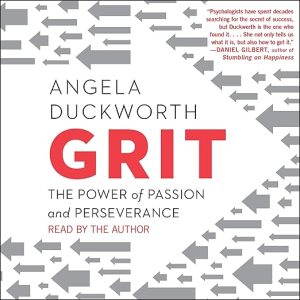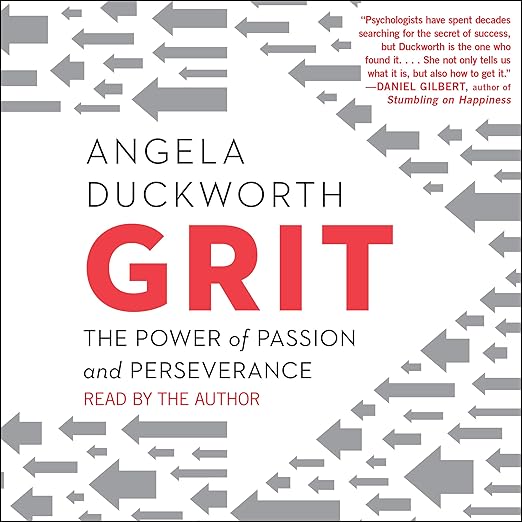
Angela Duckworth narrating her own Grit audiobook is not a minor detail - it's part of the argument. The book's central premise is that what looks like genius from the outside is usually sustained passion and long-term perseverance working invisibly over time. Duckworth's voice, reading her own research and her own story, carries the specific quality of someone who has actually done the unglamorous daily work of building something. That quality is audible from the first chapter. At nine hours and twenty-two minutes, this is a substantial listen, and the self-narration sustains you through the academic depth in ways that a hired proxy voice would not.
What Duckworth does that most achievement-psychology audiobooks avoid is take her central idea seriously enough to test it against its own limits. Grit - her term for the combination of passion and perseverance that drives sustained high performance - is not presented as a magic variable that explains everything. She takes you into West Point's Beast Barracks, into National Spelling Bee preparations, and into conversations with Seattle Seahawks coach Pete Carroll and New Yorker cartoon editor Bob Mankoff, and she shows how grit manifests differently across radically different domains. The conclusion she reaches - that effort counts twice toward any goal, once building skill and once converting skill into achievement - is deceptively elegant. One reviewer, Alex Frey, notes that Duckworth's answer "is unlikely to seem that surprising" once stated, and that's accurate: the insight has the quality of something obvious in retrospect. But the book's value is in the evidence marshaled for it, and in the practical implications Duckworth draws out with precision.
The daughter of a scientist who frequently noted her lack of genius, Duckworth built a career around the research question of what actually drives success if not talent. The personal stakes in that question are real, and in audio, heard in her own voice, they're palpable. When she discusses the specific combination of passion and perseverance that she found in high achievers - the consistent pattern of caring deeply about something and then working at it with sustained commitment - the argument carries the authority of someone who knows it from the inside as well as the research data.
Duckworth Narrates Her Own Fascinating Tour
The self-narration format is the right choice for this book, and the right reason to choose the audio version specifically. Duckworth is a researcher who tells personal stories to ground abstract concepts, and that combination performs better in her own voice than it would in someone else's rendering. She moves naturally between the anecdote of her father commenting on her lack of genius and the academic literature on achievement motivation, and the shifts feel organic rather than structural. Reviewer Laurence Benz's review specifically addresses the format, recommending that audiobook listeners set playback speed carefully - though I found standard speed entirely workable and the pacing well-calibrated for the material's density.
The Wall Street Journal calls Grit "a fascinating tour of the psychological research on success," and the audio format suits that description because the tour aspect is literal - Duckworth moves through field research, historical examples, laboratory experiments, and personal interviews, and hearing her narrate that movement gives the journey coherence that reading the same material might not always sustain. The variety of evidence and setting keeps nine hours feeling genuinely dynamic.
Duckworth's Hard Thing Rule Extends to Family
The book's most provocative practical chapter is the Hard Thing Rule, which Duckworth applies first to herself and then to her family: every member must pursue one hard thing, stick with it through the difficult periods, and not quit on a bad day. The parenting chapter more broadly is among the most nuanced in the book - she argues that neither warmth alone nor high standards alone produces grit, but that a specific combination of both does, and she backs that argument with research rather than intuition. This section has generated more productive disagreement than any other part of the book, and it's worth approaching with genuine engagement rather than assumption.
The chapters on finding your passion are also worth careful attention, because Duckworth argues persuasively that passion is rarely discovered but rather developed through exposure, experience, and practice - a significant reframe for anyone who has been waiting to stumble onto their calling. Reviewer Sam notes the book "really changed how I think about long-term success" and that the core idea "hit home." That kind of impact tends to come from this specific chapter, where the developmental model of passion challenges the more culturally prevalent idea that a calling is something you find rather than something you build.
Complements Dweck's Work for Teachers and Coaches
This audiobook is for teachers, coaches, parents, and anyone in a position of developing other people's capacities - the research on cultivating grit in others is as detailed as the sections on building it in yourself, and the chapter on creating "gritty" organizational cultures extends the framework into institutional contexts. Athletes in long-development sports, graduate students in the early stages of doctoral work, or professionals in fields where mastery takes decades rather than months will find Duckworth's framework specifically applicable to their situations.
Listeners who are already familiar with Carol Dweck's growth mindset research will find Grit building on that foundation with its own distinct contribution - where Dweck focuses on beliefs about intelligence, Duckworth focuses on the behavioral pattern of sustained passion and perseverance, and the two frameworks are complementary rather than redundant. Those expecting a quick-tips productivity manual will find the book denser and more research-forward than they anticipate. This is rigorous popular science with a genuine argument, and it rewards the sustained attention the nine-hour runtime asks of you.
Questions Listeners Ask
Does Angela Duckworth's self-narration meaningfully improve the Grit audiobook experience?
Yes, substantially. Duckworth's personal story - the daughter of a scientist who called her lack of genius a recurring theme - is central to the book's emotional architecture, and hearing her tell it in her own voice adds a layer of conviction that outside narration would flatten. The research sections also benefit from her direct authority.
Is the Grit audiobook appropriate for educators and coaches specifically?
Very much so - Duckworth draws extensively on teaching and coaching contexts, including research with teachers in challenging schools and conversations with coaches like Pete Carroll. The sections on cultivating grit in others are as detailed as the sections on building it personally.
How does this audiobook relate to Carol Dweck's growth mindset work?
Grit builds on Dweck's research but makes a distinct contribution: where Dweck focuses on beliefs about intelligence, Duckworth focuses on the behavioral pattern of sustained passion and perseverance. The books are complementary, with Grit adding empirical texture and practical framework to the psychological foundation Dweck established.
At over nine hours, is the Grit audiobook structured to sustain attention throughout?
It is, largely because Duckworth uses concrete case studies, field research, and personal stories to anchor each major concept. The pacing moves between research, narrative, and application in a pattern that breaks up potential monotony. Listeners who prefer chapter-by-chapter sessions will find natural break points throughout the runtime.