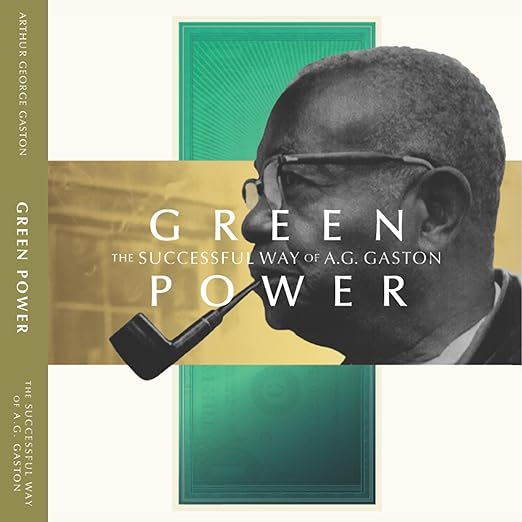
- Narrator: Victor Thomas is the only name in the narrator field, while the description credits a production house that appears in no credit line at all.
- Subjects: Black entrepreneurship under segregation, quiet financing of the civil rights movement, institution building across a hundred-year life.
- Tone: Steady and self-assured, closer to counsel than to confession.
- Bottom line: A first-hand business education wrapped in a civil rights story, weakened only by a listing that explains almost none of it.
Gaston founded the youth club that publishes this audiobook, sixty years before the recording was released, and that single fact reframes the whole listing. Publisher fields usually name a company with no stake in the story. Here the imprint is the institution the book itself describes being created, in 1966, by the man on the byline. Whatever else this release is, it is an organization circulating the account of its own founder rather than a catalog acquisition.
A Hundred and Two Years, Six Hours
Every written response on this page was filed years before the audio existed. The column runs from the middle of the last decade into the early part of this one, while the recording carries a March 2026 date, so each of those readers is describing a printed book. That does not make their judgments worthless, since the words are the same words. It does mean the enthusiasm at the top of this page was earned by a different object than the one on sale.
Nothing about the writing itself is in dispute among them, and the consistency is striking for a release put out by an institution rather than a trade house. Between them the responses describe a life story that doubles as instruction, an unusually clear window onto Black commercial success during the segregation era, and a portrait of a marriage and a family that most business memoirs would leave out. One reader in their forties writes about finally seeing what their grandparents' generation had been doing in those years.
Where the listing lets that material down is in explaining itself. Born in a log cabin in Demopolis, Alabama, on the fourth of July in 1892, dead at a hundred and two, Gaston lived across almost the entire arc of American segregation and its dismantling. A hundred and two years compressed into just under six hours means selection, and selection is a choice somebody made. The page never says who, or on what principle.
Funding a Campaign He Partly Opposed
Count the businesses the description lists and the strategy becomes obvious: a construction company, a business college, a funeral home, an insurance company, a bank, and a motel that still bears his name. Each one answers a need the segregated economy refused to serve, and several of them feed the others. A funeral home needs insurance, insurance needs a bank, a bank needs trained staff, and the college supplies them. That is a closed system, built deliberately, and hearing it enumerated in one breath does more to explain twentieth-century Black wealth building than a shelf of theory would.
Against that sits the more uncomfortable material, and it is the reason this is worth hearing rather than summarizing. The copy states plainly that Gaston disagreed with many of the movement's tactics, and that he nonetheless funded its leaders and its front-line activists, advised King, Shuttlesworth and Abernathy, and helped negotiate an end to the violence in Birmingham in 1963. A man financing a campaign he partly opposed is a far more interesting figure than a hero, and the copy makes no attempt to smooth the contradiction away. Business conservatism and material support for radicals ran side by side in the same person, in the same city, in the same years.
Practical value comes attached. One reader frames the book as a snapshot of history that also hands over tips applicable to any endeavor, and that double register is exactly what the material supports. Gaston's method was to look at what his community could not buy and then sell it to them, which is a repeatable analytical habit rather than a slogan. Business listeners will recognize it. Historical listeners will get the segregation-era economics that made it necessary.
Whose Voice, Gaston's or a Writer's?
Form is the first unresolved question. The byline carries Gaston's own name, which points squarely at autobiography, yet the description talks about him in the third person throughout, in the voice of a jacket blurb. So the listing alone will not tell a buyer whether the voice belongs to Gaston or to somebody writing about him. On a life this long, the difference between hearing a man explain himself and hearing another person explain him is the whole experience, and only pressing play resolves it, since the copy declines to.
Shelving compounds it. The record files this under biographies and memoirs, which is right, and then tags it Entertainment and Celebrities, which is not remotely right for a banker and insurance man who never sought the spotlight. Somebody browsing that tag will find a businessman's life; somebody searching for Black business history or civil rights financing may never reach it at all. The title alone offers no help either, since Green Power arrives without a subtitle of any kind.
One response tells you something about provenance without meaning to, closing on the fact that the order arrived promptly. It is a comment about a parcel, not about a book, and it sits among the five stars carrying exactly the same weight as the readers who engaged with the material. That is the ordinary hazard of a column assembled around a physical edition and then attached to a recording, and it is worth remembering when the average at the top looks unanimous.
Testimony From a Subject Who Controlled It
Listeners who want the mechanics of building enterprises inside a hostile system are the natural audience, and so is anyone drawn to the civil rights era through its money rather than its speeches. Founders will find a case study running across decades instead of quarters. One reader argues the book belongs in school curricula, and the argument is easy to follow: this is economic history told by a participant, in plain language, at a length students would actually finish.
Anyone wanting a movement narrative should adjust expectations first. Gaston is explicitly not a movement figure in the copy's own telling, and a memoir by a man who disagreed with the tactics around him is not going to deliver marches and speeches. Nor is this a critical biography: it is testimony, and testimony from a subject who controlled his own story, published now by the institution he created.
Weighed together, the case is strong and the packaging is weak. Just under six hours with a centenarian who built a bank, a college and a motel in Birmingham while quietly bankrolling the people negotiating around him is a genuinely unusual proposition. Another reader puts it more simply, saying the story is one everybody can learn from, and after sitting with the material I find that hard to argue with.
Common Questions
How long is the Green Power audiobook and who publishes it?
The recording runs five hours and fifty-three minutes and is published by the A.G. Gaston Boys and Girls Club, dated March 2026, with Victor Thomas credited as reader. The description also names Audiostate 55 as the audiobook's producer, though that company appears in none of the record's actual credit fields.
Is this a memoir or a biography of Gaston?
The byline carries Gaston's own name, which is the strongest signal available, but the description is written in promotional third person and never labels the form. A buyer cannot tell from this page whether the voice is first-person recollection or an account assembled about him, and that difference changes the listening entirely.
Does the audiobook cover his role in Birmingham in 1963?
The description says he played a quiet but pivotal part in negotiating an end to the violence there, funded civil rights leaders and front-line activists, and advised figures including Martin Luther King Jr., Fred Shuttlesworth and Ralph Abernathy, all while disagreeing with many of the movement's tactics.
Which businesses did Gaston actually build?
The description enumerates a construction company, a business college, a funeral home, an insurance company, a bank, and the motel that still carries his name. It presents these as a deliberate network built around what the Black community in Birmingham needed and could not obtain elsewhere.