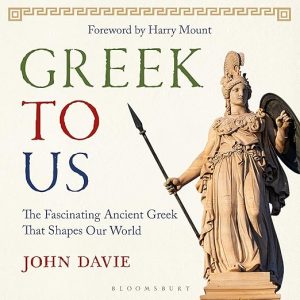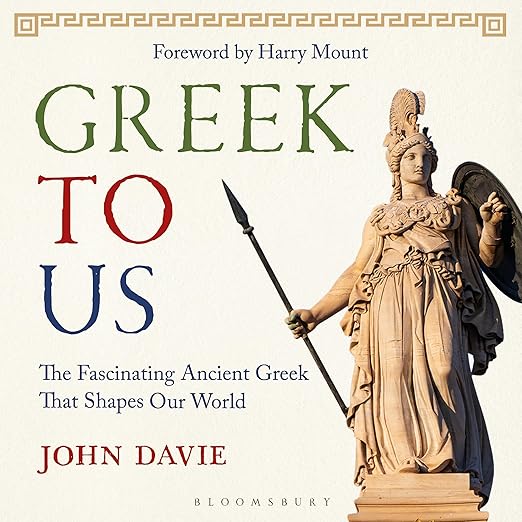
Why does the ancient Greek word for an actor give us the modern word 'hypocrite'? John Davie spends this audiobook chasing down exactly that kind of buried etymology, tracing how Ancient Greek quietly survives inside everyday English centuries after the language itself stopped being spoken outside a classroom. Greek to Us, published by Bloomsbury and both written and narrated by Davie himself, moves from the word for actor, hupokrites, through myth-derived phrases like an Achilles heel or the Midas touch, all the way to the ancient belief that crocodiles cried while devouring their prey, the actual origin of the phrase crocodile tears.
Davie's self-narration is the right call for a book built this specifically around wordplay and pronunciation. A book explaining that an astronaut is, in Davie's own etymology, 'literally a sailor of the skies', or unpacking exactly how hupokrites became hypocrite, depends on a narrator who can handle Greek terms accurately and enjoy the etymology as much as the reader is meant to; having the author read his own research aloud removes any risk of a professional narrator stumbling over unfamiliar Greek vocabulary or missing the specific joke inside a word origin.
At nine hours and fifty-three minutes, this is a substantial listen for what could easily have been a slim trivia collection, and that length signals real ambition beyond a list of fun word facts. The synopsis is explicit that Davie is tracing 'the thread of ancient Greek thought that runs through our own civilization,' bringing in figures like Eros and Aphrodite, Alexander the Great, the Stoics, and Epicurus alongside the etymology, using language itself as the frame for a broader argument about how thoroughly Ancient Greece still shapes the present.
The synopsis pairs genuinely ancient figures, Eros, Aphrodite, the Stoics, Epicurus, Sparta, alongside a distinctly modern one: Oscar Wilde. That juxtaposition is a fair preview of Davie's actual method throughout, tracing a straight line from classical thought into recognizably modern wit and culture rather than treating Ancient Greece as a sealed-off museum subject. Bloomsbury's involvement as publisher also signals a level of editorial polish worth noting; this is a mainstream literary press backing a genuinely academic subject for a general audience, not a niche university-press release.
Davie's own dual role, credited as both the author who researched this material and the narrator delivering it, means the pronunciation and comic timing around each Greek term are coming from the person who chose exactly how to phrase the joke in the first place. That matters more here than in most narration pairings, since a large share of the book's appeal rests on landing the specific etymological punchline correctly, the exact beat between introducing a Greek root and revealing the modern word it produced.
Davie Explains Why Crocodiles Seem to Cry
Reviewer Barry11's five-star review speaks directly to listeners without a classics background, describing the book as excellent 'especially for those like me who only have a tenuous knowledge of the Ancient Greek world', and praising how Davie 'manages to cover a broad sweep of the history, culture, literature and philosophy' of the civilization. That accessibility for genuine beginners, combined with real scholarly range, is a difficult balance for a language-and-history book to strike, and it's the specific balance this one is built around.
The etymology hook is genuinely well chosen as an entry point. Word origins are the kind of detail that reward listening rather than skimming, since hearing Davie explain why a crocodile's supposed tears became shorthand for false sadness, or how a myth about Achilles' one vulnerable spot turned into a common English idiom, lands with more narrative punch spoken aloud than as a dry glossary entry on a page. The synopsis itself poses the underlying question directly, asking what language is if not 'the frame through which we understand the world', and the audiobook format suits that argument better than a reference book would.
The synopsis describes its own approach as 'a learned but always entertaining journey', and that specific tension, real scholarship without academic dryness, is worth taking at face value as the book's actual pitch rather than routine cover copy. Davie has to earn both halves of that claim simultaneously: accurate enough to satisfy a listener who already knows some classical history, entertaining enough to keep a total newcomer following along across nearly ten hours, and Barry11's five-star reaction from someone with only 'tenuous knowledge' of the subject suggests that balance is genuinely working as intended.
Alexander the Great Shares a Sentence With Wilde
A perfect 5.0 average sitting on only three ratings is a genuinely small sample, one early, enthusiastic signal rather than a broad consensus, however strong the single attached review reads. Listeners weighing star ratings heavily should treat this as promising but still lightly tested territory rather than a settled verdict.
Nearly ten hours is a real commitment for what is, at its core, a book about etymology and cultural history rather than a plot-driven narrative pulling a listener forward chapter to chapter. Davie covers serious ground, mythology, philosophy, and the Stoics alongside the wordplay, and listeners expecting a lighter, purely comedic trivia collection about funny word origins should know the scope runs considerably deeper and more academic than that framing alone would suggest.
Alexander the Great sits alongside Oscar Wilde in the same sentence of the synopsis, a deliberately wide historical net that stretches from classical antiquity into modern literary wit within a single breath. Listeners should expect that same range throughout: genuine classical scholarship on myth, philosophy, and figures like the Stoics and Epicurus, threaded together with lighter cultural references that keep the nearly ten-hour runtime from ever settling into a single unchanging register.
The synopsis promises Davie brings 'the lightness of touch' to material that could easily tip into dry academic lecture, and that specific balance, real etymological rigor delivered without heaviness, is the standard the audiobook has to hit across nearly ten hours to keep from exhausting a general listener. Reviewer Barry11's enthusiasm suggests it clears that bar, but anyone allergic to any classical-history content at all, regardless of tone, should still know the subject matter itself runs deep and specific throughout.
Patience With Philosophy Pays Off Here
Word nerds, etymology enthusiasts, and anyone who has ever wondered where a common phrase like crocodile tears actually comes from are the most obvious audience, and Barry11's review confirms the book rewards curious generalists without a formal classics background just as well as it would reward someone who already knows their Greek history. Listeners who enjoy language-history hybrids that use small linguistic details to build toward a larger cultural argument will find the nine-hour-plus runtime consistently rewarding rather than padded.
Something to dip in and out of for a quick trivia hit between other listens is not really what's on offer, and expectations should shift toward something more sustained and academically grounded, since Davie is building connected arguments about Greek thought's influence across nearly ten hours, not delivering isolated bites in short bursts. A little patience with mythology and philosophy sitting alongside the wordplay goes a long way here.
At a Glance
- Performance: John Davie narrates his own etymological research, landing the specific joke of each word origin himself rather than a hired voice guessing at it.
- What it covers: Ancient Greek etymology, classical history, language and culture
- Feel: Erudite, playful, wide-ranging
- Our call: A genuinely well-balanced blend of scholarship and entertainment, best for curious generalists willing to sit with nearly ten hours of connected argument.
Frequently Asked Questions
Do I need a classics background to follow this audiobook?
No. Reviewer Barry11, who describes only a tenuous knowledge of the Ancient Greek world, still rated the book five stars for its accessibility to genuine beginners.
Does this audiobook cover Greek mythology, or just word origins?
Both. Alongside the etymology, Davie brings in figures like Eros, Aphrodite, Alexander the Great, the Stoics, and Epicurus as part of a broader argument about Greek thought's influence.