Quick Take
- Narration: Norris reads her own book with the dry wit and precise timing that made her New Yorker columns distinctive, this is author narration that genuinely elevates the material.
- Themes: Language as love object, Greece as site of self-discovery, the deep intimacy between etymology and personal identity
- Mood: Playful and learned, with unexpected depth in the quieter memoir passages about solitude and obsession
- Verdict: Mary Norris does for Ancient Greek what she did for punctuation in Between You and Me, makes an apparently narrow subject feel like a lens on everything that actually matters.
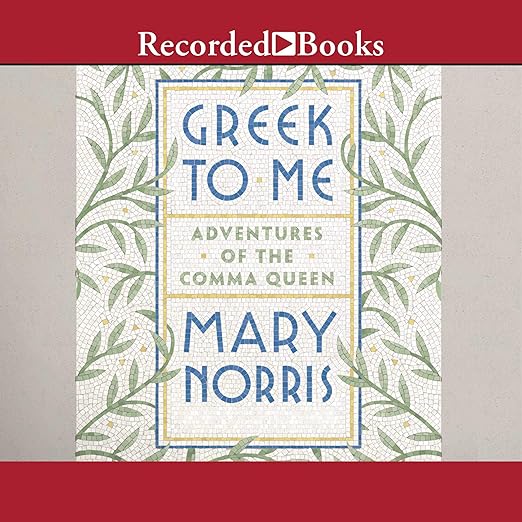
I came to Greek to Me having already spent several enjoyable hours with Mary Norris’s Between You and Me, her memoir-of-sorts about a career spent in The New Yorker’s copy department. That book made pencils and commas feel like characters in a life’s sustained drama, which is an improbable achievement and the kind of thing I am professionally inclined to distrust until I actually read it and find myself convinced. Greek to Me earns a similar unlikely affection: it is, on its surface, a book about a New Yorker copy editor’s passion for Ancient Greek, her solo adventures in the land of olive trees and ouzo, and the surprising ways the language shaped English without most English speakers noticing or caring. What it actually is, under all of that, is a meditation on the things we love that are too large and too strange to easily justify to anyone else in ordinary conversation.
Norris has been learning Ancient Greek off and on throughout her adult life, traveling to Greece regularly for decades, and accumulating the kind of obsessive knowledge that belongs to people who love a thing for its own sake rather than for its utility or social legibility. The book that results from this long accumulation is genuinely hybrid in its form: part travel memoir of solo adventures, part language history of surprising depth, part personal essay about desire and obsession, and occasionally something closer to mythology criticism as Norris makes the case for Athena as a feminist icon with the confident irreverence of someone who has been developing this argument at dinner parties for decades and has refined it considerably along the way.
What the Comma Queen Does with Greek Etymology
The linguistic material in Greek to Me is genuinely illuminating rather than pedantic, which is the critical distinction that determines whether a book like this succeeds or collapses under the weight of its own erudition. Norris does not simply enumerate Greek roots in English and invite you to be impressed by the inventory; she traces specific words through narrative, showing how they arrived in English through particular historical channels and what those journeys preserved or distorted along the way over centuries of use and transformation. One reviewer mentioned the revelation that ancient Greek had only capital letters, and that lowercase Greek letters are a medieval invention rather than an ancient one, this is the kind of detail that seems initially small until it completely reframes how you understand the history of written language and the choices that shaped it. Norris is a professional editor, and her understanding of language as a living system that carries historical freight in its every element is the intellectual foundation of the entire book. The etymology never feels like a detour from the travel and personal narrative; it is woven into both as naturally as the olive trees and the crumbling marble she keeps encountering on her walks through landscapes layered with centuries.
The Solo Greece Passages and What They Reveal
The travel sections of Greek to Me are among the most alive and immediate writing Norris has produced, and they work in part because she is traveling alone and does not soften or editorialize what she observes. She interacts with Greeks who find her Ancient Greek comprehension baffling and her Modern Greek comprehension essentially nonexistent, seeks out the fabled Baths of Aphrodite in a journey that turns out to be more comedic than romantic or transcendent, and accumulates encounters that illustrate with specific detail the gap between the Greece she has constructed from a lifetime of classical reading and the actual country she is walking through. One reviewer noted her encounters with Greek men specifically as a memorable element of the book, and the text handles this thread with the self-awareness it deserves. Norris is not presenting Greece as a backdrop for romantic self-discovery in a familiar literary travel mode; she is exploring what it means to be a woman traveling alone in a country whose ancient culture canonized female power in mythological forms that the modern country complicates in genuinely interesting ways.
Where the Book’s Balance Tips and Why It Still Works
I want to be honest about one structural tension in Greek to Me, because a reviewer raised it fairly and the observation is accurate enough to be worth noting for prospective listeners. The etymological material is dense in places, and readers who came to the book primarily for the travel memoir will find that the linguistic passages sometimes dominate for longer stretches than their patience can comfortably sustain. This is not a neutral structural problem to be dismissed, Norris is entirely clear that the language is her primary subject and Greece the organizing context, not the reverse. If you come in expecting a Greece travel book with some language asides sprinkled in for texture, the actual balance will frustrate you in the middle chapters where the etymology becomes most concentrated. If you come in expecting a language lover’s memoir that uses Greece as its animating experience and recurring reference point, the balance is exactly right and the seven hours move with a pleasurable and natural momentum. Norris reads her own text with the dry precision and occasional warmth that made her New Yorker work distinctive and widely read, and that narration is what makes this audiobook work better than the print version in several specific and important respects.
Athena, Aphrodite, and the Feminist Mythology Thread
One of the more distinctive threads running through Greek to Me is Norris’s argument for Athena as a feminist icon, which she pursues with the same scholarly confidence and dry humor she brings to everything else in the book. Athena is the goddess of wisdom, strategy, and crafts, born fully armored from the head of Zeus, never subordinated to romantic narrative, patron of a city-state named for her as recognition of her superior gift. Norris traces how this figure was deployed and interpreted across ancient literature and art, and what it means that a patriarchal culture produced and honored a goddess of this specific kind in a position of this specific honor and centrality. The argument is not polemical or didactic; it emerges from the same love of language and myth that drives everything else Norris writes. And it gives the book a running theme beyond etymology and travel, a meditation on what ancient cultures encoded in their divine figures, and what those encodings tell us about the cultures themselves and the anxieties and aspirations they carried across centuries.
Frequently Asked Questions
Do I need any knowledge of Ancient or Modern Greek to enjoy Greek to Me?
No prior knowledge is needed. Norris writes as someone who learned Greek as an adult passion project rather than a formal scholar, and the book is structured to bring readers along rather than to address specialists. The Greek terms she introduces are always contextualized and explained through engaging narrative.
How much of the book is travel memoir versus language history, is there a clear balance?
The two strands are intertwined throughout rather than appearing in separate chapters, but the linguistic material is arguably the primary subject and the Greek travel the organizing frame. Readers who want pure travel writing will find the etymology sections substantial; readers who want language history embedded in personal narrative will find the balance exactly right.
Is Between You and Me worth reading before Greek to Me, or do the books stand completely independently of each other?
They stand independently. No knowledge of the first book is required to enjoy Greek to Me. That said, readers who loved Between You and Me will recognize Norris’s voice immediately and find this a deeply satisfying companion. The same sensibility operates in both books, applied here to a richer and more personal subject.
Is Greek to Me available as a free audiobook, and does Norris’s narration of her own work add something specific to the experience?
Yes, it is available as a free audiobook through Audible membership. Norris’s narration is genuinely valuable rather than merely adequate, her comic timing and the precision of her delivery reflect decades of working with language professionally, and her obvious affection for the material comes through in every page she reads.