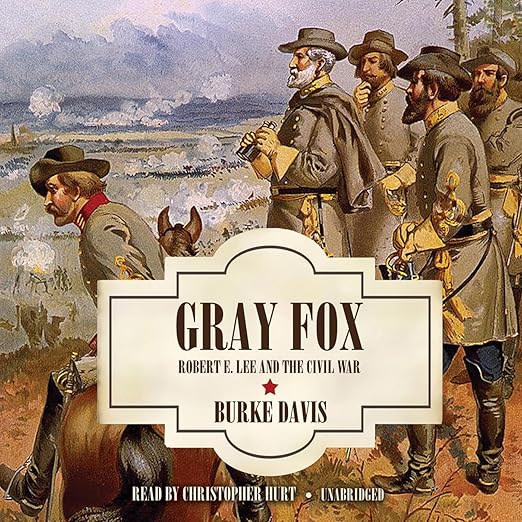
Davis made one decision before any other: how much of a life does a war book owe its subject? Twelve hours and forty-eight minutes of audiobook answer that question narrowly. The copy calls Robert E. Lee the most remarkable man to emerge from the Civil War and promises to bring him to life, while the column beneath it states that the book was never designed as a biography at all. Both descriptions are accurate. A buyer needs the second one first.
Twelve Hours Bounded by Sumter and Appomattox
Scope is what the December 2000 four-star establishes, and it may be the most useful sentence anywhere on the page. The narrative opens a few days before Fort Sumter and closes at Appomattox. Only limited dimensions of the man's character and life are revealed, that appraisal says, because revealing them was never the project. What the book achieves instead is a vivid picture of one commander's role in the war and, through that, something essential about the bloodiest stretch of American history.
Adjectives are how the listing sells it, and they arrive in a rush: reserved and unflappable, savvy and fearless, shrewd and tenacious, fatherly and kind, with the phrase noble hero fixed to the end of the run. That is publisher copy taking a position, and buyers should read it as exactly that. The description is written from inside a tradition of admiration for its subject, and nothing in it signals that the tradition has been contested for as long as it has existed.
Virginia is where the column pushes back, and it pushes with specifics. An April 2013 five-star grants that Lee was the most successful of the Confederate generals, then qualifies it hard: much of that success came inside his home state, and campaigns beyond it went differently. That appraisal names the field where the opposing general is described as having beaten himself, and Gettysburg, where Pickett's division was spent trying to win the day. Admiration and assessment sitting inside one response is worth more than either on its own.
A Single Choice Picks This Over Freeman's
Diaries and letters are why the book works, and a September 2010 five-star describes the effect precisely: the narrative is flooded with immense detail and with accounts from people who lived alongside its subject, drawn from journal entries and correspondence. The result, that appraisal reports, connects strongly enough that a reader feels transported into the 1860s. Primary material used at that density is also what gives the dramatic form its texture, since the voices belong to people who were present.
Freeman's biography surfaces in an August 2016 five-star written by someone who had read both, and the comparison is the most practical recommendation in the whole column: the other work is more expansive, but given a single choice, that appraisal picks this one. The reason offered is craft, a readable narrative woven around excerpts from period diaries and letters, which is what a listener wants from a long recording and what a more expansive book frequently sacrifices.
Hurt has the narrator credit, and the listing makes a claim about the experience that a buyer should attribute correctly: listening to this work, the copy says, gives you the feeling you are there. That sentence was written by the party selling the recording. It also happens to describe what a dramatic narrative assembled from eyewitness testimony is attempting, which makes it the rare piece of marketing that names the design rather than decorating it.
Filed Under Politics and Activism, Oddly Enough
Appomattox ends the book, and that means everything afterward sits outside these twelve hours: the surrender's aftermath, the years that followed, and the long argument over how the war would be remembered. Everything before Fort Sumter is absent as well, including whatever brought the subject to the position he holds when the narrative opens. Anyone wanting to understand the man rather than the campaign is buying the wrong volume, and the listing never says so.
Politics and Activism is the tag carried by this record, under categories spanning biography, history and social sciences. A narrative of one general's campaigns is not an activism title on any reading, and the effect is predictable: the book surfaces for browsers who did not want it and stays buried from military history readers who did. Three category assignments, none of which lands cleanly on what this actually is.
Eyewitness sourcing has a limit worth naming out loud. Journals and letters from the people around a commander are vivid and partial at the same time, and a narrative built primarily from them will carry the perspective of the circle that produced them. The column supplies its own corrective, since the most detailed responses argue with the record rather than simply admiring it, but nothing in the listing indicates that any counterweight exists inside the book itself.
Lee's War Is What Davis Wrote and You Get
Buffs are who the copy has in mind, and a July 2018 five-star confirms it in a single line, calling this a poignant biography of Lee and the Civil War and describing it as part of a Civil War collection. The word biography is doing a great deal of work in that sentence, and the column does not agree with itself about whether it applies. Collectors, listeners who already know the campaign outlines and want the human texture, and anyone who found a conventional biography airless will get what they came for.
Lee as a subject remains contested, and nothing in the copy prepares a listener for how contested. Anyone who wants that argument engaged head-on should look for a book that sets out to have it, because this one does not. Anyone who wants the campaign years rendered through the letters and diaries of people who lived them will find this well built and well sourced. Lee's war is what Davis wrote, and Lee's war is what you get.
Frequently Asked Questions
Is the Gray Fox audiobook abridged or complete?
Nothing on the record marks it as abridged, and no comparison against a print edition is offered anywhere. The stated running time is an ordinary length for a single-volume war narrative, and no companion file, map set or supplementary document is listed beside the recording.
Is this audiobook a good entry point for a Civil War newcomer?
Partly. The dramatic narrative form carries a listener who knows nothing, and the eyewitness material makes the period concrete very quickly. What a newcomer will not receive is context: the copy takes a strongly admiring line, and no part of the framing signals that this view has been argued over for generations.