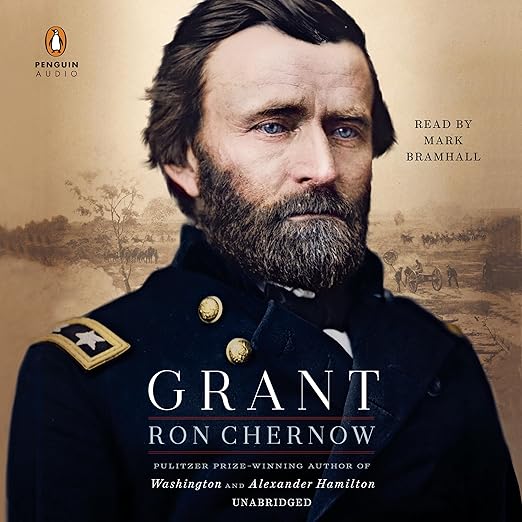
Forty-eight hours is a genuinely rare commitment to ask of a listener, and Grant asks for it without apology: this is Ron Chernow's sweeping biography of Ulysses S. Grant, a number one New York Times bestseller and one of the New York Times Book Review's ten best books of 2017. Reviewers on this particular audiobook write in from four different countries, an unusually international spread for a single listing.
Nothing Heroic, and Yet the Greatest Hero
Chernow's stated project is corrective: Grant, per the synopsis, has typically been misunderstood, caricatured either as a chronic loser and inept businessman or as a triumphant but brutal Union general, and this biography sets out to replace both cartoons with a complete portrait of a man whose fortunes rose and fell with real speed throughout his life. That reframing is the spine the other 48 hours hang on.
Real reversal defines the arc: failed business ventures and a resignation from the army amid accusations of drunkenness before the Civil War, followed by a dramatic turnaround once war gave Grant, per the synopsis, room to realize his potential, prevailing at Shiloh and in the Vicksburg campaign before ultimately defeating Robert E. Lee and earning Lincoln's deep trust. The presidency that followed brought corruption scandals involving his closest staff, but also, per the synopsis, real work toward freedom and justice for black Americans and crushing the Ku Klux Klan, work that earned Frederick Douglass's admiration and public praise.
Grant's story does not end with the presidency. A Wall Street swindler brought him low again afterward, before he rebuilt his standing by working with Mark Twain to publish memoirs the synopsis describes as a masterpiece of the genre in their own right. Threaded through all of it, per Chernow's account, is a lifelong struggle with alcoholism, and Walt Whitman's assessment gets quoted directly in the synopsis: nothing heroic, and yet the greatest hero.
Deliberately unglamorous framing shapes how the synopsis introduces its subject: a simple Midwesterner who managed to be, at once, thoroughly ordinary and genuinely extraordinary. That tension between the plain, unremarkable man Grant appeared to be for long stretches of his life and the outsized consequence of what he actually accomplished is presented as the throughline that finally makes sense of his contradictions, rather than smoothing them over into a simpler, more flattering story.
Hits Like a Mack Truck of Knowledge
The critical reception quoted in the synopsis sets a high bar before a single review is read: Ta-Nehisi Coates, writing in The Atlantic, calls it eminently readable but thick with import, adding that Grant hits like a Mack truck of knowledge. The book is also credited as a best-of-year pick across Goodreads, Amazon, The New York Times, Newsday, BookPage, Barnes and Noble, and The Wall Street Journal, an unusually broad consensus for a single title.
Tom from LA's review brings an unusual lens to the material, reading Grant's battlefield composure at Shiloh through Kipling's poem If and its portrait of stoic, unshakeable character under pressure, describing Grant on the battlefield as someone known to stay cool as a cucumber while others around him saw only disaster. Kenneth C. Mahieu's review adds useful context from having already read Chernow's biographies of Washington and Hamilton and planning to continue regardless of subject, describing this one as balanced rather than a love letter, critical, sympathetic, and admiring all at once, and thorough without burying the reader in every available fact.
What stands out most across this particular set of reviews is geography. Vincent's review, posted from France, calls it magistral and credits it with teaching him a great deal about a general and president he considers underappreciated. Mic's review, from Germany, calls it a masterpiece and thanks both Grant and Chernow directly for the reflection the book prompted. Fernando Manrique Kunze, writing from Mexico, compares it directly against Grant's own memoirs and argues this book elevates Grant beyond how Grant judged himself, crediting him with carrying Lincoln's unfinished projects forward.
Closer to a Season Than a Weekend
Scope is the practical issue here above all else. Forty-eight hours and two minutes is a multi-week commitment for most listeners, closer to a season of listening than a weekend, and worth going in with real intentionality about pacing rather than expecting to finish it the way you would a typical nonfiction audiobook.
Penguin Audio released this recording in October 2017, and the earliest reviews attached to this listing follow within weeks, in November 2017 and March 2018, a much tighter turnaround between release and reader response than this particular lineup usually shows. That quick, substantial reaction lines up with a book already generating major national attention right out of the gate.
Four Countries of Reviewers, Zero on Bramhall
Fourteen total ratings back the listing's 4.8 average, and the five written reviews visible here are all five stars without exception. That is about as strong a signal as a small, visible sample can send, whatever the broader rating pool beyond these five reviews looks like.
Mark Bramhall narrates, carrying the full forty-eight hours solo across a life this eventful, business collapse, war, the presidency, financial ruin, and a late-career memoir all included. Reviewers spanning the United States, France, Germany, and Mexico all comment on Chernow's writing and not one word on the narrator, so how that performance holds up across two full days of material stays an open question.
Neither a Hit Piece Nor a Love Letter
Serious history listeners with real time to invest are the obvious audience, especially anyone drawn to Reconstruction-era civil rights history, Civil War military strategy, or presidential biography that resists hagiography in either direction. Kenneth C. Mahieu's point about balance, neither a hit piece nor a love letter, is a genuine selling point for listeners tired of biographies that pick a side before the first chapter ends.
Skip it if forty-eight hours is simply more than you want to commit to one book right now, no matter how well-reviewed it is, or if you specifically want a narrow military history rather than a full-life portrait spanning business failure, war, politics, and a late memoir. Stay for the long haul and you get a heavily decorated biography, with an international reader base to match the acclaim.
Key Details
- Performance: Mark Bramhall carries all forty-eight hours solo, and not one of the five reviews gathered here, spanning four countries, mentions the reading itself.
- What it covers: redemption through adversity, Civil War leadership, Reconstruction-era civil rights, lifelong struggle with alcoholism
- Feel: Sweeping, authoritative, and richly detailed
- Our call: A decorated, exhaustively researched biography worth the two-day commitment for serious history listeners, though the runtime alone will rule out casual ones.
A Few Questions About Grant
Is forty-eight hours too long for a single audiobook, or does Chernow's pacing justify it?
It is a genuinely major commitment, at forty-eight hours, but reviewers consistently praise the pacing rather than flagging it as bloated. One reviewer specifically credits Chernow with covering vast ground without burying the reader in excess detail, suggesting the length reflects Grant's eventful life rather than padding.
Does this audiobook cover Grant's struggles with alcoholism honestly?
Yes, directly. The synopsis describes Chernow's portrait of Grant's lifelong struggle with alcoholism as transforming the reader's understanding of him at the deepest level, treating it as central to the man rather than a footnote. This is not a hagiography that glosses over Grant's documented personal struggles.