Quick Take
- Voice: A single credit covers a South Carolina childhood, four decades and everyone in them, with no second voice listed beside Heather Alicia Simms.
- Big ideas: Survival of intimate and public violence, generational silence broken, motherhood built from scratch, faith and reclaimed authority
- Atmosphere: Heavy and unhurried, with the rebuilding given more room than the wreckage
- Worth it?: A memoir that earns its twelve and a half hours by staying in the difficult middle of a life instead of racing to the redemption.
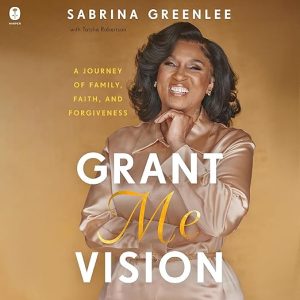
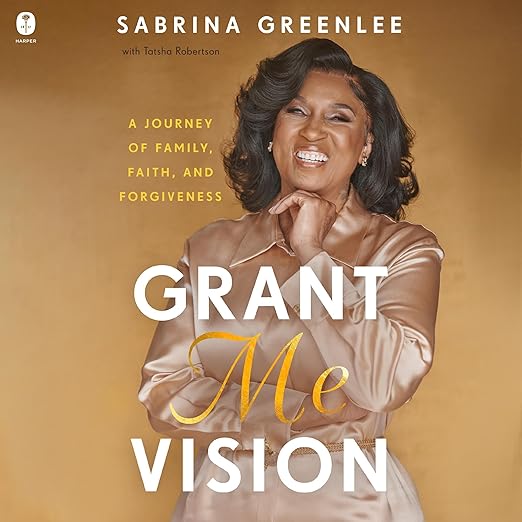
Foreword by DeAndre Hopkins sits at the very top of this description, and it will pull a particular listener toward the page: someone who follows football and wants the origin story behind a wide receiver. That listener is about to get a different book. Grant Me Vision belongs to Sabrina Greenlee, and Hopkins enters it as a fact rather than a subject. This audiobook gives twelve and a half hours to a woman who lost her brother, the man she planned to marry, her sight and most of her early safety, and who then built the household nobody had built for her.
A Catalog of Disasters Becomes a Life
Greenlee was born to teenage parents in the shadow of Clemson University, into a family the copy describes as lacking the means, financial and emotional, to give three children safety. Her younger brother Dilly died in a drunk driving accident while she was still a teenager. In her early twenties she lost the man she loved. A decade after that she was assaulted in public, and the attack cost her her vision. Compressed into one paragraph, that sequence reads as a catalog of disasters. Spread across twelve and a half hours it becomes a life with an internal logic, which is the harder thing to render and the reason the length matters.
Writing on 16 June 2025, a five-star response says it could not put the book down and admits to wondering how anybody survived what Greenlee survived. That reaction points at the memoir's actual architecture. The assault is not the climax and the lost sight is not the ending; both land somewhere in the middle, and the hours after them belong to what she did next, which the copy lists as raising four children, ending a pattern of abusive relationships, and breaking a silence it calls generational.
Heather Alicia Simms Holds the Reading Credit
Testimony gains something specific in audio, and here the gain is not abstract. This is a memoir by a woman who cannot read a printed page, and the edition that works for listeners in her position is this one. People with Disabilities, the tag attached to the record, is doing real descriptive work rather than sitting there as a marketing category.
Heather Alicia Simms holds the reading credit, so the book is performed rather than delivered by the person it happened to. Author-read memoir carries a particular authority and a particular limitation, since a writer reliving her worst night is not always the steadiest guide through it. Pairing a credited actor with first-person testimony is the central production decision on this record, and it is the one worth testing against a sample before you commit, because register in a book like this determines whether you finish it.
Twelve hours and thirty-five minutes is generous for a single-subject memoir, where eight to ten is more usual, and the extra time shows up in the range the description claims: the childhood, Dilly, the fiance she lost, the assault, the years of abusive relationships that followed, the four children she raised, who went on to college, and the work she does now helping other women reclaim their own authority. A tighter edit would have had to choose two or three of those and drop the rest.
A Handle Filled With an Unrelated Complaint
Framing is the first practical caution. A foreword by an NFL star, and that name in the first line of the copy, will place this book in front of sports readers, and the book has very little to do with football. Anyone arriving for the Hopkins story gets a mother's life at full length instead, and the description hands Hopkins a foreword and a single clause rather than a storyline.
Two of the five visible responses say almost nothing about the book itself. One of them, posted on 4 May 2025, runs to two words. Another, from 16 May 2025, describes buying a second copy and sending it to a sister, which is a sentence about a gift rather than about a reading, and the handle attached to it has been filled with the text of an unrelated product complaint about an item arriving much smaller than expected and being hung on a door anyway. Whatever went wrong in that field, it is a reminder that a five-entry column can look unanimous and still carry very little information.
Against that, the badge reads 4.8 from 62 ratings while every visible written entry carries five stars. That gap is the ordinary shape of a review column: people who write are more emphatic than people who only tap a star and move on. Read the written five as a sample of the enthusiastic end rather than as the settled verdict, and note that none of them engages with the hardest material in any detail, which tells you something about how the book is being received and nothing about how it is built.
More Interested in How She Rebuilt
Memoir readers who want the difficult middle of a life rather than its triumphant summary will find this worth the runtime, as will listeners who follow disability narratives told from the inside and anyone drawn to books about interrupting a pattern that ran through several generations of a family. It also belongs on the short list for listeners who read for the mechanics of survival, since Greenlee is more interested in how she rebuilt than in how much she lost.
Approach with care if any of this material sits close to your own life. The book contains a fatal drunk driving accident, a violent public assault with permanent consequences, and years inside abusive relationships, and the copy does not present any of it at a comfortable distance. Anyone hoping for a football memoir, or for an inspirational summary that skips the wreckage on the way to the lesson, should look elsewhere, because Greenlee spends most of twelve and a half hours in the part other books abbreviate.
Questions Listeners Ask
Does the Grant Me Vision audiobook cover DeAndre Hopkins and a football career?
No. Hopkins writes the foreword and is named in the copy as Greenlee's child, and the description mentions her children as part of what she built. The subject throughout is her own life, from a South Carolina childhood to the assault that took her sight and the advocacy work that followed.
Does the audiobook use Sabrina Greenlee's own voice?
No. Heather Alicia Simms is credited with the reading, alone, across twelve hours and thirty-five minutes for Harper. That runtime is longer than most single-subject memoirs, which usually land between eight and ten hours, and it reflects a book covering roughly four decades rather than one episode.
How graphic is the account of the assault that took her sight?
The page does not describe the level of detail. What it does establish is that the attack was violent, public, and permanent in its consequences, and that abusive relationships and a fatal drunk driving accident also sit in the story. Anyone with proximity to that material should approach deliberately.
Is this a faith-based memoir?
Faith is named directly in the description, alongside tenacity and redemption, and it underpins the work Greenlee now does with other women. A five-star response from 12 March 2025 calls the story inspiring, uplifting and relatable and calls the author a hero, which is roughly the register the faith material occupies.