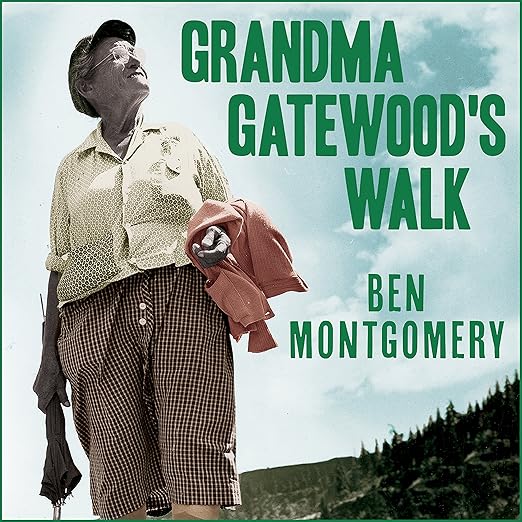
- Voice: Patrick Lawlor carries a single-voice Tantor production built on days, miles and weather rather than on dialogue.
- Big ideas: Postwar America on foot, endurance, the making of a folk hero, the rescue of a neglected national trail.
- Atmosphere: Steady and companionable, with the plainness of good newspaper reporting.
- Worth it?: The best account available of an extraordinary hike, told with more repetition than the running time quite absorbs.
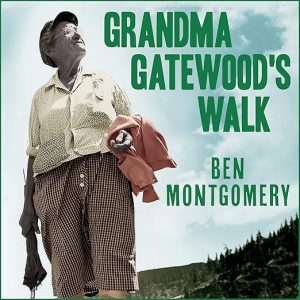
In 1955 a sixty-seven-year-old great-grandmother from small-town Ohio told her family she was going out for a walk, then hiked the Appalachian Trail alone, and Ben Montgomery's account of it runs just under eight hours as an audiobook. Patrick Lawlor holds the reading credit for Tantor. The listing gives you the bare title and nothing else, which turns out to matter more than it should: the book's actual subtitle contains the claim the whole project rests on, and you will not find that subtitle anywhere on this page.
How Grandma Gatewood's Walk Holds Up
Facts this good are a problem for a writer. Emma Gatewood left home with a change of clothes and less than two hundred dollars, told nobody what she intended, and the next anyone heard she had covered eight hundred miles of a 2,050-mile footpath. In September 1955, on top of Mount Katahdin in Maine, she sang the first verse of America, the Beautiful and announced that she had said she would do it and had done it. Montgomery is writing around a story that arrives pre-mythologized, and for the most part he resists the pull of it.
Clyde S. Dale's September 2018 response does the most useful work on the page and restores the missing subtitle while doing it: the inspiring story of the woman who saved the Appalachian Trail. That entry lays out the biography the hike sits on top of, eleven children, a farm to help run, a life that left almost no room for the reading she found time for anyway, and identifies why the legend grew far beyond hiking circles. It is the closest thing here to a full review, and it is the one to read before buying.
Montgomery's method is newspaper reporting applied to a folk hero. He works from what is documented, quotes where he can, and keeps the mythmaking at arm's length, which produces a book stronger on the trail itself than on the woman walking it. The material about the condition of the path in the mid-fifties, and about what her very public criticism of the worst stretches did to maintenance afterward, is the part that surprises a listener who came for the eccentric grandmother and stayed for the institutional history.
This is a walking book and it behaves like one. The structure is a sequence of days, each with weather, mileage, a place to sleep and somebody met along the way, and that shape suits a listener doing something repetitive: a drive to work, a treadmill, an afternoon of yard work. You are not tracking a thesis through the chapters. You are covering ground alongside her, and the episodic build means losing five minutes to a phone call costs you nothing you cannot pick back up immediately.
Reporting gives the recording something solid to hold. Montgomery reconstructs 1955 in detail, the roadside America she walked through, the newspapermen who found her, the strangers who put her up overnight, and those set pieces work spoken because they are scenes rather than analysis. Alfretha's February 2026 response, written by somebody who hiked sections of the trail in the late 1960s and remembers shelters spaced every twenty miles, describes the combination of the life story and the hikes as a book that was hard to put down.
Patrick Lawlor is the credited reader and Tantor issued the recording in December 2014, roughly two years after the print edition had already found its readership. What the responses on this page discuss is the writing: the pace, the repetition, the editing, the author's handling of his subject. Not one of them mentions the reading, which leaves the performance entirely undocumented and makes the audio sample the only reliable way to work out whether this particular voice suits hours of your attention.
Weak Spots in Grandma Gatewood's Walk
A four-star entry from May 2020, signed The archaeologist, is the only critical voice here and it earns a hearing. It calls the writing fine and the underlying story rather thin, complains that better editing would have removed the repetition, and argues that Montgomery is more interested in Gatewood as a person than as a woman, missing the chance to place her against the structural origins of feminism and the social context of her family. That is a genuine gap, and anyone who wants the social history will feel its absence.
Repetition costs more in audio than it does on paper. A reader skims past a point already made; a listener sits through it in real time. The book returns to Gatewood's endurance and to the state of the trail more often than a tighter edit would have allowed, and across a book of this length those returns accumulate into something noticeable. It is not fatal, and the day-by-day structure absorbs a good deal of it, but anyone allergic to hearing a point made twice should know it gets made more than twice.
Then the title as displayed. The listing shows Grandma Gatewood's Walk and stops there, while the book as its own readers cite it carries a subtitle naming her as the woman who saved the Appalachian Trail. That subtitle is not decoration, it is the argument, and dropping it turns a book about the preservation of a national footpath into what looks like a gentle story about an old lady. Ten ratings and five signed entries make a thin footprint for a book this well known, and a title stripped of its claim will not help.
The Right Listener for Grandma Gatewood's Walk
Hikers are the obvious audience and the least interesting one. This works best for a listener who likes American social history delivered through a single person: the postwar roadside, the newspapers that turned her into a story, the improvised hospitality of strangers, the state of a public trail nobody was maintaining. K. Johnson's account, filed in April 2014 and therefore predating this recording by eight months, comes from somebody who lived nearer the John Muir Trail, knew almost nothing about the Appalachian Trail, and got a great deal out of it anyway.
Trail practicalities are not on offer, since this is a biography rather than a guide, and neither is the kind of nonfiction that argues rather than narrates. JT's brief February 2026 response says the book should be made into a movie, and that instinct reads the material correctly: a story that moves, reported by a journalist, built to be watched or heard rather than studied. Anybody wanting analysis of postwar American womanhood will need to bring their own framework and apply it as they go.
The trade here is a thin book about an outsized life, reported carefully and told a little too often, and it remains an easy trade to accept.
Before You Listen
How much of the audiobook is the 1955 hike itself?
Less than you might expect. Montgomery moves between the walk and the life that preceded it, so trail sections alternate with Ohio, the farm and the decades before anyone had heard her name. Listeners who come purely for the miles find themselves inside a biography, which is the point but not what the short title promises.
Is this audiobook useful for someone planning their own thru-hike?
Only as motivation. The trail Gatewood walked in 1955 was badly marked, poorly maintained and in places barely a path at all, and almost nothing about her logistics transfers to the trail as it exists now. Take it as history and inspiration, then get your route planning from something written this decade.
Did Emma Gatewood really walk the Appalachian Trail more than once?
Yes. The description credits her as the first woman to hike the whole trail alone and the first person of either sex to walk it twice, then three times. The book covers the attention that followed, which is where her complaints about the worst stretches began to change how the path was maintained.