Quick Take
- Narration: Malcolm Hillgartner brings a measured, intelligent quality to Bellow’s prose, the kind of narrator whose voice signals seriousness without becoming ponderous.
- Themes: Jewish identity in the twentieth century, the Israel-Arab conflict in the 1970s, intellectual witness
- Mood: Reflective and urgent, with the weight of a Nobel laureate’s moral reckoning
- Verdict: An essential document of a specific historical moment, and one of the finest examples of the literary travel memoir in American letters.
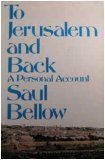
I came to this one during a long flight, somewhere over the Atlantic, and finished it two days later in a state of productive unsettlement. To Jerusalem and Back is Saul Bellow’s account of a winter spent in Israel in 1975, a Nobel Prize winner circulating among generals, poets, politicians, and intellectuals, recording what he heard and thought with the precision of a novelist who also happens to be reckoning with his own relationship to Jewish identity and to the survival of a state. The New York Times called it impassioned and thoughtful, and both adjectives earn their place.
Malcolm Hillgartner narrates the audiobook with the kind of steady, intelligent authority the material demands. Bellow’s prose is dense with proper names, historical reference, and shifts between reported conversation and private reflection. Hillgartner manages those transitions cleanly, and his voice carries the weight of the subject without turning the listening experience into a lecture. This is a harder balance to strike than it sounds.
Our Take on To Jerusalem and Back
What Bellow does here is not quite journalism and not quite memoir, it occupies the space between them that only a writer of his particular stature could claim. He interviews Yitzhak Rabin on Israeli security policy. He speaks with Amos Oz, whose literary voice was already fully formed. He records the perspective of the editor of the largest Arab-language newspaper in Israel. He visits a kibbutznik who escaped the Warsaw Ghetto. Each conversation is rendered with novelistic attention to voice and implication, and Bellow frames each voice with his own commentary, sometimes agreeing, sometimes skeptical, always visibly thinking.
The personal dimension is inseparable from the political. Bellow is explicitly examining what it means to be Jewish in the twentieth century, from a position of relative safety in America, while facing a country that has no such safety. That friction, between the comfortable observer and the existentially threatened community he is visiting, gives the book its moral tension. He does not resolve it neatly, which is exactly right.
Why Listen to To Jerusalem and Back
For anyone interested in the literature of political witness, this is a rare thing: a great novelist applying his full attention to a geopolitical situation in real time, without pretending to have answers he does not have. Bellow is honest about the limits of his perspective. He is also honest about the fear he encounters, not abstract fear but the specific, daily awareness of an encircled people. Listening to this in 2026, with fifty years of history layered over the 1975 conversations Bellow recorded, is a genuinely strange and instructive experience.
The audiobook format suits the material unusually well. Bellow’s prose demands concentration, and Hillgartner’s pacing gives the listener time to absorb each observation before the next one arrives. The running time of seven hours and twenty minutes feels earned rather than padded, this is not a book that wastes words, and the audio version does not waste minutes.
What to Watch For in To Jerusalem and Back
Listeners approaching this expecting a conventional travel memoir, landscape descriptions, food recommendations, tourist sites, will be surprised by the book’s intellectual density. This is first and foremost a work of political and philosophical observation. The setting is Jerusalem and its surroundings, but the real terrain is the inner life of a diaspora Jew confronting the existence of Israel as both ideal and embattled reality.
The historical distance also matters. The figures Bellow interviews, Rabin, Oz, and others, are now historical themselves, some of them dead, some of their positions overtaken by events Bellow could not have foreseen. Reading this as history rather than current affairs is part of what the listening experience demands. Those who bring that patience will find the book deeply rewarding.
Who Should Listen to To Jerusalem and Back
Readers of Bellow who have not yet encountered this nonfiction work should treat it as essential. It illuminates the concerns that run through his fiction, identity, mortality, the weight of being alive in a specific time and place, from a position of direct reportage rather than imaginative construction. Literary travel writing enthusiasts and readers interested in the history of Israel and the Israeli-Palestinian conflict will also find this invaluable as a primary document from a pivotal decade.
Those looking for light listening or a conventional travel experience should look elsewhere. To Jerusalem and Back makes serious demands on its listener’s attention and prior knowledge. It rewards that attention generously, but it does require bringing something to the table.
Frequently Asked Questions
Is To Jerusalem and Back primarily a travel book or a political memoir?
It is genuinely both, but the political and philosophical content dominates. Bellow uses his time in Israel as the occasion for sustained reflection on Jewish identity, the Israeli-Arab conflict, and the moral position of the diaspora observer. The setting is vivid but the argument is the point.
Does Malcolm Hillgartner’s narration serve Bellow’s complex, allusion-rich prose?
Yes. Hillgartner has the intellectual bearing and tonal control to handle Bellow’s layered sentences and frequent shifts between reported speech and interior reflection. The performance feels like a considered interpretation rather than a mechanical reading.
How dated does the content feel given that it was written in 1975?
The historical distance is part of the book’s value rather than a liability. Hearing Bellow speak with Rabin and Oz, knowing what came after, adds a layer of poignancy and historical weight that a contemporary account cannot provide.
Is any background knowledge of Israeli history needed to appreciate this audiobook?
Some familiarity helps significantly. Bellow writes for an educated general reader, not a specialist, but listeners who know the broad outlines of Israeli history and the 1973 Yom Kippur War aftermath will get considerably more from the political conversations he records.