The Short Version
- Performance: A 21-actor celebrity cast including Martin Scorsese, Nathan Fillion, and Simon Pegg, with Max Brooks as The Interviewer. Voice acting is the production's primary strength.
- What it covers: Survival and testimony, global catastrophe, the oral history of mass trauma
- Feel: Urgent, documentary, and intermittently grim with dark gallows humor
- Our call: Five hours of exceptional full-cast zombie apocalypse oral history, with one important purchase caveat for Complete Edition owners.
The first time I listened to the original World War Z full-cast production, I was on a late-night train from Paris to Lyon with bad headphones and a borrowed phone. The audio quality was mediocre and I did not sleep. I have been devoted to the franchise in audio form ever since, because the oral history format is one of those rare structures that becomes something categorically different when performed rather than read. The Lost Files is the companion piece to that experience, and for listeners who love the immersive format of the original, it fills a genuine gap.
Max Brooks' zombie war chronicle is one of the defining works of the genre precisely because of what it is formally: not a novel with a protagonist, but a simulated historical document assembled from survivor testimonies spanning continents, governments, and decades. That structure is born for audio performance, and The Lost Files takes full advantage of it.
How World War Z: The Lost Files Holds Up
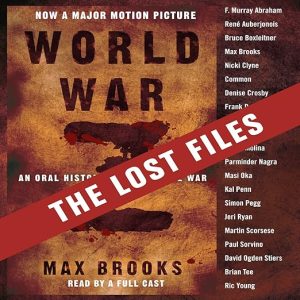
Twenty-one performers contribute to this recording, including Martin Scorsese, Nathan Fillion, Simon Pegg, Common, Alfred Molina, Frank Darabont, and Rene Auberjonois, among others. The roster is not just marketing spectacle. Each actor brings a distinct register to their character's testimony, and the variety of voices across the oral history format reinforces the sense that you are hearing accounts from genuinely different people rather than a single narrator performing different roles. Max Brooks reprises his position as The Interviewer, providing the continuity thread through what might otherwise feel like disconnected episodes.
Reviewers consistently describe the voice acting as the book's primary strength, which is as it should be given the material. One notes simply that voice acting makes this book, and that is not hyperbole for a work that exists almost entirely as a performance medium. The celebrity cast earns its billing by subordinating individual star power to the demands of the oral history register.
Why World War Z: The Lost Files Works as an Audiobook
Because this is where the zombie apocalypse becomes genuinely global in texture. The five hours of previously unrecorded content expand the geographic and tonal range of the original, bringing in perspectives and stories that the abridged edition did not have room for. At six hours and thirteen minutes, it is a compact listen for what it delivers, and the production quality from Random House Audio matches the ambition of the cast.
For listeners new to the World War Z universe, this is technically a companion piece rather than a starting point, designed to supplement the original abridged recording. But several reviewers suggest it works well enough on its own terms, particularly for listeners who saw the Brad Pitt film adaptation and found themselves curious about what the source material actually contains. The answer, broadly, is something considerably more varied and geographically ambitious than the film suggested.
Weak Spots in World War Z: The Lost Files
The purchase clarity matters here. As one reviewer explicitly warns, if you already own World War Z: The Complete Edition, this content is already integrated into that recording and you do not need to purchase The Lost Files separately. That is an important caveat worth noting before clicking purchase. The Lost Files offers the five hours of stories not in the original abridged edition, but the Complete Edition weaves those same stories into the full narrative.
Listeners who are entirely new to Max Brooks' work may also find the oral history format requires patience. The absence of a traditional narrative arc means there is no building momentum in the conventional sense, just the cumulative weight of testimony after testimony. That accumulation is the point, but it asks something different of the listener than a plot-driven thriller does.
The Right Listener for World War Z: The Lost Files
Fans of the original World War Z audiobook who have not yet picked up the Complete Edition, listeners who love celebrity full-cast productions, and anyone who believes the zombie apocalypse deserves the same formal treatment as serious historical nonfiction. Not the entry point for newcomers to the franchise, and not necessary for Complete Edition owners.
Before You Listen
Do I need to have listened to the original World War Z audiobook before The Lost Files?
The Lost Files works as a companion piece designed for listeners familiar with the original abridged recording. It can be followed without prior exposure, but the context of the larger World War Z framework enriches the individual testimonies considerably.
If I already own World War Z: The Complete Edition, do I need The Lost Files?
No. As explicitly noted by reviewers, The Complete Edition integrates the Lost Files content directly. Purchasing The Lost Files separately if you already own the Complete Edition means paying for content you already have.
How does Martin Scorsese's performance compare to the other celebrity narrators?
The cast collectively maintains a consistent documentary register rather than showcasing individual star power, which is the right choice for the material. Scorsese, Fillion, Pegg, and the other performers serve the oral history format rather than their own personae, which makes the production feel unified despite the large ensemble.