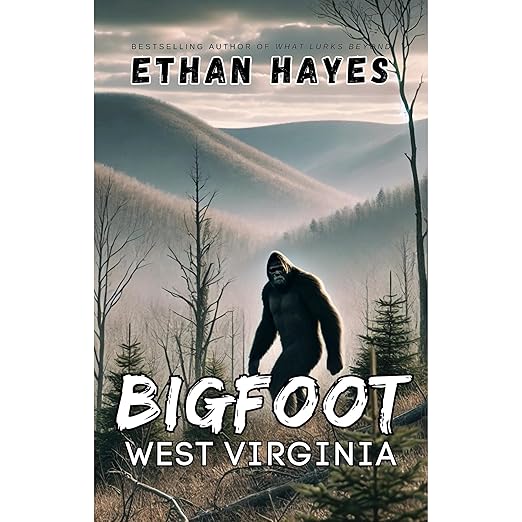
Bigfoot West Virginia is a cryptozoology collection that draws on firsthand encounter accounts from West Virginia residents: hunters, campers, late-night drivers, and hikers who report crossing paths with the creature in locations ranging from the Monongahela National Forest to the outskirts of Charleston and Wheeling. As an audiobook, it arrives in a crowded subgenre that attracts devoted listeners who appreciate regional specificity in their cryptid folklore, and that specificity is both its main appeal and the standard by which it should be judged. At four hours and five minutes, the collection is concise enough to consume in a single listening session, which suits the episodic format of encounter narratives.
Ethan Hayes frames the material with the geography and atmosphere of West Virginia's mountains and hollows, emphasizing what makes the state's particular terrain hospitable to Bigfoot mythology: the vast, untouched land, the isolated trails, the ancient quality of the Appalachian ridgelines. A driver near Parkersburg freezes under the gaze of a massive fur-covered figure. A hiker in the Monongahela National Forest finds disturbed snow and tracks that suggest intelligence rather than animal instinct. A farmer near Huntington hears calls no recognized animal could produce. These are the building blocks of the regional cryptid tradition, and Hayes presents them as jagged memories preserved as they were told rather than polished folklore, which is the right instinct for the genre.
What Ethan Hayes Delivers
The collection's strongest quality is its sense of place. Hayes connects the encounter accounts to specific West Virginia geography in a way that grounds the stories in something real even when the creatures themselves remain stubbornly unverifiable. The Monongahela National Forest, the hollows near Charleston, the ridgelines near Wheeling: these are named, specific locations that listeners with any familiarity with the Mountain State will recognize. That regional grounding distinguishes this from generic cryptid collections and gives it value as a document of local folklore tradition even for readers who are agnostic about the creature's existence.
The framing decision to present these as firsthand accounts from ordinary people, raw and unfiltered, rather than as investigated or analyzed stories, is also appropriate for the genre. Hayes does not aim to prove or disprove, which is the honest stance for a collection of this kind. The book invites readers to feel the weight of these moments and to question what lurks beyond the treeline, which is exactly the experience the best cryptid collections offer.
What Ethan Hayes Gets Right
The audiobook format works for encounter collection material because the episodic structure means you can listen to one or two stories at a time without losing narrative thread. Unlike a sustained narrative that rewards uninterrupted listening, this kind of folklore anthology is comfortable as a companion for walks or late-evening listening where the atmosphere of the stories benefits from the listener's own environment. The Virtual Voice narration handles the short chapter format adequately, maintaining consistent pacing through the succession of witnesses and locations.
For listeners specifically interested in Appalachian cryptid folklore, the West Virginia focus provides regional depth that general Bigfoot collections cannot offer. The state has its own encounter tradition distinct from the Pacific Northwest or the Great Lakes region, and Hayes draws on accounts that reflect the particular character of Appalachian mountain wilderness: more enclosed, more isolating, with a different quality of darkness than the open Pacific coast forests. That regional specificity is the collection's clearest selling point.
Where Ethan Hayes Loses Some Ground
Two reviewers raise the same editing problem from different angles, and both deserve attention. At least two chapters in the collection are duplicated, meaning the same content appears twice in the same volume. One reviewer described chapters 12 and 19 as identical, which is a significant production failure in a collection that relies on variety for its entertainment value. A second reviewer confirmed the duplication while noting that several stories were also drawn from other books in the series. For a collection presenting itself as firsthand West Virginia accounts, the presence of recycled material and repeated chapters affects confidence in the editorial care of the project overall.
Listeners who are devoted Bigfoot enthusiasts may find the familiar story patterns, the frozen witnesses, the vanishing tracks, the sounds that defy known animals, pleasurably genre-consistent. Listeners coming to cryptid collections fresh may want to know that the accounts follow conventional encounter templates, which is true of the tradition generally but worth stating for calibrated expectations. The narrative does not distinguish between more and less credible accounts, which is the genre's typical approach but may frustrate listeners who want any critical engagement with the evidence.
Who Should Pick Up Bigfoot West Virginia
Cryptozoology enthusiasts with a specific interest in Appalachian encounters and West Virginia geography will find the regional specificity here worth the collection's limitations. Fans of American wilderness folklore and listeners who enjoy encounter accounts as an oral tradition rather than as claimed fact will have a reasonable time with this one. It works well as late-night listening or as atmospheric background material for anyone with a general curiosity about what people believe they have seen in the Mountain State's forests. The Virtual Voice narration keeps the pace moving through the succession of accounts, and the short chapter structure makes it easy to listen in brief sessions without losing your place.
Listeners expecting careful editing, well-sourced accounts, or critical analysis of the evidence should look elsewhere. The production failures noted by reviewers are real and substantive, and the collection's approach is to preserve rather than investigate. Anyone frustrated by repeated content in a collection they have paid for has entirely legitimate grounds for the complaint.
Common Questions
Is this audiobook suitable for listeners who are skeptical about Bigfoot as a real creature?
Yes. Hayes explicitly frames the collection as an invitation to feel the weight of these encounters rather than as proof of the creature's existence. The book does not argue a position on Bigfoot's reality, so skeptical listeners can engage with it as a document of regional folklore and belief.
Does this audiobook focus on a particular region of West Virginia, or does it cover the whole state?
Hayes draws on accounts from across the state, with specific locations including the Monongahela National Forest, areas near Charleston, Wheeling, Parkersburg, and Huntington. The geographic spread is one of the collection's strengths for listeners interested in regional distribution of encounter accounts.