Quick Take
- Narration: No narrator is listed in the metadata, the listening experience will depend on the production, but the writing itself is described by reviewers as beautifully crafted.
- Themes: Pacific exploration history, legendary figures of the South Pacific, the intersection of myth and documented adventure
- Mood: Evocative and curious, moving between deep history and lived human drama
- Verdict: Twelve real-life stories spanning Polynesian settlement to Amelia Earhart make this a richly varied introduction to South Pacific history, elegant writing that works equally well for cruise preparation or pure reading pleasure.
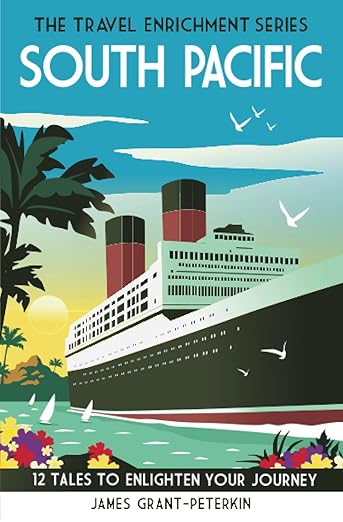
I approached South Pacific by James Grant-Peterkin with mild skepticism, short story collections built around a theme can feel like they are stretching to fill a brief, and twelve chapters about the South Pacific sounded like it might flatten into a parade of famous names. I was wrong. The book is a surprise: tightly written, genuinely varied in its subjects and registers, and shaped by an author who has extensive first-hand knowledge of the region, its people, and its history, as one reviewer noted.
Grant-Peterkin covers twelve real-life stories, moving from the original Polynesian navigators who settled the Pacific, arguably the most extraordinary feat of human navigation in history, through to Paul Gauguin, Thor Heyerdahl’s Kon-Tiki expedition, the mysterious disappearance of Amelia Earhart, and Alexander Selkirk, the real person behind Robinson Crusoe. Each chapter is self-contained but the collection builds a layered sense of the Pacific as a space that has attracted and consumed human ambition across centuries.
Our Take on South Pacific
What separates this from a generic anthology is the quality of the individual chapters. Grant-Peterkin does not simply summarize well-known stories; he finds the detail and the angle that makes each one feel freshly examined. The chapter on Polynesian navigation, these were people sailing across thousands of miles of open ocean before most civilizations had left their coastlines, sets the collection’s tone. The Pacific is presented not as empty space but as a managed environment, understood intimately by the people who first crossed it.
The Easter Island chapter, touching on the riddles that still surround its monuments and the collapse of the civilization that built them, is another strong entry. Grant-Peterkin handles the historical controversy with appropriate care, acknowledging what is known versus what is theorized, which is a discipline not all popular history writers maintain.
Why Listen to This Audiobook
Reviewers describe the writing as beautifully crafted, and that quality carries into the listening experience. The book immerses you in events, according to one reviewer, making them so real as if you have actually been there, and that response to the prose suggests the writing is working at a level above standard popular history. The collection runs six hours and fifteen minutes, which is right for twelve chapters, enough time with each subject to feel the story fully without overstaying.
One reviewer specifically bought it as a gift for a sister taking a South Pacific cruise, and the book circulated among fellow passengers. That is a specific and useful recommendation: this works both as pre-trip context-building and as an independent reading experience for people who will never visit the region but are curious about its deep history.
What to Watch For in This Book
The narrator is not listed in the available metadata for this edition, which makes it difficult to assess the audio production in advance. The writing quality appears strong enough to carry most narrations, but prospective listeners may want to sample before committing. The lack of narrator information is unusual for a major audiobook release and may indicate this is a text-to-speech or lightly produced edition.
Some chapters will inevitably resonate more than others in a collection this diverse. The Gauguin chapter, for instance, touches on the more complicated aspects of his life in the Pacific, and Grant-Peterkin is noted by at least one reviewer as not glossing over the controversial aspects of historical figures. That honesty is admirable but may produce a less comfortable listen for readers who prefer their legends unexamined.
Who Should Listen to This Audiobook
History enthusiasts with an interest in the Pacific, its exploration, its cultures, its legendary figures, will find this absorbing and well-organized. Travelers planning visits to French Polynesia, the Cook Islands, or the broader region will benefit from the historical context, which runs deeper than any guidebook provides. Readers who grew up with Robinson Crusoe or Treasure Island and want to trace the real events behind those fictions will find the Selkirk chapter particularly satisfying. Those looking for sustained narrative nonfiction rather than a story collection may want a single-subject book instead.
Frequently Asked Questions
Does South Pacific require prior knowledge of Pacific history to be enjoyed?
Not at all. Grant-Peterkin writes for a general audience and provides the context needed for each story within its chapter. The collection is designed to introduce the region’s history through compelling individual stories, which makes it accessible as a starting point as well as satisfying for those who already know the broad outlines.
Is the book better suited as pre-trip preparation or as standalone reading?
Both work well. Reviewers specifically recommend it as cruise preparation, and the historical context it provides for places like Tahiti, Easter Island, and the Marquesas adds meaning to a visit. But it also works as pure reading pleasure for those with no plans to travel, the writing quality holds on its own terms.
How does Grant-Peterkin handle the more controversial historical figures, like Gauguin?
With honesty rather than hagiography. At least one reviewer explicitly noted that the book does not gloss over the controversial aspects of some historical figures, which is a meaningful distinction from much popular Pacific history writing that tends to romanticize its subjects.
Are the twelve stories equal in length and depth, or does the collection favor certain subjects?
The chapters appear roughly equal in length across the six-hour runtime. Some subjects, Polynesian navigation, Easter Island, Kon-Tiki, have more material available and may receive more nuanced treatment, but the format is designed to give each story its own space rather than subordinating some to others.