Before You Press Play
- Performance: Mark Deakins is the only performer named, on a book that runs two separate expeditions in parallel and has to signal every switch between them by voice alone.
- What it covers: Obsession inherited across generations, Amazonian exploration and its casualties, a journalist becoming his own subject
- Feel: Humid, propulsive, faintly ominous
- Our call: First-rate narrative nonfiction with one structural choice you will either love or resent, and the written record contains both reactions.
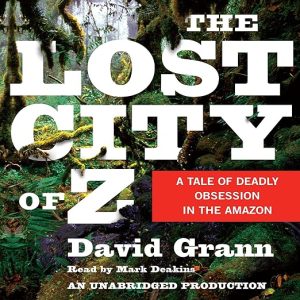
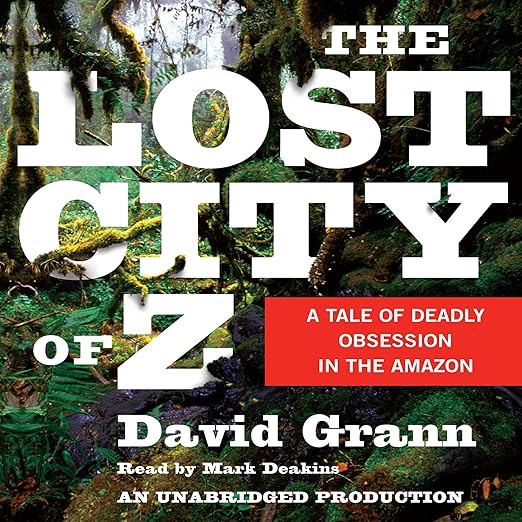
Percy Fawcett walked into the Amazon in 1925 with his twenty-one-year-old son and a conviction that an ancient city was waiting under the canopy, and neither of them came out again. Hundreds went in after them, and the description is blunt about the result: death, capture by tribes, or madness. David Grann went too, and this audiobook braids his own trip together with Fawcett's, which is both the best idea in the book and the one decision the written record openly disputes.
The Review
Gerald Alcorn, whose August 2025 response carries five stars, names the form exactly: a blend of biography, historical detective story and travelogue, which is three books running at once and a considerable amount to hold together. Grann does hold it together, mostly by keeping Fawcett's obsession and his own curiosity in the same frame rather than treating one as the subject and the other as the method. That structural gamble is what everything else in the book depends on. The description explains where it started: a hidden trove of diaries that a New Yorker writer stumbled into, and a decision to treat the greatest exploration mystery of the last century as a reporting assignment rather than as a legend.
Titles do not agree across this page. The listing reads simply The Lost City of Z, while the same five-star account quotes the full form, The Lost City of Z: A Tale of Deadly Obsession in the Amazon, which is the version that tells a browser what kind of book this is. Deadly obsession is not a subtitle a publisher adds casually. Losing it turns a story about people destroying themselves into what reads like a place name.
J. Puckett, at four stars in May 2009, supplies the craft observation the sales copy cannot make about itself: what could easily have become tedious accounts of endless hacking through jungle simply does not, because the style accentuates the material rather than competing with it. That account arrived knowing nothing about Fawcett and left unable to forget him, which is a fair summary of what the book is built to do to a reader.
The Best Parts of The Lost City of Z
Centuries of belief sit underneath the 1925 expedition, and Grann uses them. Europeans looked for El Dorado in that jungle for generations, thousands died trying, and the failure convinced a good many scientists that the Amazon was simply hostile to human settlement. Fawcett spent years assembling a scientific case against that consensus, and the expeditions that inspired Conan Doyle's The Lost World were the groundwork. The book is arguing about archaeology as much as it is telling an adventure story. Grann borrows the jungle's own nickname for the argument, the green hell, and the phrase carries the double meaning the book needs, a place that punishes intruders and a place that swallowed the evidence.
MG, filing five stars in September 2017, praises the balance and describes what the wider frame actually covers: the Victorian age and its influence on the world, and specifically on South America, with Bolivia and Brazil and the Amazonian region they share. That account found the book easy to move through precisely because it kept connecting the historical material to things already familiar, which is the mark of good expository writing.
Mark Deakins is the only performer named, and the assignment is more demanding than the genre suggests. Two expeditions separated by eight decades alternate through the book, along with diary material, period sources and the author's present-tense reporting. A printed page marks those transitions typographically. A recording has nothing but the reading itself to signal that the century has changed, which makes the handoffs the whole navigation problem here.
The Caveats
Zangiku, grading three stars from Japan in March 2011, objects to exactly the thing other readers admire. That account argues a straight historical investigation would have done the job, and that the author cluttered and slowed the book by giving equal time to his own re-creation of the trip, asking pointedly whether we really need to know where he bought his equipment. The complaint is coherent, and anyone who dislikes writers appearing inside their own reporting should take it seriously.
Pool size is the second thing to weigh. Twelve ratings sit above five written accounts, and those five come from three different countries, one of them writing in Spanish. That account, filed from Spain in June 2017, reports enjoying it a great deal while finding the first chapters somewhat dense before the rest ran smoothly, with a surprising final chapter. Twelve ratings on a title of this profile is a very thin sample.
Category placement completes the oddities. This sits under travel and tourism with an adventure travel tag, labels that suggest a trip somebody might want to take, and the book they are attached to describes a jungle the copy says killed, captured or maddened countless people who went in after the same prize. Nobody is booking a trip after this. History and narrative nonfiction are where it belongs, and neither category appears on the record.
The Right Listener for The Lost City of Z
Magazine journalism of the long-form kind is the closest relative, and readers of it will recognize the shape immediately, since a reporter's instincts govern the whole book. Anyone drawn to Antarctic and polar disaster narratives gets the equatorial equivalent, complete with the same questions about why people keep going back. Listeners interested in how archaeological consensus actually changes will find the argument about Amazonian civilization more substantial than the adventure framing implies.
Whoever wants a straight biography of Fawcett should weigh the three-star objection first, because roughly half this book is not that. Travel listeners looking for inspiration are in the wrong section entirely. Readers who need a resolved ending should also know what they are buying: the description promises stunning discoveries about Fawcett's fate, not a body, and a mystery that survived a century does not close neatly in the last chapter.
Ten hours is a serious commitment for a story with an unresolved center, and it earns that time by making the obsession itself the subject rather than the answer. Come for Fawcett and stay for the question of why hundreds of otherwise sensible people followed him into a place that had already consumed people exactly like them. That question is what the modern half of the book exists to ask, and it is the reason the braid was worth attempting. Read the written responses individually before you commit, since the five on this page disagree about the book's central choice and the average above them hides that argument completely.
A Few Questions About The Lost City of Z
Does this audiobook tell you what happened to Percy Fawcett?
Not with certainty, and it does not pretend to. The disappearance has stayed unsolved since 1925, and what the book offers is a substantial narrowing of the possibilities together with a firm argument about what the surviving evidence supports. A century-old mystery rarely closes as neatly as a reader would like.
How much of the book is about the author rather than Fawcett?
Roughly half of it. Grann's own journey into the jungle runs alongside the 1925 expedition from beginning to end, and the two threads carry comparable weight. Readers who enjoy reporters inside their own stories will like the arrangement; anyone who wants the history on its own should know that before buying.
Is this audiobook a travel book?
The record files it under travel and tourism, and that placement misleads. Nobody plans a trip from this. What arrives is narrative nonfiction about exploration, obsession and an archaeological argument, set in a jungle the book treats as a place that consumed almost everyone who went looking.
What is the running time, and how many people have reviewed this audiobook?
Ten hours and four minutes, with twelve ratings and five written accounts. Those five arrive from three separate countries, and the one filed from Spain is written in Spanish, which makes the sample both small and scattered. Weigh each account on its own merits rather than the number sitting above them.