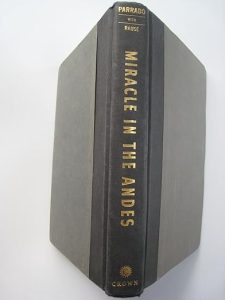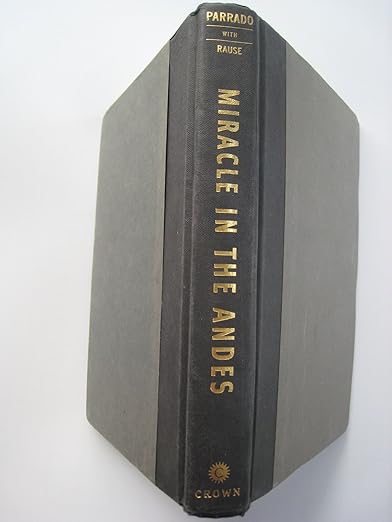
Ten hours of audio sit on a page that also advertises 573 pages, a printed book's ISBN, and a hardcover imprint, which is the first sign that this audiobook has been welded onto a print record somewhere upstream. Nando Parrado's account of the Andes crash is one of the essential survival memoirs, and Arthur Morey is the credited reader. Almost everything else the page tells you describes a physical object instead: a page count, a ten-digit print identifier, and a description that signs off by announcing it came from the hardcover edition.
What We Made of It
Mardelac, writing at five stars in August 2013, said the thing that matters most about Parrado's prose: you can almost feel the cold they felt. That is the achievement. The facts of the crash have been retold often enough that a new account has to justify itself sensorially or not at all, and Parrado does it by refusing to dramatize. The plane carrying his rugby team, their families and their supporters came down on the way to a match in Chile. He was unconscious for three days. When he woke, his mother and his sister were among the dead, and the survivors were stranded on a lifeless glacier at nearly twelve thousand feet with no supplies and no way to summon help.
What separates this telling from the others is the thirty-year gap. Parrado is not reporting from inside the emergency; he is looking back across three decades at the young man he was, and the distance produces a strange, level tone that gives the worst passages their force. The book is candid about how ordinary he was. No disposition for leadership, no aptitude for heroism, nothing to suggest he would be the one to cross forty-five miles of frozen wilderness. He decides to go because staying is certain death, and because his father is at home, consumed with grief, and might yet be spared some of it.
That father is the actual subject. The expedition supplies the plot, but the engine underneath it is a son who chooses to die closer to home rather than farther from it, and who says so plainly. Parrado frames the whole account as a meditation on the redemptive power of love, which reads as publisher language until you hear him mean it. Morey reads without amplification, and material this loaded needs a credited reader willing to stay out of its way.
What Makes Miracle in the Andes Worth Hearing
Rose A. Miller, in October 2013, described the narrative as well written and said it pulled a reader straight into the situation, which is precisely what the audio format does to this particular book. Survival writing lives on accumulation: cold that never lifts, hunger that turns into arithmetic, deadly avalanches, and then the news that the search has been called off. Read on the page, those beats can be skimmed in a minute. Heard in sequence at their own pace, they arrive at the weight the author intended, and the decision to walk out stops looking like courage and starts looking like arithmetic too.
The other argument for hearing it is the first line, which the publisher was smart enough to lead with: in the first hours there was nothing, no fear or sadness, just a black and perfect silence. Spoken aloud, that sentence sets the register for everything after it. Parrado writes in short declaratives with very little metaphor, and short declaratives are what audio handles best. Nothing in the prose asks you to hold a diagram, a timeline, or a map in your head.
Ten hours and three minutes is also the right size for the material. Long enough that the time on the glacier registers as duration rather than summary, short enough that the climb arrives while the cold is still in your ears. The publisher calls it more than a true-life adventure, and for once the distinction holds up, since the reflection is presented as the point and the ordeal as the occasion for it.
What Might Not Land
The 2.7 average is not a verdict on the book, and it needs explaining before it costs Parrado a listener. Five responses are visible. Two of them, both five stars, are about the writing. The other three are one star each, and not one of them concerns the content. A buyer waited almost a month and received a French translation shipped from France. Another was shown a black hardcover and received a Reader's Digest Select Editions volume collecting four different stories, three of them unwanted. A third, writing from India, dismissed the same condensed edition in six words.
Those are fulfillment complaints attached to a record that now sells audio, and they have pulled the number down to a figure that would ordinarily warn a shopper off. Nothing in any of the three touches the recording, the reader, or the text. The pooling crosses marketplaces as well, so verdicts written about entirely different physical products in different countries now sit under one score alongside the audio edition.
Genre placement compounds the damage. The page files this under travel and tourism with an adventure travel tag, which is how a memoir about a plane crash, mass death, and a forced march ends up shelved beside guidebooks. The listeners who want it are searching memoir, survival, or true story, and will never look here. The ones browsing travel inspiration will open a book whose opening chapter is a body count.
Should You Listen to Miracle in the Andes?
Come to this if you want the interior account rather than the incident report: what certainty about your own death does to a young man, and what he concluded it meant three decades later. It suits listeners who read memoir for voice, who can sit with grief described flatly and without consolation, and who prefer their survival stories told by the person who walked out rather than reconstructed by someone who arrived afterward.
Approach with care if bereavement written in detail is difficult for you, since Parrado loses his mother and his sister in the opening chapter and returns to both of them throughout. The publisher's own framing, a revealing look at life at the edge of death, is accurate rather than promotional, and some of what that involves is grim. If you buy from this page, check the format on the confirmation screen, because the record underneath it has plainly served several different products.
Parrado set out up that mountain believing the effort would kill him, and he tells it as though anyone in his position would have done the same. Morey's unhurried reading lets that modesty carry the book.
Before You Press Play
- Narrator: Arthur Morey is credited with a text that gives a reader nowhere to hide, built from short declaratives and long silences.
- Subjects: Survival at altitude, grief for a mother and a sister, a son walking toward his father, ordinary people making impossible decisions.
- Tone: Cold, plain, quietly devastating.
- Bottom line: A first-hand survival memoir worth every minute, sitting under a rating that belongs to somebody else's parcel.