At a Glance
- Narration: Michael Hacker reads with the measured clarity this educational content requires, handling the shift between conceptual argument and classroom case studies without flattening either.
- Themes: Alternative grading as formative feedback, the relationship between assessment and learning, institutional change from within
- Mood: Rigorously practical, with a genuine reformist energy that avoids both utopianism and cynicism
- Verdict: An audiobook that makes a serious evidence-based case for rethinking educational assessment, with enough concrete classroom examples to move well beyond theory.
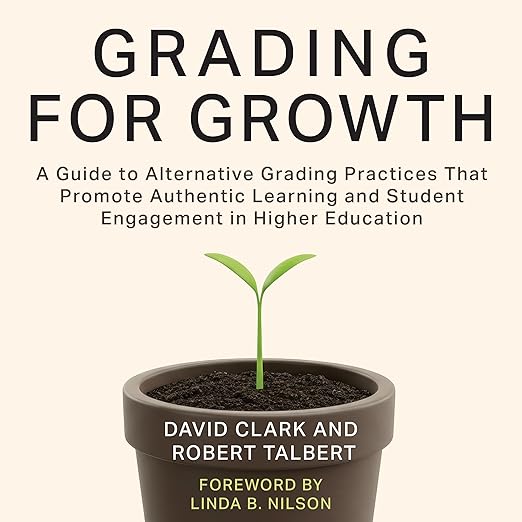
The argument at the center of David Clark and Robert Talbert's Grading for Growth is one that many educators have intuited but few have pursued systematically: traditional grading does not primarily measure learning. It measures performance at a fixed point in time, penalizes the process of learning itself, and creates incentive structures that reward grade-grubbing over genuine understanding. Clark and Talbert, two mathematics professors who have implemented alternative grading systems for over a decade, bring both the evidence base and the practical experience needed to make this audiobook more than a theoretical complaint about the status quo. Michael Hacker narrates the 9 hours and 26 minutes of content with the kind of clear, unobtrusive delivery that lets the argument carry its own weight, and the production includes access to a companion PDF in the library, which matters considerably for a book with this much workbook content.
The craft of this audiobook lies in how Clark and Talbert structure a complex institutional argument for a genuinely broad audience. Alternative grading is not one thing. The book covers Standards-Based Grading, Specifications Grading, and Ungrading as distinct systems with different applications, different evidence bases, and different implementation challenges. The decision to present these as a landscape of options rather than a single prescription is intellectually honest and practically useful, because the right approach depends heavily on discipline, class size, institutional context, and instructor appetite for the kind of ongoing feedback loops that alternative grading systems require.
Clark and Talbert Test Grading Reform in Practice
The central insight that traditional grading penalizes students in the learning process by depriving them of formative feedback is not new in educational research. Constructivist learning theory and formative assessment researchers have made versions of this argument for decades. What Clark and Talbert add is the specific implementation experience of faculty who have actually run these systems in mathematics courses, across class sizes from small seminars to large multi-section lectures, and who have collected firsthand accounts from colleagues across disciplines and institution types. That accumulated practice is what distinguishes this from a theoretical critique and makes it genuinely useful rather than merely aspirational.
Reviewer E. Jensen, who used the book for an academic book club, found it engaging and practical, noting that it reviews the supporting research, describes the methods with examples and case studies, and includes workbook instructions for converting your own course grading system. That workbook chapter is a significant practical feature. The permission to start small that reviewer Deanna L. Wilkinson noted is not just rhetorical reassurance; the book is structured to let educators implement a single element of alternative grading in one course rather than requiring a full curriculum conversion. The authors understand that institutional change happens incrementally, and the book is designed to support that reality rather than demanding wholesale transformation.
Hacker Shifts Pace Between Argument and Case Study
Michael Hacker's narration handles the transition between conceptual argument and concrete classroom example with consistent clarity throughout. The audiobook's structure, moving from philosophical framework through detailed system descriptions to first-hand faculty accounts and a practical workbook, requires a narrator who can signal these shifts without heavy-handed announcement. Hacker achieves this by varying his pace slightly when moving into case study material, a small but effective choice that helps the listener track whether the current passage is establishing evidence or delivering instruction. For an educational book with this much structural layering, that tonal awareness is not a minor benefit.
The companion PDF, available in the audiobook library, is genuinely necessary for the workbook chapter. The step-by-step process for building a prototype alternative-graded course involves tables, rubric templates, and visual organizational tools that do not translate to audio without significant loss of usability. This is not a deficiency of the production; it reflects the nature of the material and the transparency with which the authors designed it. The audiobook handles the conceptual and narrative content with full effectiveness, while the PDF handles the visual and structural components that no amount of narration can replace.
College Faculty Get More Than K-12 Teachers Do
This audiobook is written primarily for higher education faculty, and the case studies and examples reflect that context throughout. Secondary educators and K-12 teachers will find the underlying principles applicable but the implementation specifics more abstract and requiring more interpretive translation to their own settings. Clark and Talbert note explicitly that alternative grading can be used at any level, but the worked examples draw heavily from university mathematics and college courses, and listeners working in secondary contexts will need to do significantly more work to adapt the frameworks to their institutional constraints.
The 4.2 rating suggests some readers found the book less immediately applicable than the strongest reviews indicate. The gap between the richness of the conceptual argument and the practical limitations of any book that cannot substitute for peer consultation and institutional support is real. Educators considering significant course redesigns will benefit from this audiobook as a rigorous starting point, but implementation in actual classroom settings works best alongside a community of practice rather than in isolation, regardless of how thoroughly you have absorbed the audio content.
Department Chairs Get a Map of the Options
This audiobook is for college and university faculty who are dissatisfied with traditional grading and want a rigorous, evidence-based introduction to alternative approaches, complete with real classroom examples rather than purely theoretical models. It is also for department chairs, instructional designers, and educational administrators who want to understand the landscape of assessment alternatives before supporting faculty development initiatives. The companion PDF is worth accessing alongside the audio, particularly for the workbook chapter. Skip it if you want a quick overview of progressive education ideas; this book earns its 9-hour length through depth of coverage and classroom specificity that shorter treatments simply cannot match.
Good to Know
Does the audiobook cover multiple alternative grading systems, or does it advocate for one specific approach?
It covers Standards-Based Grading, Specifications Grading, and Ungrading as distinct systems with different evidence bases and applications. Clark and Talbert present a landscape of options rather than a single prescription, which is one of the most practically useful qualities for educators trying to find the right fit for their specific course structure.
How does Michael Hacker's narration handle the transition between research evidence and practical classroom examples in this audiobook?
Hacker manages these transitions with consistent clarity, slightly varying pace when moving from conceptual argument into case study material. The book's structure moves methodically from framework through evidence through firsthand faculty accounts to practical workbook content, and the audio maintains the clarity of that progression throughout the full 9-plus hours.