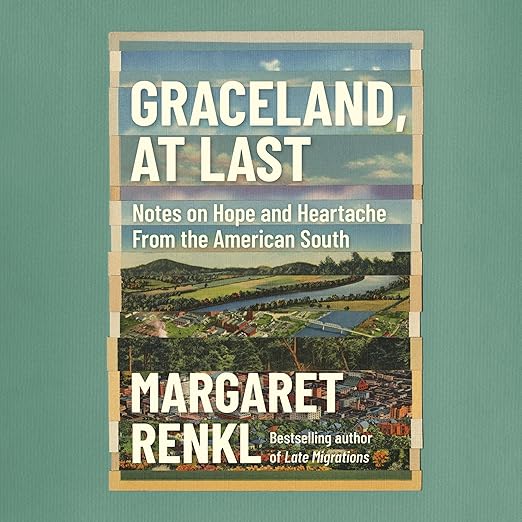
I have a habit with essay collections of reading them out of order, dipping in wherever the title of a piece catches me, and Graceland, At Last is the kind of collection that rewards that approach. Margaret Renkl's New York Times columns arrive weekly, each one complete in itself, which means the sixty-plus pieces gathered here do not require linear consumption. That said, listening to Joyce Bean read them in sequence on an overcast Sunday afternoon gave me a different experience than the scattered reading: a sense of the accumulating vision, of a writer committed to staying in one place long enough to truly understand it.
Renkl addresses the issue of representativeness directly in her introduction, noting that she is not the voice of the South, and that no one is, because there are many Souths distinguished by geography, race, political alignment, and economic circumstance. It is a disarmingly honest framing for a collection that could easily have presented itself as definitive, and it sets the tone for writing that is consistently specific rather than sweeping. Renkl writes from Nashville, from her own experience, from her garden and her family and her community, and she is careful throughout to acknowledge the limits of that vantage point while still trusting it enough to write from it with conviction.
What We Made of It
The essays about Renkl's backyard are not the smallest pieces in the book despite appearing to be about the most domestic subject matter. Her attention to the birds, insects, and native plants of Middle Tennessee is so precise and so clearly rooted in genuine love that the writing moves from natural history into something closer to ethics. One reviewer noted that her blood pressure goes down just reading Renkl's descriptions of her backyard flora and fauna, and that is a real effect the writing achieves, but it is not achieved through pastoral escapism. Renkl is aware throughout that the backyard she tends exists in a region with a complicated relationship to land, conservation, and the systems of ownership that shape what can be grown and by whom.
The collection places these intimate natural history pieces alongside more directly political essays about racial justice marches organized by teenagers, urban shepherds removing invasive vegetation, and church parishioners sheltering the homeless. The juxtaposition is deliberate. Renkl is arguing, through structure rather than assertion, that paying attention to a native bee and paying attention to a social justice movement are not separate activities but expressions of the same quality of care for the world as it actually is rather than as we imagine it should be.
Renkl's decision to work primarily in the essay form, specifically in the short newspaper column, means that each piece in this collection has been compressed to its essential argument. There is very little waste. A reviewer described the collection as an excellent range of topics, from flora and fauna to politics, religion, social justice, environment, and family, and attributed that range to the column form that produces short, quick pieces. That is accurate as a description but slightly undersells what Renkl does within the constraint. The short form requires that she know exactly what she thinks before she begins writing, which produces essays that are unusually clear about their own purposes.
The winner of the 2022 Southern Book Prize and the PEN/Diamonstein-Spielvogel Award for the Art of the Essay, this collection has received the kind of recognition that suggests its qualities are not idiosyncratic to readers already sympathetic to Renkl's outlook. The awards mark it as achieving something in the essay form that crosses the usual readership boundaries, and listening to Joyce Bean deliver the prose confirms that assessment. Bean's narration honors the rhythmic care of Renkl's sentences without adding interpretive layer that might distort the author's particular voice.
Things to Know Before Starting Graceland, At Last
Matching the narrator to the writer's regional identity is not always possible, and not always necessary, but here it matters. Joyce Bean's delivery carries the specific quality of Southern speech that Renkl's prose inhabits, a way of placing emotional weight inside apparently simple declarative sentences that is characteristic of the best Southern literary writing from Faulkner through to contemporary practitioners. The seven-hour-plus runtime passes without the kind of fatigue that poorly matched narration can produce, and several individual essays benefit significantly from being heard rather than read silently, particularly those that employ repetition and sentence rhythm as deliberate formal devices.
One thing the audio format preserves that the print version cannot is the cumulative temporal quality of Renkl's project. These pieces were written week by week across four years, and while the collection is not organized chronologically, the rhythm of the listening experience recreates something of that serial quality. Renkl is a writer who returns to the same places, the same garden, the same neighborhood, the same political concerns, not because she has run out of subjects but because she believes that sustained attention to the ordinary is itself a form of resistance against the systems that want everything to feel temporary and disposable. Heard in sequence over eight hours, that argument accumulates into something that individual essays can only gesture toward.
Best Suited For
This free audiobook is for readers who want literary essay writing that is simultaneously personal, political, and rooted in close attention to the natural world. It is for listeners who are already interested in the South as a literary and political subject, who want a perspective on the region that is neither defensive nor dismissive but genuinely grappling. It is also for anyone who responds to the kind of writing that makes ordinary things feel worth paying attention to. Listeners who prefer essays with a polemical edge and a cleaner ideological argument may find Renkl's gentle, generous tone frustrating; she is interested in complexity rather than clarity of position, and not every reader wants that from their political writing.
Do the essays in Graceland, At Last need to be listened to in order, or does the collection work if you skip around?
The collection works non-linearly since each essay is self-contained. However, listening in sequence gives a stronger sense of the accumulating vision and the deliberate juxtaposition of natural history and political essays that Renkl structures into the collection.
How political are the essays, and will readers who are not from the South or interested in Southern culture find them accessible?
Several essays address racial justice, voting rights, and Southern political history directly. But the majority of the collection is personal and observational in ways that travel beyond regional specificity. One reviewer noted the topics center on Middle Tennessee but the stories are about everywhere.
Is prior familiarity with Renkl's earlier book Late Migrations useful before listening to Graceland, At Last?
Not required. Graceland, At Last stands entirely on its own. Some of the themes overlap with Late Migrations, particularly around nature writing and grief, but the books are independent and can be read in either order.
Does Joyce Bean's narration affect how individual essays land, compared to reading them silently?
Yes, meaningfully. Renkl uses sentence rhythm and repetition as deliberate formal tools, and Bean's delivery honors those patterns in ways that enhance the emotional effect. Essays that rely on cumulative rhythm work particularly well in audio.