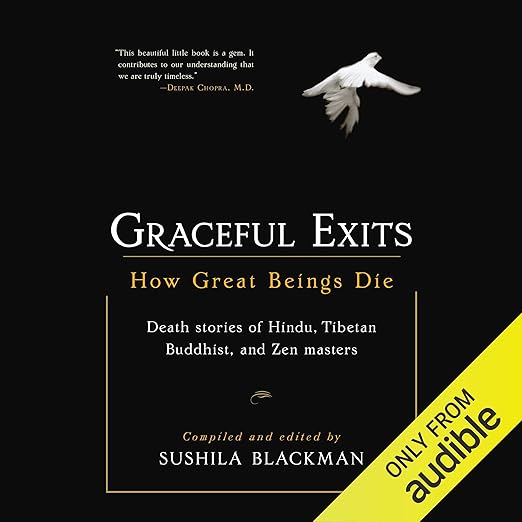
Quick Take
- Narration: Neil Shah’s calm, unhurried delivery is exactly right for a collection of death stories that ask the listener to slow down and sit with what they’re hearing.
- Themes: Conscious dying, cross-tradition spiritual wisdom, the relationship between how we live and how we leave
- Mood: Contemplative and unexpectedly luminous – this is not a heavy listen despite its subject
- Verdict: One of the most unusual and quietly essential audiobooks in the religion and spirituality space, recommended for anyone willing to think seriously about death before it arrives.
I listened to most of Graceful Exits on a long train journey, watching the landscape go by, which turned out to be the right setting. There’s something about sustained motion – the kind that doesn’t require your attention – that opens you up to this kind of material. Sushila Blackman’s compilation of 108 death stories from Hindu, Tibetan Buddhist, and Zen masters is the kind of audiobook that has no real equivalent in the category it occupies. It is not a grief memoir, not a philosophical treatise, not a spiritual how-to. It is 108 accounts of how great teachers died, and the cumulative effect is something I didn’t fully anticipate.
Blackman’s framing draws on the Mahabharata from the first page: Yudhisthira, asked what is most amazing in life, answers that a man, seeing others die all around him, never thinks that he will die. The book is a sustained correction to that particular form of denial, but it makes its case gently, through story rather than argument. The masters profiled here include figures ancient and modern, drawn from Hindu, Tibetan Buddhist, and Zen traditions, and the variety within the 108 entries is striking – some leave with elaborate ceremony, others with a few words to a student, some with silence, some with humor.
Our Take on Graceful Exits
The numerology of 108 is not accidental. One reviewer notes that 108 adds up to 9 in numerological tradition, representing completion, which gives the structure a kind of internal symmetry. Blackman herself died shortly after the book’s publication – a fact that several reviewers find quietly significant, given the subject – which makes the book feel less like an academic compilation and more like an act of preparation.
What strikes me most about these stories, heard rather than read, is how often grace and humor arrive together at the end of these teachers’ lives. The stories that stay with you are not necessarily the ones where the master delivers a final teaching of elaborate profundity. Sometimes it’s a minimal gesture, a few words to a student, an instruction to sit down for tea, and then nothing. One reviewer describes the teachers as “mastering simplicity and discipline” rather than leaving elaborate legacies of words. In audio, where the stories are delivered one after another in Shah’s unhurried voice, that pattern accumulates into something more than any individual entry could achieve.
Why Listen to Graceful Exits
Neil Shah’s narration is quiet and measured in a way that serves the material without underlining it. This is not emotionally manipulative narration – he does not push you toward feeling a particular way about what you’re hearing. The restraint is the right call for a collection that trusts its material to do its own work. At three hours and thirty-five minutes, the book is short enough to hold in a single sitting, which I think is actually the ideal way to experience it. The individual stories are brief, and the accumulation effect that makes the collection powerful is better sustained without significant gaps.
The cross-tradition structure is one of Graceful Exits’ genuine contributions. By bringing Hindu, Tibetan Buddhist, and Zen perspectives together in a single volume, Blackman creates space for comparison without forcing a unified theological argument. What the traditions share – the possibility of approaching death with awareness, dignity, and even joy – becomes visible through the collection without being stated explicitly. Listeners from within any of these traditions will find familiar figures; listeners from outside them will find an introduction that doesn’t demand prior knowledge.
What to Watch For in Graceful Exits
The book is a compilation, and the stories are brief – some running only a paragraph or two. Listeners who prefer sustained narrative or argument may find the format unsatisfying. This is not a book that builds a case across chapters; it accumulates through accumulation itself, and that particular mode of persuasion requires a kind of receptive patience. One reviewer who found the book extraordinary might be followed by another who finds the format too fragmented to engage with – both reactions are understandable.
The audiobook also runs under four hours, which makes it short for a full-price purchase if you’re paying by title rather than through a subscription service. The price on Audible is listed at $55, which is worth knowing. The content has real depth, but the runtime is genuinely brief, and listeners should weigh that against their format preferences and budget.
Who Should Listen to Graceful Exits
Anyone seriously engaged with questions about death, dying, and what it means to leave this life well will find this collection invaluable. It’s particularly suited to listeners interested in Hinduism, Tibetan Buddhism, or Zen who want to encounter these traditions’ wisdom on mortality in an accessible format. Those in healthcare, hospice work, or personal caregiving roles have also found it meaningful. Listeners who want sustained narrative, doctrinal instruction, or a single coherent argument should look elsewhere. This is a book about sitting with uncertainty and finding that others have done so with considerably more grace than the rest of us usually manage.
Frequently Asked Questions
Do you need knowledge of Hinduism, Tibetan Buddhism, or Zen to appreciate Graceful Exits?
No. The collection is organized for general readers, and Blackman does not assume prior familiarity with any of the three traditions. Listeners from within these traditions will recognize figures and contexts; those from outside them will find an accessible introduction without doctrinal gatekeeping.
How does the audiobook format handle the 108-story structure – does it feel fragmented?
The stories are brief, and Shah’s narration keeps the transitions smooth. Whether the format feels fragmentary or accumulative depends on the listener – this is genuinely a book that benefits from being heard in one or two sustained sittings rather than in small pieces over many days.
Is Graceful Exits appropriate for someone who is currently experiencing grief or facing a terminal diagnosis?
Many readers in exactly those situations have found it comforting and clarifying. The book’s premise – that death can be approached with dignity, humor, and grace – is specifically oriented toward offering models for the inevitable. It is not a clinical grief resource but a spiritual and humanistic one.
Given the $55 Audible price and the short 3.5-hour runtime, is this worth the cost?
The content is substantive and genuinely unusual – there’s nothing quite like it in the category. Whether the price is justified depends on how you value rare, non-replicable material versus runtime-per-dollar. Listeners who can access it through a subscription service or credit system will find the question easier to answer.