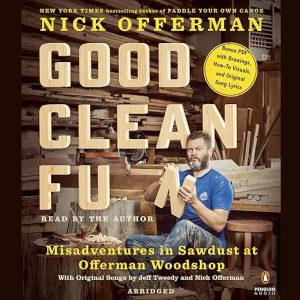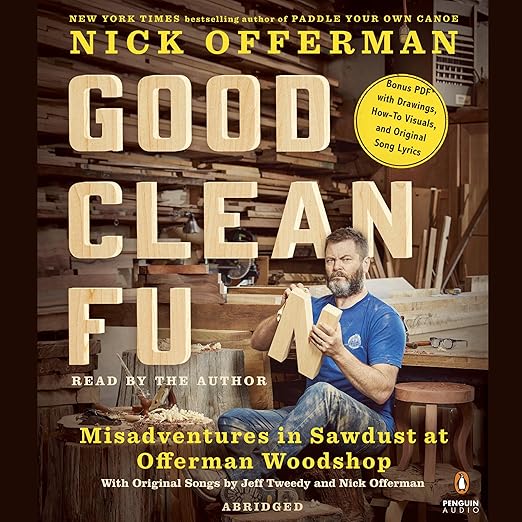
Five original songs are recorded into this audiobook, and the description calls them exclusive: Music to Sand By, American White Oak, Raising the Grain, The Lazy Carpenter, and the title track. Nick Offerman reads the whole thing himself across six hours and seven minutes, Penguin Audio produced it, and a bonus PDF carries the drawings, visuals and song lyrics. That combination makes this one of the rare cases where the audio edition is not a translation of the book but a different version of it.
Kazoos and Canoes From the Offerman Woodshop
A June 2020 five-star opens with a line that saves everyone some trouble: Nick Offerman is not Ron Swanson. Swanson, that response argues, is a bumbling character convinced of his own competence, while Offerman actually knows what he is doing and spends the book crediting the people who taught him and pointing readers toward more experienced artists. Anyone arriving from the television persona should adjust accordingly. The comedy is real, but the woodworking underneath it is sincere, and the book's default posture is deference rather than swagger.
What Offerman Woodshop makes turns out to be a strange and endearing list. Fine handcrafted furniture, yes, and also kazoos, baseball bats, ukuleles, moustache combs and cedar strip canoes. Around that sit humorous essays, odes to his own woodworking heroes, and what the description cheerfully files as assorted tomfoolery. The shop sits among the glitz and glitter of Tinseltown, which the copy makes a running joke of, an honest day's work parked in the middle of it.
Six Hours Feels Like an Afternoon in the Shop
The audio edition changes the balance of those parts. Once the songs are playing and the author's own timing is doing the comic work, the humor and the shop portrait move to the front, and the instructional material recedes to something you absorb rather than follow. Six hours is not a long book, and the version in your ears is closer to spending an afternoon in the shop than to reading a manual about one.
Jeff Tweedy's Songs Only Exist as Music Here
Eliot Rosenkranz, writing in December 2024, describes the structure more usefully than the marketing copy manages: each chapter highlights one member of the Offerman Woodshop team, explains who they are and how they ended up there, then moves into a detailed discussion of a project of theirs that a reader could reasonably copy. That is an ensemble portrait with plans attached, and it is a genuinely good shape for a listen, because the human material carries the technical material rather than the other way around.
Those songs are the strongest single argument for the format. Offerman wrote them with Jeff Tweedy, and titles like Music to Sand By and The Lazy Carpenter tell you the register: shop songs, played straight enough to enjoy and silly enough to belong in a book about kazoos. In print they exist as lyrics in a PDF. In the recording they are music, and music inside a nonfiction program is rare enough to be worth the purchase on its own for the right buyer.
Self-narration seals it. This is a book built on a voice, on asides and digressions and a particular kind of dry sincerity, and having the author deliver his own odes to his heroes removes the layer of interpretation a hired reader would add. Six hours and seven minutes suits the material exactly, long enough for the shop to feel populated and short enough that the tomfoolery never wears through.
Shop Notes Skimming Does Not Survive the Recording
Cape Dory Sailor, in October 2016, praises the lovely photography, and that response is a warning label for the format. This is a visual book. The same reader describes shelves of Shop Notes and Wood back issues, the way woodworkers skim articles for techniques and design elements, and a volume designed to be consumed exactly that way. None of that motion survives a linear recording, and no listener flips.
That bonus PDF is the mitigation, and it deserves credit for being there rather than merely promised. It carries the drawings, visuals and lyrics, so the material is not lost. It is also a document you have to open deliberately on a screen, which is not the same as a book lying open on a bench, and the two projects taught in these pages, a Pop Top bottle opener and a three-legged stool, are exactly the content that needs the diagrams beside the words. Plan to have the PDF up if you intend to build anything.
The shelf placement is odd too. The catalog files this under home and garden with a crafts tag, which undersells a book that is at least as much comic essay collection and workplace portrait as it is a how-to. Buyers browsing for project books will find something looser than they expect, and buyers browsing humor will not find it at all.
Memoir, Comedy, or Tutorial? All Three at Once
Bob Lewis, in a June 2021 four-star, asks the useful question outright: is this a memoir, a work of comedy, or a woodworking tutorial? The answer arrived at is all three at once, which is fair. That response also came to the book after spotting a page dedicated to Andrew Leman of the H.P. Lovecraft Historical Society, who made the Offerman Wood Shop logo, and that detail says something about the book's texture. It is full of side doors.
Listen if you like Offerman's voice, work with your hands at any level, or enjoy books about small enterprises where everybody is named. Hand-tool woodworkers, weekend tinkerers and people who have never touched a chisel but like hearing craftspeople talk about their trade will all find their footing. It also works well as shop company, which is what the songs are for.
The wrong buyer here is the one who wants a reference. If you are after measured plans, joinery instruction or a book to keep open on the bench, the print edition is the working copy and the recording is the entertainment. Worth noting before you weigh the average: the rating counter shows two votes while five people have written responses, so the score on display is not summarizing the crowd you can actually read.