Fifty-nine minutes is the whole runtime here, which puts this audiobook closer to a single long podcast segment than to the shelf of diet books it sits among. Wagner Paiva Fernandes wrote it as testimony rather than instruction: he changed what he ate, his weight and his health followed, and the ten headings in the description walk from that decision through cheap cuts of meat, cooking fats, and a case against vegetable oils. What arrives in your library is one man's account, compressed hard, and the listing is candid about that much.
Reviews for a Different Carnivore Diet Book
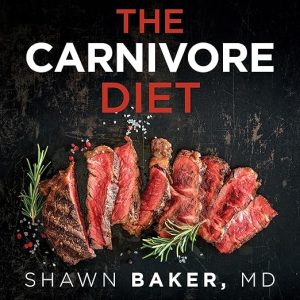
Then you reach the reviews, and they belong to a different book. The most recent of them, dated February 21, 2026 and worth the full five stars, names its subject outright: The Carnivore Diet by Shawn Baker, which that response praises for being more scientific than diet-book packaging would lead you to expect. Different author, different title, different book. Nothing in that verdict touches the account credited on this page to Wagner Paiva Fernandes, and two of the five written responses name Baker directly.
Counting makes it worse. Two ratings, says the line under the stars, and five written responses sit beneath that line. A page cannot carry more written verdicts than it has votes unless the pool was stitched together from more than one product record, which is exactly what the February response points at from the other direction. Treat the 5.0 as a figure attached to a title you would not be buying, and judge this recording on its description alone.
Synthetic Narration Undercuts a Personal Testimony
Strip the pool away and the description still tells you what the recording contains. Ten headings, in order: the decision to change, the first weeks on the diet, the obstacles that arrive with it, the myths the author wants dismantled, affordable cuts that carry high nutritional value, the role of fats, life without carbohydrates, a hostile look at vegetable oils, the results, and a closing reflection on whether any of it is sustainable. As an arc for a personal account, that holds together.
Useful material sits in the middle of it. Cheap cuts and cooking fats are where most people abandon an all-meat regime, not at the level of theory, and somebody who has run the grocery arithmetic has something to hand over that a summary of the research does not. Fernandes frames the question as a budget one: which cuts carry the nutrition without breaking the bank. At this length those sections are positions rather than protocols, but they are concrete positions.
Virtual Voice fills the narrator field, so the reading is machine-generated rather than cast. On a reference manual that would barely register. On a book whose entire persuasive engine is a first-person account of one body changing, it registers hard: the description promises the author's own story and his own results, and synthetic delivery hands that story to something with no body at all. Anyone who buys testimony partly for the voice carrying it should know that going in.
Four Years Between the Review and the Recording
January 10, 2021 carries the oldest verdict on the page, and it is unusually even-handed for a five-star: strong on anecdote and circumstantial evidence, honest that no opposing research has yet been run, written by somebody who arrived from low-carb eating already. Good reading, on its own terms. It was also posted more than four years before this recording was released in April 2025, so whatever it grades, it cannot be this.
Closing the description is a disclaimer that deserves its own sentence: not a substitute for medical advice, no endorsement of any diet adopted without professional guidance, no responsibility taken for results. Striking that note is the right call, and it also tells you the register you are buying. Eliminating entire food groups raises questions a doctor should answer, and a testimony this short is not where those questions get settled.
Shelving is off as well. This entry sits under home and garden with a fitness and nutrition tag hanging off it, which is how a dietary memoir ends up filed on a lifestyle shelf. Nothing about the content changes because of it. If you found the page by browsing a category rather than by searching a phrase, though, that mismatch is the reason, and the category is telling you nothing true about what you would hear.
Fernandes Describes a Change and What It Cost
Buy it if you want one person's before-and-after in under an hour and you already know the arguments on both sides. Fernandes is not trying to convert a skeptic with citations; he is describing a change and what it cost him. For somebody circling the idea, a plain account of the first weeks, the social friction and the grocery bill can land harder than another survey of the literature, precisely because it claims less.
Practical value concentrates in the only four-star on the page, filed in November 2024, which lands on the friction nobody advertises: cycling on and off the diet, feeling better each time, and then having to explain the whole thing to a doctor watching a cholesterol number drift upward. That conversation is what this book leaves you holding. Anyone who wants a text that prepares them for it will need considerably more than this one.
Pass if you came looking for evidence. The page cannot keep its own reviews attached to its own book, the counter and the response list disagree with each other, and the reading is synthetic. Anyone researching all-meat eating seriously should start from a full-length treatment whose reviews actually describe it, then come back to this one for what it genuinely offers, which is texture rather than proof.
Common Questions
How much can a fifty-nine-minute audiobook cover across ten stated topics?
Under six minutes per heading on average, which is enough for a position on each and not enough for a protocol. The early weeks, the affordable cuts and the fats take the most room; the closing question about sustainability gets a reflection rather than an argument. Treat the whole thing as an outline of one experience.
Which book do the written responses on this listing actually describe?
Not this one. A July 2021 five-star reports buying the book twice in early 2020, roughly five years before this recording existed, and traces a route from Paleo through low-carb and Keto into all-meat eating. The dates alone settle it. That pool was carried over from a different title with a similar name.
Is this an argument for carnivore eating or a personal account?
An account. The description calls it an inspiring story of weight loss and health rebirth in one breath and a revolutionary guide in the next, and the second claim is the one it cannot fund at this length. Read the ten headings as chapters of a memoir carrying practical asides.
Should this audiobook be your first encounter with all-meat eating?
Probably not. It assumes you already know why anyone would eliminate plants, and it spends its hour on the doing rather than the reasoning. Start with a full-length treatment, then come back for the texture: what the opening weeks feel like, what meat costs weekly, and which fats keep the routine survivable.