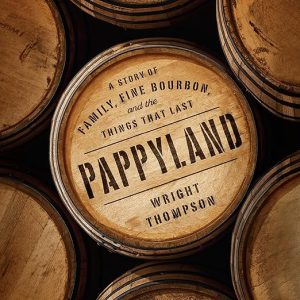
Bourbon is the subject on the label, but inheritance is what this audiobook is actually about. Wright Thompson follows Julian Van Winkle III, the third-generation head of a Kentucky whiskey family, through the problem that arrives once the miracle has already happened: the barrels that made Pappy Van Winkle the most coveted bourbon in the world were finite, they have been used up, and the taste of a grandfather's work has to be recreated from scratch. Chris Abernathy reads it, and the file runs five hours and thirty-six minutes.
Thompson writes about Julian Van Winkle the way a sportswriter writes about an athlete past his peak, which is to say with attention to the mechanics of pressure. The description supplies the numbers that create it: a twenty-three-year-old bottle starting at three thousand dollars online, a journalist's line about a five-thousand-dollar bottle of liquified, barrel-aged unobtanium, and lines of people waiting for a signature. Booze Yoda is what Thompson calls him. The book is about what that does to a person.
Neil F Sullivan, five stars in August 2025, said Thompson nails it and recommended the book to anyone who enjoys families, bourbon and the value of hard work, in that order. The order is right. The whiskey is the occasion; the family is the subject; the work ethic is the argument. Anyone buying this for tasting notes and distillery process will find those present but subordinate to a story about a man trying not to disappoint the dead.
The other half of the book is Thompson's own. He was invited to be Van Winkle's wingman during the recreation attempt and could not stop applying the lessons to his own craft, his Mississippi upbringing and the child he and his wife were expecting. That braid is either the reason to buy the book or the reason to put it down, and the written record on this listing splits on exactly that question.
What Wright Thompson Gets Right
Three thousand dollars is where a bottle of the twenty-three-year-old starts, and that figure explains why this story needed telling now rather than forty years ago. The Van Winkle business nearly died: Julian's father sold the old distillery in a brutal downturn and died partly of heartbreak, and Julian stepped in with almost nothing. The rescue came from barrels the multinational conglomerate that bought the distillery had saved without knowing what it had. That is a better plot than most business books manage.
Thompson is a sportswriter by trade, and the prose carries the habits of one. Scenes are built around gesture and silence rather than exposition, the interviews arrive as talk rather than as quotation, and the pacing assumes a reader who wants to be moved rather than instructed. KathyBiedenharn, five stars in January 2026, described embracing the family's struggles and successes with bourbon in hand, which is roughly the mode the book invites and the one it rewards.
Five and a half hours is the right length for this material, and shorter than the subject usually gets. The mission statement Thompson quotes, we make fine bourbon, at a profit if we can, at a loss if we must, but always fine bourbon, is the sort of line that would be repeated for three hundred pages by a lesser book. Here it lands once and does its work. Compression suits a story whose real subject is restraint.
Things to Know Before Starting Pappyland
Nothing on this listing's numbers adds up. The rating counter reads three while five written responses sit underneath it, and an average of 4.6 cannot be produced by three votes at all, since three whole-star votes can only average 4.3 or 4.7 near that range. Whatever population produced the 4.6, it is not the one displayed. The written grades run 5, 5, 4, 5 and 5, which is at least a number you can check.
Four stars in August 2021 came with the only substantive criticism on the page, and it is a structural one. That entry loved the Van Winkle family history and Thompson's weaving of his own story into it, and objected to the jumping around, the refusal to tell the story as a simple straight narrative. It also wanted to award four and a half stars and could not, because the scale takes whole numbers only, which is worth remembering before you read that four as disappointment.
On audio that structural objection carries more weight than it does in print. A nonlinear book is one you navigate by flipping back; a nonlinear audiobook is one you navigate by guessing at timestamps. None of the five written responses discusses the reading itself, so the question of whether Abernathy's delivery signals the transitions clearly is one the page leaves entirely unanswered. On a book that jumps between Kentucky, Mississippi and three generations, that is the information a buyer most needs and least has.
Who Should Pick Up Pappyland
Bourbon drinkers who have never gotten near a bottle of Pappy are the ideal audience, since the book explains the mania without requiring you to have participated in it. William H, five stars in July 2025, came to it from a family with its own past, including relatives who ran a speakeasy, and left wanting to read more by the Van Winkles themselves. That is the effect the book has: it makes you curious about other people's inheritances.
Set it aside if a distillery tour or a buying guide is what you are after. Mash bills, barrel entry proof and warehouse placement are not what Thompson came for, and anyone hoping to learn how to identify a good wheated bourbon will finish no better equipped than they started. The genre slot on this listing reads home and garden, which fits the book about as well as it sounds.
Sportswriting readers have a second reason to buy, since this is Thompson working the same muscles that produced his magazine profiles, only with a longer runway and a subject who lets him stay. Whiskey supplies the frame, grief supplies the engine, and the recreation of a lost taste supplies a deadline that keeps the reflection honest.
- Narrator: A single credited reader for a book that jumps between generations and states, with no cast and no signposting the page tells you about.
- Subjects: Family legacy, Kentucky bourbon, craft under commercial pressure, fatherhood and inheritance.
- Tone: Reflective and Southern, warm without being sentimental.
- Bottom line: A short, well-built book about inheritance that happens to be set in a distillery; not a whiskey primer.
Does the audiobook teach you anything about how bourbon is made?
Some, incidentally. Thompson is embedded with Julian Van Winkle during an attempt to recreate a lost flavor profile, so process appears wherever the story needs it. An October 2025 entry at five stars recommended it especially to bourbon collectors, which is the right target: people who already know the bottles and want the story behind them, not people learning what a mash bill is.
How much of the audiobook is Wright Thompson writing about himself?
Enough that it changes the book. His Mississippi upbringing, his craft as a writer and the birth of his first child run alongside the Van Winkle material rather than after it, and the description presents that braid as the point rather than as a digression. If memoir folded into reportage irritates you, factor it in before buying.