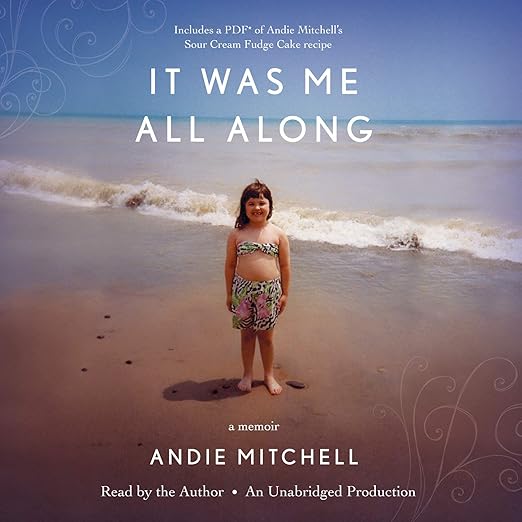
Can a memoir about food addiction reasonably ship with a cake recipe attached? This audiobook does exactly that, and the tension in the decision runs through all seven hours and fourteen minutes of it. Andie Mitchell was a young food blogger who stepped onto a scale on her twentieth birthday, saw 268 pounds, and understood that her life was at stake. Random House Audio released the book in January 2015 with Mitchell reading it herself.
What Andie Mitchell Delivers
Random House made one casting decision that changes the entire object: the author reads it. A memoir whose whole subject is a woman's relationship with her own body, built around numbers she has to say out loud, works differently when she is the one saying them. Two hundred and sixty-eight pounds is a figure that lands one way from the person who weighed it and another way from any performer hired to sound sympathetic about it.
Honest, vulnerable and raw is how the January 2017 five-star sums the book up, and that response arrived already knowing the author, as a long-time follower of the blog who had also watched a filmed talk of hers. It describes an arc running from childhood to the present and the factors that shaped one person's relationship with food and self-esteem. Somebody who wanted the private detail behind a public persona got it.
Home and garden is the shelf this listing sits on, with a Food and Wine tag layered over it. The memoir is about morbid obesity, a fractured family and an eating disorder. Neither label is dishonest, since the author came out of food blogging and the story ends somewhere near a kitchen, but nobody browsing home and garden is looking for this, and anybody browsing memoir will never reach it.
What Andie Mitchell Gets Right
Highlighters rarely come up in discussions of memoir, and the June 2016 five-star mentions one: so much of the book felt worth keeping that the response describes searching the house to find something to mark it with. That is specific, physical praise, and it doubles as a format warning. The passages that reader wanted to keep cannot be kept here without stopping, opening something else, and typing them out by hand.
Boston is where the story starts, working class and fractured, with food acting as babysitter, best friend and confidant. Rome is where it turns, in bowls of handmade pasta described as exquisite but modest. The distance between the two, from anything that came cream-filled and two to a pack to something small and deliberate, is the real structure of the book. It works as a story about proportion rather than about loss.
Hearing an author narrate her own worst years does something no performance can. Mitchell has to voice her twenty-year-old self, the family she was taking refuge from, and the version of herself that ate lustily and mindlessly, in the copy's own phrase, with no professional distance available to hide behind. What to sample is not the emotional peak but a plain factual passage about a meal, because that is where a non-actor reading her own confession either holds steady or does not.
Where Andie Mitchell Loses Some Ground
Expectation is where the September 2016 four-star parts company with the book. That response wanted inspiration and did not find it in the shape it was looking for, though it grants that the memoir reinforced ideas it had already used for weight loss in the past. It also raises a commercial question, wondering aloud whether the book was partly a promotion for the author's blog and cookbook. Both points are about what the book is for, not about how well it is done.
A recipe for Sour Cream Fudge Cake ships alongside this recording as a PDF. That is a strange and slightly wonderful thing to attach to a memoir about food addiction, and it is also the one piece of content the audio cannot deliver on its own terms. Finding the attachment, opening it elsewhere and reading it is the only route in. The book's closing gesture is the one part of it you cannot listen to.
Five written responses sit on this page and every single one of them reaches for a reading verb rather than a listening one. Two of the five were filed within ten weeks of this recording's release and still describe a physical object held open in the hands. None of that is unusual for a title whose print edition arrived first, and it does mean the star average on this page was assembled by readers rather than by anybody who pressed play.
Rome deserves a caution of its own for anyone who bought after reading the copy. The romantic streets appear as a hinge in one sentence of the copy rather than as a destination, and this is not a food-travel memoir. The pasta is there to mark a change in how a person eats, so treat Rome as a turning point rather than as a destination in the book.
Who Should Pick Up It Was Me All Along
Weight is a subject people bring their own history to, and the March 2015 five-star filed in Canada shows what the right listener gets from this. That response comes from somebody who had been heavy in the past, resonated with much of the book, and valued most that the author accepts the experience of her journey instead of rejecting her heavier self in exchange for a thinner one. That distinction is the entire reason to choose this over a diet book.
Food writers and bloggers will recognize the professional half of the story, which the copy keeps almost entirely offstage. Anyone recovering from disordered eating should know in advance that the book carries explicit figures, a starting weight and a halving of it, and describes compulsive eating directly rather than by implication. That specificity is what makes it useful to some listeners and genuinely hard for others, and the description does not soften it.
Leave it alone if you want a plan, because none is offered here and none is implied. Leave it alone as well if hearing a person describe her own body in numbers for the better part of a working day sounds like something to avoid. What remains is a warm, unsentimental account of somebody who changed her life and then refused to disown the person who needed her to.
- Voice: Author-read on a 2015 Random House Audio production, with a companion recipe PDF attached to the file.
- Big ideas: Food as refuge, body image, weight loss without disowning the earlier self.
- Atmosphere: Candid and unsentimental, considerably warmer than the subject suggests.
- Worth it?: A memoir worth hearing in its author's own voice, and badly shelved under home and garden.
Frequently Asked Questions
Is this audiobook a memoir or a weight-loss plan?
A memoir, and firmly so. The copy describes finding balance and self-acceptance rather than a method, no program or regimen appears anywhere in the description, and one four-star response headline says outright that it is not a diet book. Treat any practical takeaway as incidental.
Will this audiobook work for someone who has never struggled with weight?
Yes, though the pull will be different. The strongest material is about a fractured family and about using one thing to manage feelings about everything else, which travels well beyond the specific subject. Listeners with no history here get a coming-of-age story with an unusual center of gravity.