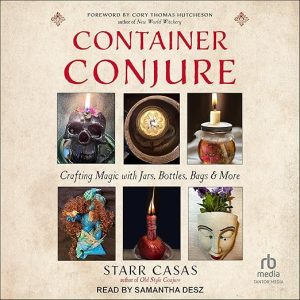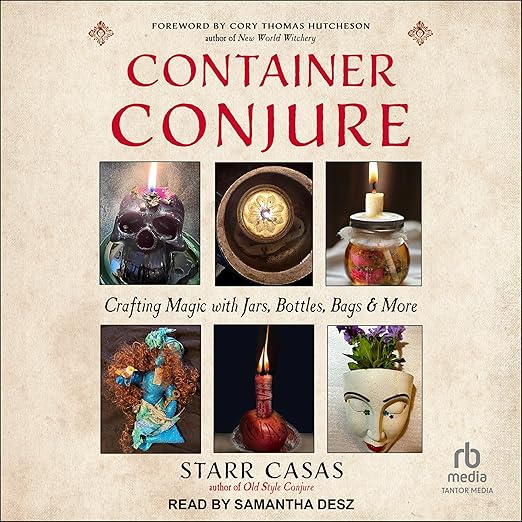
Jars, dolls, light bulbs, sachets and fruit all count as containers in this audiobook, which tells you within a minute that Starr Casas is not teaching the tidy version. A container spell works by selecting items deliberately and sealing them somewhere for a purpose, and archaeologists keep turning up the proof: English witch bottles packed with objects and fluids, sealed and buried to keep witches off. Samantha Desz reads six and a half hours of how to load your own.
Ownership is what gives the three-star its weight. Filed on February 19, 2026 by somebody who owns every previous book Casas has written and loves all of them, it is not a stranger being difficult. Too much of this repeats, in that account: the same prayers, jar spells carried over from an earlier title, hot foot work already covered elsewhere, with a handful of genuinely new spells scattered among them. Devoted followers of a prolific author notice recycling before anybody else does.
Twelve days separate that grade from the March 3, 2026 release of this recording, which means it assesses a printed edition rather than anything Samantha Desz voiced. And the rating pool is unusually transparent for once: two votes, both of them written up, sitting at three and five. Eight stars divided across two ratings displays as exactly 4.0, which is what the page shows, so nothing silent is hiding inside that average at all.
Desz Voices Prayers Better Than Ingredient Lists
Casas is presented as an acknowledged authority and master of Conjure-style container magic, and the book earns its usefulness through how unfussy the definition stays. A container is whatever holds the work: mojo hands and charm bags to carry, honey jars meant to sit still, and then dolls, light bulbs, sachets, fruit and other organic material once you stop thinking in glass. Ingredients come from the home and belong personally to whoever assembles them.
Control turns out to be the real subject. Mama Starr, as the copy calls her, teaches listeners to load their own containers and then to maintain authority over what they have made, which is precisely the step popular spellwork tends to skip. Describing a honey jar is easy enough: items in, honey over, lid closed, candle burning on the top. What happens afterward, and who answers for it, is where a practitioner separates from a recipe collection.
Samantha Desz reads a book of procedures, and procedure is the hardest thing to hand over by voice. Part of this material gains from the format, since prayers are spoken by design and hearing one said aloud sits closer to its working form than reading it off a page ever does. Ingredient lists run the opposite way. No companion document appears anywhere on this record, so anything you intend to reproduce has to be transcribed as it goes past.
Nothing to Bookmark When You Need a Spell
Reference value is where the format costs you most. Spellwork gets consulted at the moment of use, which means turning to the honey jar section on the specific evening you need it, and a recording offers no index, no page to mark and no way to confirm a component at a glance. That is a great deal of instruction to carry in your head without a written copy sitting open beside you.
Overlap with the back catalog also lands differently in audio. With the earlier books on a shelf you can compare a jar spell in half a minute and skip whatever you already own; inside a linear recording you pay for the repetition in listening time before you find out it is repetition. Anybody holding several Casas titles already should treat the new spells as the purchase and price the remainder accordingly.
Filing is the other oddity worth flagging. A manual of Conjure practice has landed on the home and garden shelf, tagged crafts and hobbies, which places container spells somewhere between candle-making and storage solutions. One small counterweight: the description was clearly adapted for this edition rather than lifted whole from a print jacket, because it says Casas teaches listeners to load their own containers.
Returning Casas Buyers Are the Real Market
Practitioners already working inside Conjure are the intended audience and the book assumes it throughout. No introduction to the tradition arrives, no defense of it, no comparative framing to ease anybody in. You get containers, ingredients and the question of control, and the copy expects you to know why a mojo hand differs from a honey jar before the first chapter finishes.
Curious newcomers can still start here if breadth is what they want. Container spells are among the more accessible forms of the practice, the ingredients are generally found in the home, and the range covered, portable and stationary, glass and organic, hands a beginner a usable map of the territory. What it will not hand over is a step-by-step first working you can carry out from memory.
Returning buyers are visibly the core market, and the shorter of the two responses makes the point with real economy: five stars, filed from the United Kingdom on March 13, 2026, and the words amazing work as usual. Four words do not constitute a review. As usual, however, is a data point. People who like Casas keep buying Casas, and this listing is aimed straight at them.
Look elsewhere if you came for history or anthropology, because the archaeology gets a paragraph before the practical work takes over. Hold off too if you need to follow along exactly, since a recording of procedures with no document beside it is a frustrating way to learn a craft built on precise components. Owners of the back catalog should check what is genuinely new before paying twice.
- Narrator: Samantha Desz reads procedures and prayers, one of which suits a voice and one of which badly wants a page
- Subjects: Conjure-style container magic, mojo hands and honey jars, control over the work, domestic ingredients
- Tone: Matter-of-fact, practitioner to practitioner
- Bottom line: Worth it for the range of containers, though the format fights the reference use this material is built for.
What are witch bottles, and why do they open this audiobook?
English jugs packed with assorted objects and fluids, sealed and typically buried to keep witches away, and archaeologists periodically dig them back up. Casas opens there because they prove the practice is documented rather than invented, and international rather than local. Container magic turns out to be one of the oldest surviving forms of the work.
Does the audiobook assume you already practice Conjure?
It largely does. Nothing here introduces the tradition, argues for it or situates it against neighboring practices, and the vocabulary of mojo hands, hot foot work and honey jars arrives unglossed. Newcomers will follow the procedures without difficulty but will be assembling the context themselves as they go along.
Is six and a half hours the right length for a book of spells?
For a single-topic manual it is generous, and the generosity goes into range rather than depth. Portable containers, stationary containers, organic containers and the maintenance work each get real room. The trade is that no individual spell receives the kind of extended treatment a dedicated chapter in a shorter book might give it.
What do you need on hand for the honey jar the description walks through?
Very little, which is the appeal. A jar, the items going into it, honey to cover them, a lid and a candle to burn on top. The copy stresses that ingredients are generally found in the home and personal to whoever makes the thing, so the variable component is what you bring rather than what you buy.