At a Glance
- Narration: Author-read for Simon & Schuster Audio, a solo production of a first-person memoir that names six other makers but keeps one voice throughout.
- Themes: making as permission rather than skill, reversible decisions over permanent ones, tolerance for mess
- Mood: Workshop-warm and companionable, with rules attached
- Verdict: Better as a push than as a reference, and print is the format to own if you plan to look anything up.
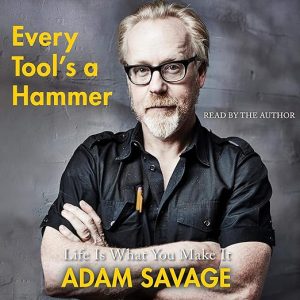
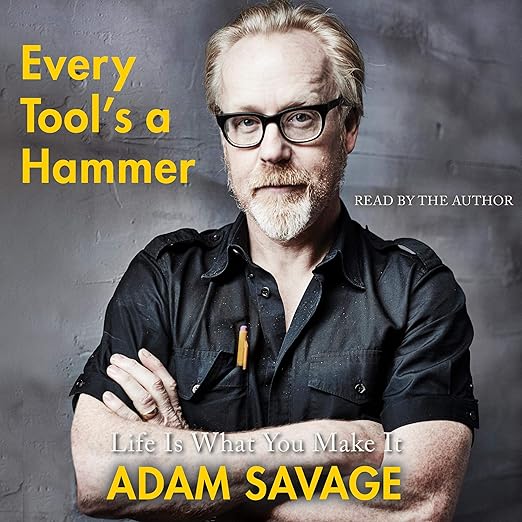
Permission slip is the phrase Adam Savage reaches for, and it describes the shape of this book better than any subtitle would. Every Tool's A Hammer is not a manual and not quite a memoir: it is forty-plus years of building, molding and breaking things, converted into rules with names like Screw Before You Glue and Increase Your Loose Tolerance. Savage reads the audiobook, seven hours and forty-five minutes of it, which for a text written entirely in the first person is the only sensible arrangement.
Soft Hyphens Reveal a Copy-Pasted Description
One response out of five declines to round up, and that verdict is the most useful of the set. Filed on December 27, 2019, it warns that anyone considering the book is probably already a maker, that plenty of the content will land as reinforcement rather than news, and that the whole thing sometimes reads like a self-help title, rescued by the personal stories. The warning is accurate. Technique is not being taught here; technique arrives as illustration for a philosophy of work, which is a different product from what a tools-and-materials framing promises.
Look closely at the description and you can see where it came from. Soft hyphens survive inside two words, breaking and friction, the invisible break points a typesetter leaves in justified print columns, which means this audio listing was built by pasting a page out of the printed edition. The genre slot tells a similar story: Home and Garden, tagged Crafts and Hobbies, for a book about creative process by a television maker. Nobody shopping for seasonal garden advice wants this. Everybody who wants it is shopping somewhere else entirely.
Savage Narrates a Chronicle Written in Second Person
A five-star response from December 7, 2019 maps the structure better than the publisher's copy does: each chapter carries one or two lessons, organization, momentum, the humility to ask for help, each of them illustrated from a specific job. That response also names Industrial Light and Magic among the places the work happened, which tells you the scale of the examples on offer. The lessons themselves are ordinary. The illustrations are not, and the distance between the two is where this book earns its keep.
Rules with names are the organizing device, and the names are good. Increase Your Loose Tolerance argues that making is messy and that screwups sit on the path rather than beside it. Use More Cooling Fluid is about blade life and equally about reducing friction in your work and your relationships. Screw Before You Glue prefers reversible decisions to permanent ones. Every rule starts as shop practice and then widens, which is either the best trick in the book or its most irritating habit, depending on your patience for extended metaphor.
Self-narration counts for more here than it usually does, because the copy is written as direct address: a chronicle of my life as a maker, a permission slip of sorts from me to you. Delivered by anybody else, that second person would curdle immediately. Savage also brings other people in, Jamie Hyneman, Nick Offerman, Andrew Stanton, Guillermo del Toro, Tom Sachs and the chef Traci Des Jardins, so the category of maker is drawn wide enough to include a professional kitchen.
Returning to Look Things Up Is the Weak Spot
An August 2025 five-star response reports going back to the book several times, which is praise and also a warning about format. A book you return to is a book you look things up in, and looking things up is the one job audio does worst: no index, no flipping, no eye scanning a column for the paragraph about mechanical fasteners. That same response declares its own bias openly, which I appreciated. Anyone planning to use this as a shop reference should keep a printed copy within reach.
Capitalization is a small tell worth pausing over. The listing renders the title Every Tool's A Hammer with a capital A, while the copy directly beneath writes Every Tool's a Hammer in lowercase, twice. The title compresses one of the book's own rules, the one arguing that a hammer waits inside every tool, so the difference is not merely cosmetic: the page is quoting the book slightly wrong on the one line that names it.
All five written responses describe reading rather than listening, and not one of them mentions the recording. That is a fact about the pool rather than a complaint about the production, and it is the normal condition for a nonfiction title released in 2019 whose readers found it in print first. What the metadata does confirm is a single credited voice belonging to the author, which is more than most nonfiction listings bother to make clear.
Ideal for a Project Stalled at Planning
Makers already in the habit are the obvious buyers, though they are also the readers most likely to find the practical content familiar. The better fit is somebody with a project stalled at the planning stage, since the central argument runs against waiting for the right tool or the right conditions. Mythbusters viewers get the origin stories they came for, and the workshop detail is specific enough to satisfy rather than tease.
Non-makers are served better than they expect. A September 2019 five-star response, from somebody who sews and writes, reports that the definition of making in play is broad enough to cover both, and predicts that a reader who does not identify as a maker may discover otherwise a few chapters in. That widening is deliberate. The book keeps stretching the category until it covers almost any deliberate creative act, which is a rhetorical move and a generous one.
Hold off if you want instruction, because almost no technique is taught here and the tools discussion is philosophy wearing a shop coat. Hold off as well if you already own it in print, since everything the responses value most, the returning, the looking up, the reinforcement, works better on paper. Savage wrote a permission slip and then read it out loud, and that combination suits somebody who needs pushing far more than somebody who needs teaching.