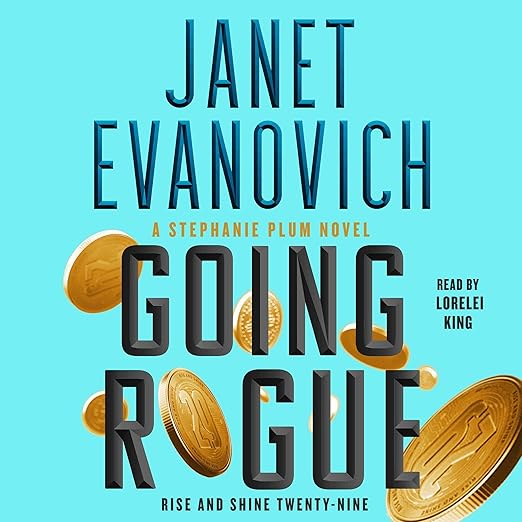
I came to Janet Evanovich's Stephanie Plum series relatively late, picking up the first book on a whim during a trip to a used bookshop in Philadelphia. By the time I reached number twenty-nine, Going Rogue, I was listening on a Saturday afternoon with nowhere to be, which turned out to be the exact right conditions for this book. It is not one you want interrupted. The pace is relentless in the best, most cheerful way, and Lorelei King's narration keeps things moving like a commuter train that never runs late.
I'll admit that twenty-nine installments into any series, a certain amount of formula is expected - and going in with that expectation is exactly how you enjoy this. Connie Rosolli, the bail bond office's unfailingly dependable manager, fails to show up for work one Monday morning, which is treated with the same alarm you might expect if the sun forgot to rise. What follows is a mystery built around a missing coin left as bail collateral by a recently murdered man, and the hunt for that coin pulls together the full ensemble: Stephanie, Lula, Grandma Mazur, Joe Morelli, and Ranger.
Evanovich writes ensemble comedy with real skill. The pleasure here is less about the mechanics of the kidnapping plot and more about watching this particular group of characters respond to pressure in exactly the ways you'd expect - which is to say, loudly, unexpectedly, and with frequent stops for food. Reviewer Heather B called it a series standout, and I understand why. Connie's absence removes a central stabilizing force from the office, which changes the dynamic in ways that actually feel fresh. Stephanie and Lula have to manage their own chaos without their usual backstop, which generates some of the funniest and most chaotic set pieces in recent entries.
The mystery itself is functional rather than elaborate. The coin at its center is more MacGuffin than genuine puzzle - Evanovich isn't writing Agatha Christie, and she's never pretended otherwise. What matters is that the threat is credible enough to give Stephanie real stakes, and the resolution is satisfying on the terms the series has always promised: the bad guys lose, the good guys win, and Stephanie somehow ends up in the middle of all of it. Reviewer John Mariotti put it well: knowing it will all work out in the end is half the point, and the fun is watching how the characters arrive there.
The Best Parts of Going Rogue
Lorelei King's performance is the beating heart of this audio experience. She has been narrating this series for a long time and the confidence shows - she doesn't just read the dialogue, she inhabits each character. Grandma Mazur's cheerful disregard for propriety, Lula's bulletproof self-confidence, Morelli's dry exasperation, Ranger's carefully calibrated cool: King handles the full range without a missed beat. At eight hours and sixteen minutes, the runtime is generous without feeling padded, and the pacing never sags.
For listeners who are new to the series, a note: this is book twenty-nine, and while Evanovich provides enough context to follow the plot without prior knowledge, the emotional rewards are considerably greater if you have history with these characters. The running jokes land harder, the recurring gags accumulate, and the supporting cast's personalities have texture that a newcomer won't yet feel. That said, the comedy is accessible regardless of where you enter.
Before You Commit to Going Rogue
The thing Evanovich does quietly well in this installment is redistribute the warmth. With Connie gone and Vinnie absent, the tether that usually holds the office together is missing, and Stephanie has to rely more heavily on her broader network. This gives Grandma Mazur and Lula more space to operate, which they fill with characteristic energy. Reviewer GiGi described the series as funny and in good taste, and that's accurate: these are comedies of situation rather than shock, built on affection for their characters rather than contempt.
There's also a genuine sweetness in how the book frames loyalty. Everyone shows up when Connie needs rescuing - not because they're obligated, but because that's simply what this group does. It's sentimental without being cloying, and it's one of the reasons the series has sustained itself across nearly three decades.
Should You Listen to Going Rogue?
If you're already a Stephanie Plum fan, this is an easy recommendation. It delivers exactly what the series promises: sharp comic timing, a colorful ensemble, a kidnapping that serves as backdrop to the real entertainment, and Lorelei King doing what she does best. Readers looking for intricate plotting or narrative surprises should look elsewhere - Evanovich's genius here is reliability, not reinvention. This is comfort listening done with real craft, and on a Saturday afternoon with nowhere to be, it's exactly what you want.
The Short Version
- Read by: Lorelei King is a series institution at this point - her comic timing on Lula's one-liners and Grandma Mazur's wild declarations is pitch-perfect, keeping the energy at a rolling boil for all eight-plus hours.
- At its heart: Small-town loyalty under pressure, female friendship, the chaos of amateur detective work
- Vibe: Raucous and warmhearted, like a long lunch with a friend who keeps getting into trouble
- Short version: A confident entry in a long-running series that rewards its established fans without demanding anything complicated from them.
A Few Questions About Going Rogue
Do I need to read all 28 previous Stephanie Plum books before listening to Going Rogue?
No, but your enjoyment will be richer with series context. The basic plot is self-contained, but the humor and character dynamics reward familiarity with the ensemble. Starting around books one through five gives you a solid foundation.
Is Lorelei King's narration consistent with previous Stephanie Plum audiobooks?
Yes, Lorelei King has narrated the series for many years and her performance in Going Rogue is as assured as ever. Her character voices are distinctive and consistent, which matters a lot across a long-running ensemble cast.