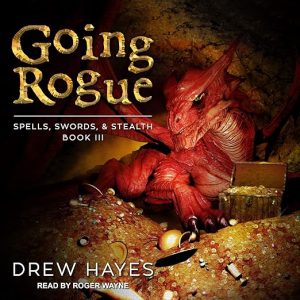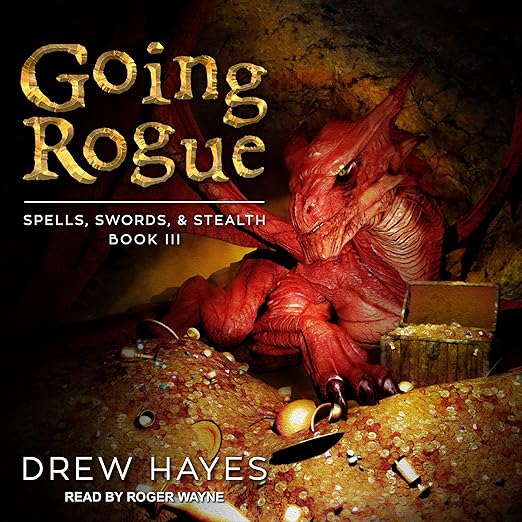
Camnarael, Alcatham's capital, is where the former NPCs arrive at the start of Going Rogue, broke and looking for the kind of work that pays in gold rather than in narrative consequence. Drew Hayes' second book in this series, narrated by Jason Reynolds across fifteen hours and nineteen minutes, picks up the party mid-trek and immediately establishes that the capital is not the safe destination the road implied. This audiobook delivers the same genre-aware humor as the first volume but gives it room to develop in a larger, more politically complex setting.
The Verdict, Briefly
Hayes' central premise, that the NPCs in a fantasy world have their own interiority and their own very real concerns about money and safety and what it means to be perceived as supporting characters in someone else's story, was strong enough in the first book to establish a devoted audience. Going Rogue extends that premise into a capital city scenario that multiplies the social complexity considerably: there are factions operating in the shadows, a Grand Quest offered by the royal family, and adventurers converging from across the land, all of which gives the former NPCs more angles to navigate and more identities to manage simultaneously.
The artifact plot thread, specifically the rumors of a Grand Quest reward that sounds uncomfortably familiar to people who know exactly what kind of artifact could exist in this world, is a tight structural choice. It connects the external political situation to the protagonists' specific history without requiring elaborate expository recap, and Hayes uses the recognition moment to do emotional work alongside the comedic work. The party's reactions to what they gradually piece together reveal character more efficiently than direct dialogue would, which is a mark of confident plotting in a series built on subverting fantasy conventions from the inside.
Reynolds handles the ensemble nature of the cast with evident investment and precision. The former NPCs are not a monolith; they have distinct speech patterns, distinct tolerances for risk, and distinct histories that affect how they read any given situation. A narrator who flattens an ensemble into interchangeable voices loses both the comedy and the drama simultaneously, and Reynolds does not do that. His differentiation across the party members is consistent and specific, which pays off particularly in longer dialogue sequences where tracking who is speaking matters for understanding the joke and for following the strategic discussion that often runs underneath it.
The humor in Hayes' writing is structural rather than set-piece-based, meaning it emerges from situations and from character logic rather than from isolated jokes inserted into the narrative. Reynolds' straight-faced delivery of the funniest moments is exactly the right instinct for this material. Fantasy comedy narration that signals the punchline to the listener in advance collapses the joke by removing the element of discovery. Reynolds trusts Hayes' timing, which means the listener gets to find the comedy rather than being directed toward it, and the difference between those two experiences is the difference between a joke landing and a joke being explained.
The fifteen-hour runtime is generous and Hayes fills it. The capital city setting introduces a larger cast of secondary characters than the first book, and several of those characters receive enough attention to suggest they will matter in subsequent volumes. The storytelling is building a world rather than just a plot, and the investment in background and context pays off as the Grand Quest mechanics become clear and the party's specific advantages and vulnerabilities within that framework come into focus. Listeners who found the first NPC volume satisfying will find this one has more surface area to explore.
Before You Commit to Going Rogue
Listeners new to the series should start with the first NPC volume before this one. Going Rogue assumes familiarity with the party members, their backstories, and the specific rules of the world Hayes has built, none of which are reconstructed here in full. The payoff from certain character decisions in this book depends on understanding what those characters did and chose previously, and that context is not optional for full appreciation of the emotional beats.
The ending resolves the immediate central crisis but opens onto a larger situation rather than providing full closure, which is the correct choice for a series with genuine momentum but may frustrate listeners who prefer finished arcs before committing further. Hayes is clearly building toward something substantial, and the capital city arc is an expansion and complication of the world rather than a self-contained episode. Listeners who want their story questions answered should plan to continue with the series rather than stopping here.
Best Suited For
This audiobook is for listeners who have already spent time with Hayes' NPC series and want to follow the same party into more complex circumstances and higher stakes. Reynolds' narration makes the fifteen-hour runtime genuinely enjoyable, and the combination of real ensemble comedy with adventuring stakes that carry actual consequence keeps the book from becoming a one-note genre satire. Listeners drawn to fantasy that takes its conventions seriously enough to play with them from a position of genuine understanding, rather than simply mocking them from the outside, will find Hayes' approach a rewarding match. Those who are willing to commit to the full series rather than expecting a single resolved volume will get the most from what Hayes is building, and this second entry demonstrates convincingly that the investment is very well-placed.
- Performance: Jason Reynolds narrates Drew Hayes' second NPC series volume with the energetic range the ensemble requires, handling comedy and genuine stakes with equal conviction across fifteen hours.
- What it covers: Former supporting characters claiming agency, found family, the economics of adventuring
- Feel: Buoyant and inventive, with real tension underneath the genre-aware humor
- Our call: The second book in Hayes' NPC series deepens the world and its characters while delivering the same structural comedy that made the first volume earn its audience, and Reynolds keeps the runtime from ever dragging.
A Few Questions About Going Rogue
How does Jason Reynolds' narration handle the ensemble cast in this audiobook?
Reynolds maintains distinct voices across the former NPC party members consistently, which matters because the comedy and dramatic beats both depend on character differentiation. His handling of the ensemble across fifteen hours is one of the production's clear strengths and makes the runtime feel managed rather than exhausting.
Is Going Rogue audiobook more comedic or more plot-driven compared to the first NPC book?
The second volume balances both, and the capital city setting adds political and organizational complexity that gives the humor more structural grounding. The stakes are higher than the first book while the tone remains consistent, which is a difficult balance to maintain in a genre-aware comedy series.
Does this audiobook end on a cliffhanger or provide a complete story arc?
Going Rogue resolves its immediate central crisis but opens onto a larger situation that sets up subsequent volumes. It is more complete than a pure cliffhanger but functions as a series chapter rather than a fully standalone story, which is worth knowing before you commit to starting here.