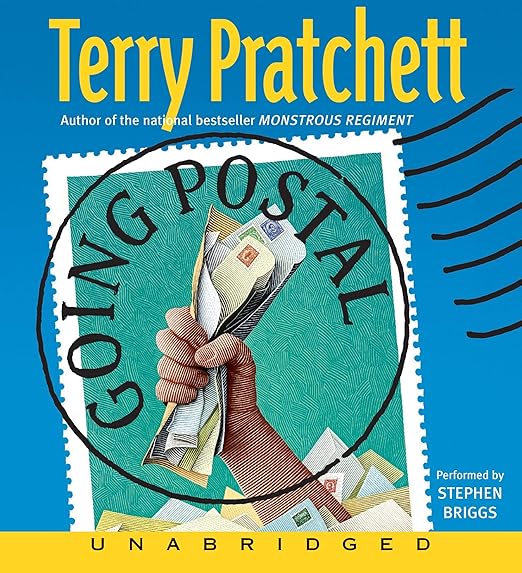
Quick Take
- Narration: Stephen Briggs is the definitive voice for this section of Discworld, having narrated more of the series than almost anyone, and his Moist von Lipwig has exactly the right slippery charm.
- Themes: The redemption of the professional liar, bureaucratic systems as both prison and liberation, whether hope is something that can be manufactured and still function
- Mood: Propulsive and funny with a surprising amount of genuine feeling underneath the con-artist surface
- Verdict: The best standalone entry point into the Moist von Lipwig subseries and one of Pratchett’s most tightly plotted novels.
There is a moment in Going Postal, somewhere around the third hour of the audiobook, where Moist von Lipwig is standing in the ruins of the Ankh-Morpork post office surrounded by decades of undelivered mail, and he begins to understand that the mail is actually talking to him. Not talking, exactly. But pressing. Demanding. The weight of all those unsent words accumulating into something that has its own kind of gravity. I was on a train when I hit that passage, and I remember thinking: this is not a novel about a con man running a post office. This is a novel about what happens when someone who has spent his entire life making things up is forced to deliver something real.
Going Postal is the thirty-third Discworld novel and the first featuring Moist von Lipwig, and it is genuinely the most sheerly enjoyable book Pratchett ever wrote, in my view. I know Guard fans will argue for Guards! Guards! and the witch fans will make their case for Wyrd Sisters, but Going Postal achieves something those books approach only in sections: complete, sustained narrative momentum from the first chapter to the last, combined with Pratchett’s most polished economic satire and a villain so precisely drawn that reading about him is uncomfortable in a productive way.
The Con That Catches Itself
The premise is perfect and also perfectly simple. Arch-swindler Moist von Lipwig is supposed to be executed, drops through a trapdoor, and instead falls into a government job. Lord Vetinari, Ankh-Morpork’s supreme ruler and one of literature’s great pragmatists, offers Moist the position of Postmaster. The post office is catastrophically broken: decades of undelivered mail, a building that is structurally unsound in ways that defy physics, and absolutely no functional staff. Against this backdrop is the Grand Trunk, a telegraph monopoly run by a man who has made it powerful through methods that do not survive examination.
What Pratchett does brilliantly here is allow the con-man protagonist to discover that some things are worth doing even when there is no angle. Moist starts this job the way he has started everything: looking for the exit. He ends it doing something he has never done before. The novel does not announce this transformation. It simply lets it happen, and because Stephen Briggs has been narrating Pratchett long enough to understand how to let a quiet moment breathe, the payoff lands cleanly.
What Stephen Briggs Brings to Moist
Briggs has narrated more Discworld novels than any other single narrator, and his deep familiarity with the world’s texture is audible in every scene. His Moist von Lipwig is particularly well-judged: charming without being cloying, slippery in a way that keeps you slightly off-balance about whether you are rooting for the right person, and funny with the kind of timing that makes Pratchett’s prose sound like it was written to be read aloud rather than adapted for audio. Reviewer Doug Oglesby, who describes moving from Death to Sam Vimes to Moist in his Discworld progression, captures something true about the way Briggs differentiates these characters: each one feels distinct even when occupying the same Ankh-Morpork geography.
Reviewer Ryan Sean O’Reilly’s note that the name Moist Von Lipwig pretty much sets the stage for everything is accurate. Briggs delivers that name with precisely calibrated relish on first use, establishing immediately that he understands what kind of novel this is.
The Clacks and the Monopoly Problem
The Grand Trunk communication system and its bloodthirsty piratical headman function as Going Postal’s most direct real-world allegory. Pratchett is clearly writing about the monopolization of essential communication infrastructure, about what happens when a technology that is supposed to serve everyone is captured by interests that serve only themselves. This was relevant when the novel was published in 2004. It is not less relevant now. The fact that Pratchett embeds this argument in a story about a lovable swindler running a post office is what makes it go down without resistance. Reviewer Kindle Customer who has re-read this more than any other book by any author has identified something real about how the novel does not wear out the way most satirical fiction does.
Who Should Listen, Who Should Skip
Listen if you want an entry point into Discworld that does not require any prior series knowledge and delivers a complete, satisfying narrative arc. Going Postal is the ideal first Discworld novel for readers who want propulsive plotting and a protagonist they can track through a genuine character transformation. It is also an excellent choice for existing Discworld readers who have not yet reached the Moist von Lipwig books.
Skip if you have previously tried Discworld and found that the satirical register does not work for you. Going Postal is Pratchett at his most accessible and most tightly plotted, but it is still fundamentally a comic satirical fantasy, and if that is not your genre, this novel will not convert you.
Frequently Asked Questions
Is Going Postal a good first Discworld novel, or do I need to read the earlier books first?
Going Postal is one of the best entry points in the entire series precisely because it introduces a new protagonist rather than continuing existing threads. Moist von Lipwig is new to Ankh-Morpork, so the reader discovers the city alongside him. No prior Discworld knowledge is required, and Pratchett provides all necessary context.
Does Stephen Briggs’s narration work for new Discworld listeners who have never heard him before?
Yes. Briggs has narrated dozens of Discworld novels and his familiarity with the world is an asset rather than a barrier for new listeners. He establishes the comedic register immediately and maintains it consistently across the eleven-hour runtime. His Moist von Lipwig is widely considered one of his best character performances.
Is this novel primarily funny, or does it have genuine dramatic stakes?
Both, and that combination is what makes it special. The comedy is present on nearly every page, but the stakes for Moist’s personal transformation are genuine, and the threat from the Grand Trunk monopoly has real consequences within the story’s logic. The novel earns its emotional moments by not announcing them in advance.
Are there sequels featuring Moist von Lipwig, and is Going Postal a complete story?
Going Postal is fully complete as a standalone story. There are two sequels in the Moist von Lipwig subseries: Making Money (Discworld 36) and Raising Steam (Discworld 40). Both continue with the same protagonist but are independent narratives. You do not need to read them to get closure from Going Postal.