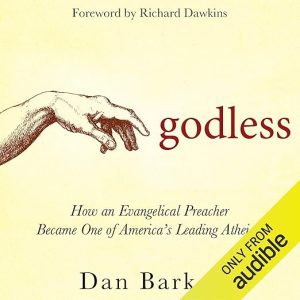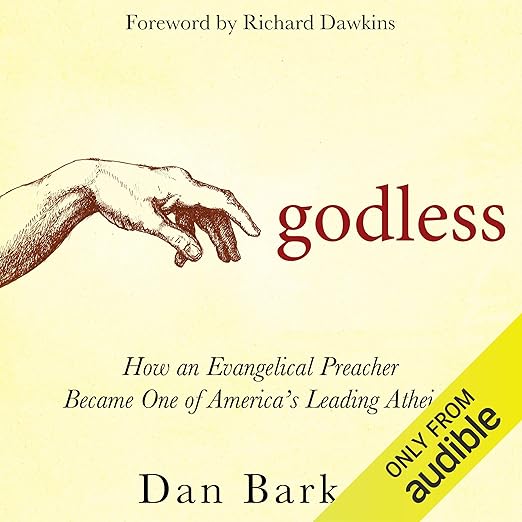
Dan Barker's Godless opens with a biographical fact that shapes everything that follows: nineteen years passed between his first sermon at age fifteen and his last sermon at thirty-four, during which Barker moved from ordained preacher and Christian songwriter to co-president of the Freedom From Religion Foundation. This audiobook is narrated by Richard Dawkins - a casting decision that deserves comment in its own right - and runs nearly twenty hours across four structured sections that move from personal memoir to philosophical argument to biblical critique to what Barker calls Adventures in Atheism.
The four-part structure Barker uses is strategically sound. Part one, "Rejecting God," grounds the listener in personal stakes before the philosophical argument begins. Barker's deconversion is not a single crisis moment but an accumulation - a preacher gradually recognizing that the intellectual foundations of his faith could not withstand the scrutiny he was increasingly capable of applying. The memoir sections have a quality that one reviewer identified precisely: Barker is not a "railing, godless activist shaking a fist at the raging sea." His arguments emerge from a position of genuine intimacy with Christianity, which gives them a different weight than the dismissiveness available to someone who never believed. He knows what he gave up across those nineteen years, and the book does not pretend otherwise.
Part two moves into philosophical territory - the case for atheism as a reasoned position rather than simply the absence of faith - and here Barker's background as a musician and songwriter produces writing that is more accessible than academic philosophy while remaining engaged enough with apologetics to address the arguments on their own terms. Part three, the biblical criticism, is the most technically demanding section and the one that apologists have found hardest to dismiss, because Barker knows the source material with the depth of someone who spent two decades preaching it. The critiques of biblical reliability and the historical evidence for Jesus are presented with chapter-and-verse specificity that general cultural arguments about religion rarely achieve. Part four returns to the personal: the Supreme Court case over the National Day of Prayer, personal trauma Barker addresses directly, and the shape of life constructed outside the community that defined his identity for nearly twenty years.
Dawkins's Cadence Never Fatigues Across Nineteen Hours
Richard Dawkins narrating this audiobook is not a neutral production choice. Dawkins - author of The God Delusion and among the most publicly prominent voices of what became known as New Atheism - brings a specific intellectual authority and a specific public history to the narration that listeners will either find appropriate or overdetermined, depending on their own position. For secular readers, the combination of Barker's personal testimony and Dawkins's delivery creates a coherence that a less ideologically aligned narrator would not produce. For skeptical or believing listeners engaging with the arguments as an honest intellectual exercise, the Dawkins narration may color the reception of arguments that deserve evaluation on their merits rather than on the narrator's associations.
What Dawkins brings technically is a clarity and confidence suited to the argumentative content. The philosophical sections - the logical structure of the case against theism, the treatment of the problem of evil, the critique of biblical reliability - are delivered with the precision of someone who has spent considerable time thinking in exactly these frameworks. At nearly twenty hours, the narration never becomes fatiguing; Dawkins's British academic cadence is consistent and focused throughout the full runtime of a substantive and demanding audiobook.
Chapter and Verse, Plus the Supreme Court Case
The sections covering the biblical text are where Barker's specific expertise becomes most evident, and where the book distinguishes itself most clearly from general atheist polemics. He is not making cultural arguments about religion in the abstract; he is engaging with chapter and verse, with the internal contradictions of scripture, with the historical evidence for and against the gospel accounts and the resurrection narrative specifically. For readers who have encountered similar critiques in less specific form, Barker's level of detail will represent a significant upgrade in precision. For readers who find that kind of textual analysis spiritually challenging, these chapters are where the book demands the most honest engagement.
Godless is most valuable for readers willing to engage with it seriously regardless of where they arrive on the question. The personal dimension - the Supreme Court case, the personal trauma Barker addresses in the final section, the account of building an identity outside a community that defined one for two decades - prevents the book from being purely abstract polemic and keeps the stakes grounded in lived experience rather than philosophical position alone.
Dawkins Narrating Barker Divides the Audience
Secular readers, agnostics, and people in various stages of questioning religious belief will find this audiobook among the more complete available treatments combining deconversion narrative with structured philosophical argumentation. Listeners who want the case for atheism presented by someone with genuine insider knowledge of Christian theology and practice will find Barker's perspective unusually credible as a result of his nineteen years of ministry. Devout Christians who prefer not to encounter extended and specific critique of biblical reliability and Christian doctrine should approach with clear awareness of what this audiobook delivers. The Richard Dawkins narration is a significant feature for some listeners and a complicating factor for others; both reactions are honest and worth factoring into the purchase decision before committing nearly twenty hours to the experience. For listeners who are genuinely open to the arguments regardless of who is making them, Godless offers something relatively rare in secular literature: a detailed account of what it actually cost someone to leave faith, combined with the intellectual case for why that cost was worth paying.
- Narrator: Richard Dawkins narrating Dan Barker's Godless is an extraordinary casting decision that functions as editorial commentary - two of the anglophone secular movement's most prominent voices in extended conversation across nearly twenty hours.
- Subjects: Deconversion and identity, the philosophical case against theism, biblical criticism and personal liberation
- Tone: Intellectually combative and personally earnest in equal measure
- Bottom line: Whether arriving as a secular reader wanting structured argument or as a curious believer willing to engage honestly, Godless delivers its case with personal weight that Dawkins's narration amplifies considerably.
Good to Know
Why is Richard Dawkins narrating Dan Barker's audiobook rather than Barker himself?
The production choice to have Richard Dawkins narrate Godless reflects the alignment between the two figures in the secular movement - Dawkins as author of The God Delusion, Barker as co-president of the Freedom From Religion Foundation. Listeners should be aware that Dawkins's public profile shapes the reception of the narration, which is worth factoring into the listening experience.
Is this audiobook primarily memoir, philosophy, or biblical criticism?
All three, across four structured sections. Part one covers Barker's deconversion story, part two the philosophical case for atheism, part three biblical criticism in substantial technical detail, and part four returns to personal narrative including the FFRF's Supreme Court case. The sections build on each other but can also be engaged with selectively.
Is this audiobook useful for someone still within a faith tradition who is experiencing doubt?
Barker's deconversion narrative in part one is particularly relevant for people navigating doubt, because it traces a gradual intellectual process across nearly twenty years rather than a crisis break. The philosophical and biblical sections provide structured arguments that doubters may find valuable to encounter in clearly articulated form.
How does this audiobook compare to Richard Dawkins's own The God Delusion in approach and content?
Godless is more personally grounded than The God Delusion. Barker's insider knowledge of Christian practice and scripture gives the critique a different texture than Dawkins's scientific and philosophical approach from outside the tradition. Godless is also structured around a single autobiography as its emotional center, making it feel more personal throughout.