Quick Take
- Narration: Dan Barker narrates his own work with the authority of a former evangelical preacher, the cadence of sermon delivery turned to secular purpose, which is its own kind of pointed irony.
- Themes: biblical textual analysis, critiques of divine morality, the gap between theological claims and scriptural content
- Mood: Methodical and confrontational, with occasional dry wit
- Verdict: A systematically organized case against the biblical God’s moral character, most valuable for readers willing to engage with close scriptural analysis rather than broad anti-religious argument.
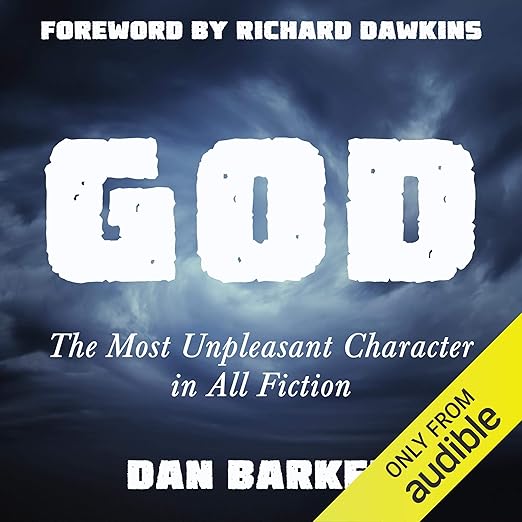
I want to be clear about what I bring to this review: I’m not a theologian, and I’m not an atheist activist. I am someone who studied texts for a living for over a decade, and what interests me about Dan Barker’s God: The Most Unpleasant Character in All of Fiction is not its conclusion, which is announced in the title and on every page, but its method. Barker, a former evangelical preacher who spent nineteen years as a minister before his deconversion, has organized this book as a systematic textual analysis of the Bible. Each chapter addresses a specific adjective: jealous, petty, unforgiving, bloodthirsty, vindictive, and so on. Each chapter then marshals the scriptural evidence for that characterization. It is structured, in other words, like a legal brief, not like a polemic, and that distinction matters considerably for how you evaluate it.
The book originated as a collaboration with Richard Dawkins, who introduced the most unpleasant character in all fiction framing in The God Delusion. Barker, who brings the insider knowledge of someone who spent two decades preaching the text he is now dissecting, does something that Dawkins’ version of the argument cannot: he demonstrates chapter and verse, across thirteen different editions of the Bible, that the characterizations he’s applying are not interpretations but descriptions. The God depicted in these pages commands genocide, demands child sacrifice in specific circumstances, expresses explicit favoritism, and punishes populations for the sins of their leaders. Barker cites the passages. He does not paraphrase or summarize.
The Structure That Makes This Different from General Anti-Religious Arguments
One reviewer who spent years studying cults and theology found the book valuable for applying to both history and religion and appreciated the chapter-by-chapter organization that addresses each descriptive adjective systematically. That structure is the book’s primary intellectual contribution. Rather than making a sweeping argument that religion is harmful, an argument that can be countered with sweeping examples of religious benefit, Barker is making the narrower and more defensible claim that the specific character of the biblical God, as depicted in the specific text of the Bible, has certain specific attributes that are difficult to square with claims of divine goodness. It is a claim about a text, not about all believers or all versions of religious experience.
The distinction matters. Barker is not arguing that all religious people are bad or that all versions of God are harmful. He is analyzing a text and describing what he finds in it. One reviewer called this the same book that all Christians believe is a book of love, sunshine and rainbows and expressed genuine shock at the scriptural content Barker surfaces. Another reviewer, a former Christian, noted never having read the chapters and verses cited in this book and finding the experience of encountering them in context disorienting in ways they hadn’t anticipated.
Barker Narrating His Own Work
Barker reads this himself, and the performance carries an unusual quality: the cadence of someone who spent nineteen years delivering sermons. His vocal register when reading biblical passages has the settled authority of a preacher, which creates a productive irony, the form of proclamation applied to content that undermines the institution that generated that form. This is not an accident. Barker is a skilled public speaker who knows what he’s doing with his own voice and with the performance history behind it.
At fifteen hours and 26 minutes, this is a substantial listening commitment, and his delivery keeps the material from becoming a monotonous recitation of unpleasant scriptural passages. The wit that several reviewers mention is present but understated. Barker is not primarily a comedian, and the humor is the dry kind that comes from juxtaposing the grandeur of theological claims against the specific granularity of what the text actually says. The gap between those two things is, in its way, the entire argument made audible.
Who Is This Actually For
This is not a book for people who already agree with Barker’s conclusion and want to feel confirmed in it. The length and density of the textual analysis will bore readers looking for anti-religious entertainment that validates rather than informs. It is also not a book for people who are firmly committed to their faith and will find the exercise offensive, Barker himself acknowledges this, and the reviews from committed believers tend to confirm it. The audience is the genuinely curious: people who have heard the argument that the biblical God has a troubling moral profile and want to see it made rigorously and with specific citations rather than broadly and from anecdote.
Several reviewers who came from faith backgrounds, a former Christian, someone whose parents converted to Jehovah’s Witnesses, a former pastor, found the book clarifying rather than provocative. They arrived knowing the conclusion was true from their own experience and found Barker’s documentation providing the systematic confirmation that personal experience could not. For that audience, the book is valuable in a particular way that general anti-religion content cannot replicate.
What the Book Doesn’t Do
Barker does not engage extensively with theological counter-arguments, the typological readings, the historical-critical frameworks, the progressive revelation interpretations that mainstream theology uses to contextualize the difficult passages he cites. His response to these frameworks is essentially that they are post-hoc rationalizations, and he makes that case briefly rather than extensively. Listeners who want a fully dialogic engagement with sophisticated theology will need supplementary reading. What the book offers is a single rigorous perspective applied with consistency across a very long text. Within those limits, and they are honestly stated limits, it is thorough and honest about what it is doing and what it isn’t.
Frequently Asked Questions
Does Dan Barker engage with theological counter-arguments, or is this a one-sided presentation?
Primarily one-sided, by design. Barker acknowledges that theological frameworks exist to contextualize the passages he cites, but he treats those frameworks briefly and dismissively. The book is an analytical case, not a debate.
Is this audiobook appropriate for someone who is currently questioning their religious faith?
It depends on the reader. The book provides systematic scriptural documentation for arguments many doubters encounter anecdotally. Some readers in that position find it clarifying; others find the density overwhelming. The fifteen-hour length is a real consideration.
Does Dan Barker’s background as a former evangelical preacher show in his narration?
Prominently and productively. His cadence when reading biblical passages carries the authority of nineteen years of preaching, which creates a pointed irony that is clearly intentional. The performance is more sophisticated than a neutral reading would be.
How does this audiobook compare to Richard Dawkins’s The God Delusion as a critique of religious belief?
Barker’s book is narrower and more textually focused. Dawkins makes a broad scientific and philosophical case against theism; Barker analyzes the specific moral character of the biblical God through close reading of the text itself. They are complementary rather than redundant.