The Short Version
- Narrator: Gordon Klassen brings a respectful, measured delivery to the biographical material that suits the reverent tone of Liardon's writing without tipping into hagiography.
- Subjects: Revival and spiritual power, the cost of ministry, faith as a public and political force
- Tone: Inspiring and sobering in equal measure, with the weight of lives spent entirely in service to a calling
- Bottom line: A richly detailed third volume in the God's Generals series that profiles four giants of Christian revival, built for faith communities but accessible to anyone curious about religious history.
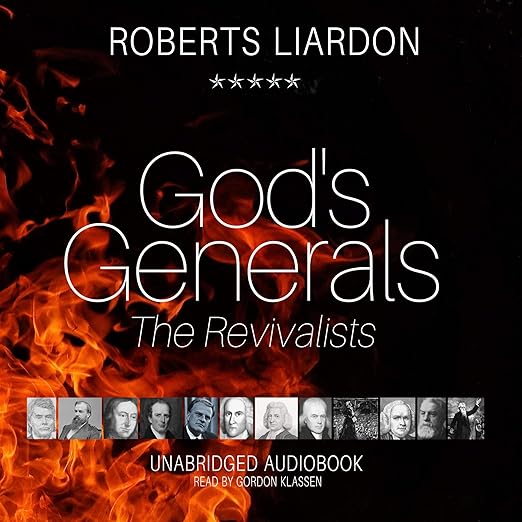
Roberts Liardon's God's Generals: The Revivalists, Volume 3 arrives as the third installment in a series that has established itself as a landmark in Christian biographical literature, and this audiobook carries the accumulated authority of that reputation. Gordon Klassen narrates nearly fifteen hours of spiritual biography covering four figures whose influence on Christian practice and social history extends well beyond church walls: George Whitefield, Charles Finney, William and Catherine Booth, and Billy Graham. That range alone - from eighteenth-century open-air preaching to twentieth-century presidential counsel - makes this a more historically ambitious listen than the word revivalists might initially suggest. The scope is not merely devotional; it is a record of how religious fervor has repeatedly shaped the political and social landscape of Western history.
Liardon's approach is openly hagiographic in its framing. He is writing as a believer about believers, drawing crucial life application and inspiration from these lives so that readers can learn how to fulfill their own sense of calling. That context matters for understanding what the book is and is not. It is not academic religious history with the critical apparatus that implies. It is devotional biography, structured to inspire and instruct within a specific faith tradition. The 4.9 rating across 438 listeners reflects how well it serves that purpose for its intended audience.
Klassen Communicates Magnitude Without Sliding Into Breathlessness
The four profiles carry very different registers. Whitefield's story is perhaps the most genuinely astonishing in purely historical terms: a preacher who required no amplification to reach crowds of more than 60,000 people, whose dramatic delivery transformed the emotional landscape of eighteenth-century religious life on two continents. The scale of that influence is difficult to grasp even with Liardon's vivid descriptions, and Klassen's narration gives the historical passages enough weight to communicate the magnitude without sliding into breathlessness.
Charles Finney's trajectory from skeptical lawyer to revival preacher is structurally compelling as a conversion narrative, but the section is most interesting for its depiction of how his ministry integrated prayer and what the tradition calls divine healing - a combination that made him controversial within mainstream Protestantism and foundational to later evangelical practice. William and Catherine Booth's chapter is the broadest in social scope: the founding of the Salvation Army, with its combination of evangelical theology, food distribution, and political advocacy against sex trafficking, is a reminder that religious revival in the nineteenth century was often inseparable from social reform in ways that current categories tend to obscure. Liardon handles that complexity with more honesty than a purely devotional framing might lead listeners to expect.
Klassen Trusts the Material to Carry the Weight
The audiobook format serves this material well because biography of this kind is at its best when it has the feel of a story being told rather than a case being argued. Klassen understands that distinction. He does not perform the emotional content - he trusts the material to carry it, which means that the passages where Liardon describes the power of these preachers' ministries land with the weight of witness rather than the pressure of promotion.
Brenda McCarthy's review describes being fascinated by the subjects and moved by the power she attributes to the Holy Spirit behind their work. Samantha Ojeda's observation that powerful men and women of God just didn't pay attention to their bodies and family is a quietly devastating note that Liardon does not flinch from - the cost of these ministries on the people who pursued them is part of the story, and the book is honest about it even while drawing inspirational lessons from the same material. That dual awareness, of achievement and cost running alongside each other, gives the biographical portraits a dimensionality that pure celebration would lack.
Eleven Successive Presidents Give This Real Density
At nearly fifteen hours, this is a substantial listening commitment. The series format means that some prior familiarity with Liardon's God's Generals project will enhance the experience, though each volume is coherent on its own terms. The Billy Graham section, given its twentieth-century subject and the scale of documentation available, carries more biographical density than the earlier profiles, and the account of his relationship with eleven successive US presidents gives it a historical texture that complements the spiritual focus.
Listeners outside the evangelical or charismatic tradition will find the book most useful as a window into how that tradition understands its own history and heroes. Liardon makes no pretense of neutrality, but the historical details are substantial enough that the profiles reward engagement even from listeners who do not share the devotional frame. The Whitefield and Booth sections in particular carry enough historical specificity to function as genuine social history alongside the spiritual biography, which expands the book's potential audience beyond its primary faith community readership.
Klassen's Patient Narration Makes the Commitment Feel Proportional
This audiobook is built for Christian listeners who want both historical depth and spiritual inspiration from the lives of the tradition's most significant revival preachers. It will also reward listeners curious about the social history of evangelicalism, particularly the Booth chapter's account of how religious revival became the engine for one of the world's largest charitable organizations. Earlier volumes in the series are not required listening, but the God's Generals series rewards sustained engagement across volumes for those already inside its world. At the 4.9 rating that positions it among the highest-rated titles in the religious biography category, the community verdict on its value is clear, and Klassen's patient narration makes the nearly fifteen-hour commitment feel proportional to the material.
Common Questions
Is the God's Generals: The Revivalists, Volume 3 audiobook suitable for listeners who are not evangelical Christians?
Yes, with the understanding that Liardon writes from a devotional perspective rather than a neutral historical one. The biographical detail is substantial, and the social history - particularly the founding of the Salvation Army - is accessible to any listener interested in religious history.
Does the audiobook version of God's Generals: The Revivalists, Volume 3 cover Billy Graham's full career and legacy?
The section on Graham is the most extensively documented in the volume given the twentieth-century subject and available material. It covers his preaching career, his presidential connections, and his theological approach, though it is a biographical essay within Liardon's frame rather than a standalone biography.