The Short Version
- Read by: Hayden Lee's clear, disciplined pacing keeps a story spanning childhood poverty to American advocacy work moving without losing momentum.
- At its heart: Religious persecution in China, underground house churches, escape and asylum, Christian human rights advocacy
- Vibe: Tense and specific in its early chapters, advocacy-focused by the end
- Short version: A well-told, detail-rich escape memoir best suited to listeners comfortable with its explicit Christian advocacy framework rather than those wanting a secular political history.
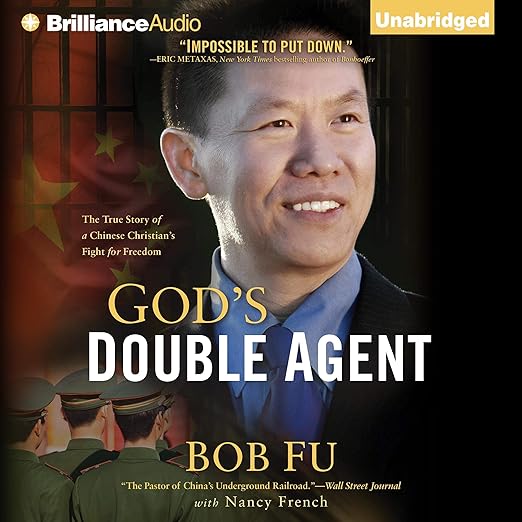
Escape memoirs live or die on specificity, and God's Double Agent has it in abundance: a Beijing house-church network operating in literal daylight-versus-darkness double shifts, a Tiananmen Square protest witnessed firsthand, an actual prison cell, an actual river crossing. Bob Fu's nearly ten-hour audiobook earns its subtitle, the true story of a Chinese Christian's fight for freedom, by staying grounded in exactly those kinds of concrete, verifiable details rather than general spiritual reflection.
Our Take on God's Double Agent
Fu's story moves through a genuinely remarkable arc: born during Mao's Great Leap Forward into serious poverty, a teacher by day in a state school and an underground preacher by night, present at Tiananmen Square as a student protester, later arrested and imprisoned for running an illegal house church, and eventually escaping to the United States, where he became a prominent advocate for persecuted Christians in China, founding the organization now known as ChinaAid. Each stage gets enough specific, textured detail that the book reads, and listens, like reporting on his own life rather than inspirational-memoir shorthand.
One reviewer traced her own interest back to watching Fu interviewed by Glenn Beck and being struck by his calm, unshowy demeanor discussing genuinely traumatic material, and that same quality carries through the book itself. Fu doesn't lean on melodrama to sell the stakes of his story; the stakes, arrest, interrogation, family separation, are inherently high enough that a measured telling actually lands harder than an overwrought one would.
The distinction between house churches and China's officially sanctioned Three-Self Patriotic Movement congregations is real and load-bearing for understanding Fu's story specifically: the state permits and monitors religious practice within state-approved institutions while treating independent, unregistered congregations as a genuine political threat requiring surveillance and, as Fu's own arrest demonstrates, prosecution. The book's tension only makes full sense once a listener understands that Fu wasn't practicing an illegal religion in the abstract, he was specifically refusing state control over his religious practice, which is the actual source of the government's hostility.
The book's American reception has traveled disproportionately through conservative and Christian media channels rather than mainstream human-rights press, a distribution pattern rather than a content judgment, and it likely shapes both who tends to discover the book and some of the specific emphasis in its American-advocacy chapters.
Fu's birth during the Great Leap Forward, Mao's catastrophic 1958-to-1962 industrialization campaign that produced one of history's deadliest famines, situates his family's early poverty within a specific, well-documented historical catastrophe rather than generic hardship. That grounding matters for the book's credibility: the suffering described in its opening chapters maps onto verifiable history rather than requiring the listener to take Fu's account of scarcity on faith alone.
Why Listen to God's Double Agent
Hayden Lee narrates with a clarity well suited to a story built on specific, sequential detail rather than abstract reflection, moving a listener through Fu's timeline, childhood poverty, secret seminary training, Tiananmen, arrest, escape, American advocacy work, without letting any single stretch drag. That pacing matters for a book covering this much ground in under ten hours; a less disciplined narration could easily make the earlier, slower-building chapters feel like setup rather than essential foundation.
The book also functions as a genuine primer on a subject most American listeners know only in outline: the mechanics of underground Christianity in China, how house churches actually operate, what real legal jeopardy their leaders face, and what happens to families after an arrest. Fu's firsthand account of Tiananmen Square specifically, witnessed as a student rather than reconstructed from news footage, adds a layer of primary testimony to an event most listeners only know through secondhand images.
Nancy French's co-writing credit matters for the book's actual reading experience: memoir co-writers shape pacing and structure as much as any single scene, and the book's disciplined momentum, rarely lingering past the point a scene has made its point, reflects craft decisions as much as Fu's own remarkable material. That collaboration produces a book that reads, and sounds, more like well-constructed narrative nonfiction than a looser, first-person-only memoir might have.
The book also sits within a recognizable subgenre, persecuted-church memoir, alongside other accounts of underground Christian practice under hostile governments, and Fu's version distinguishes itself through its specificity about the mechanics of evasion and eventual advocacy rather than staying at the level of spiritual testimony alone; listeners familiar with the broader subgenre will notice how much procedural, almost tradecraft-like detail this account includes.
What to Watch For in God's Double Agent
This is explicitly a Christian advocacy memoir, co-written with Nancy French, and Fu's ongoing activism shapes how the later chapters are framed; listeners looking for a purely secular political history of Chinese human rights will find the religious throughline inseparable from the political one throughout, by design rather than accident. That's not a flaw exactly, it's the book's actual subject, but it's worth knowing going in.
The nearly ten-hour runtime covers an extraordinary amount of ground, childhood, seminary, activism, arrest, escape, resettlement, ongoing advocacy, and the back half covering Fu's American years necessarily moves faster than the tension-heavy escape narrative that precedes it. Listeners drawn in by the espionage-adjacent tension of the title should know the book broadens into policy advocacy well before the runtime ends.
The Tiananmen Square material specifically benefits from some outside context a listener might want to bring to it: the 1989 protests, which Fu witnessed as a student before their violent suppression that June, remain a subject the Chinese government actively censors domestically to this day, which is itself part of why a firsthand, uncensored account carries particular weight and particular risk for the people involved in telling it.
The book's back half, covering Fu's American resettlement and advocacy career, necessarily trades some of the earlier chapters' tension for a more institutional, policy-oriented register; listeners most drawn to the escape narrative itself should know that register shift is real and permanent once the book crosses into its American chapters.
Who Should Listen to God's Double Agent
Listen if you want a firsthand account of religious persecution in modern China told with real narrative discipline, especially if you're interested in Christian human rights advocacy or in Tiananmen-era history from a participant's perspective rather than a historian's.
It's also a natural fit for listeners already familiar with religious liberty advocacy more broadly, whether through other persecuted-church memoirs or through organizational reporting on international religious freedom, since Fu's personal story connects directly to the advocacy infrastructure, ChinaAid among it, that grew out of exactly these kinds of individual escape stories.
Skip it if you're looking for a secular, policy-focused account of Chinese human rights issues; the book's Christian advocacy framework runs through every chapter, and readers uncomfortable with that lens throughout should look elsewhere for the same historical ground.
Is the God's Double Agent audiobook a Christian memoir or a general political history?
Both, inseparably. It's explicitly a Christian advocacy memoir, so listeners wanting a purely secular account of Chinese human rights issues will find the religious framework running through every chapter by design.
Who narrates the God's Double Agent audiobook, and how long is it?
Hayden Lee narrates, delivering the nearly ten-hour runtime with a clear, disciplined pace that keeps Fu's long timeline, from childhood poverty through American advocacy, moving without dragging.
Does God's Double Agent cover Bob Fu's experience at Tiananmen Square?
Yes, and it's one of the book's strongest sections. Fu witnessed the 1989 protests firsthand as a student, giving the audiobook a layer of primary testimony most listeners only otherwise know through news footage.