Quick Take
- Narration: David Smalley brings a clean, direct delivery that suits Stenger’s argumentative prose, no theatrics, just confident forward momentum through dense material.
- Themes: science versus religion, the history of ecclesiastical obstruction, the political consequences of faith-based epistemology
- Mood: Rigorous and combative, with occasional flashes of dry wit
- Verdict: One of the more intellectually serious entries in the science-versus-religion genre, genuinely historical in its sweep and worth the attention of anyone willing to engage with an argument that does not soften its edges.
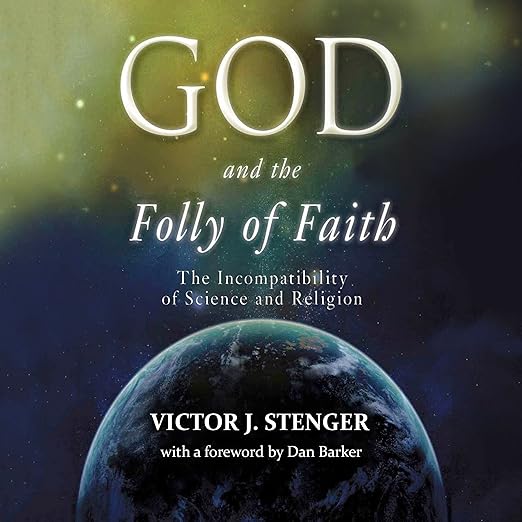
I started listening to God and the Folly of Faith on a morning walk, which turned out to be a good format for it. Victor Stenger’s argument is dense and cumulative, the kind of case you need to process in motion rather than sitting still with it. By the time I had finished the first two chapters, I had formed a clear picture of what this book is and what it is not: it is not a polemic in the style of Dawkins at his most combative, and it is not a memoir of lost faith. It is a historian of science making a methodical case that the widely accepted reconciliation between Christianity and the scientific enterprise is built on a false reading of the historical record.
That is a more specific and more interesting argument than most books in this space attempt, and it is what makes God and the Folly of Faith worth the attention of readers who might otherwise assume they have heard this debate already.
Our Take on God and the Folly of Faith
Stenger’s central thesis is twofold: first, that the popular claim that religion and science have historically coexisted without serious conflict is demonstrably false; and second, that the active obstruction of scientific inquiry by the Church cost human civilization roughly a thousand years of potential development. He builds this case through a sweeping survey that begins with ancient Greek science, moves through the Renaissance and Reformation, and arrives at contemporary disputes over physics, cosmology, and evolutionary biology.
One reviewer described this as “mostly science” and that description, while accurate, undersells the historical architecture Stenger constructs. The scientific chapters are framed by a meticulous historical argument about the specific mechanisms through which ecclesiastical authority suppressed inquiry. The claim that the scientific revolution of the seventeenth century happened only after challenges to Church authority created space for independent thought is not new, but Stenger marshals the evidence for it with a physicist’s precision.
The book grows most energized in its later sections, where Stenger turns from history to the present. His concern about the political influence of organized religion on scientific discourse, specifically around population, environmental policy, and climate, gives the argument contemporary stakes that the historical survey alone cannot provide. One reviewer accurately characterized his position on faith itself: that it means believing something for which you have no evidence, and that this habit of mind, when amplified through institutions and politics, poses a concrete threat to the generations that follow.
Why Listen to God and the Folly of Faith
David Smalley’s narration is a good match for Stenger’s argumentative register. The prose is not lyrical; it is precise and sequential, built to advance a case rather than create atmosphere, and Smalley reads it with the clear, forward-moving confidence that this kind of intellectual nonfiction requires. At twelve and a half hours, the book is long enough to require commitment, but Smalley’s pacing keeps it from feeling like a lecture.
The breadth of the historical survey is genuinely impressive. Stenger covers ground from ancient Greece through the Renaissance, Reformation, Enlightenment, and into modern physics without the kind of cursory summarizing that weakens sweeping historical arguments. Each section does enough work to stand on its own while advancing the larger thesis, which is a difficult balance to maintain over this length.
What to Watch For in God and the Folly of Faith
This is not a book for readers seeking a nuanced or sympathetic account of the religious tradition. Stenger is explicitly adversarial toward organized religion’s influence on scientific culture, and he states his conclusions without much hedging. One reviewer described it as needing to be read “without religious defenses being up,” which is a fair characterization: readers who approach from a committed faith position will find little invitation to engage and considerable material to find offensive.
The book also covers a very large amount of intellectual and historical ground in its twelve-plus hours, and individual chapters sometimes feel compressed relative to the scope of what they are claiming. Reviewers familiar with the underlying science and history found the survey compelling; those coming to the material fresh may find some sections move too quickly to fully absorb the argument.
Who Should Listen to God and the Folly of Faith
The ideal listener is someone already interested in the history of science who wants a rigorous, historically grounded version of the science-religion conflict argument rather than the more polemical entries in that genre. Secular readers and committed skeptics will find their existing positions confirmed with substantial evidence. Religious listeners who are genuinely curious about the strongest version of the opposing argument can find value here, but the book is not designed to facilitate dialogue. This is advocacy, rigorously constructed, for the position that faith and scientific epistemology are fundamentally incompatible, and it makes that case with more care and historical specificity than most books in the genre manage.
Frequently Asked Questions
How does God and the Folly of Faith differ from similar books by Dawkins, Hitchens, or Harris?
Stenger’s primary contribution is the historical argument: where Dawkins focuses on evolutionary biology and Hitchens on political and cultural damage, Stenger builds a detailed case from the history of science itself. His claim that Christianity actively obstructed scientific progress for a thousand years is argued through specific historical episodes rather than rhetorical assertion, which gives the book a different texture from the more polemical New Atheism titles.
Does the book engage with the ‘non-overlapping magisteria’ position, the idea that science and religion address separate questions and therefore can’t conflict?
Yes, and rejecting that position is one of Stenger’s central goals. He argues explicitly that religion and science do make overlapping claims, particularly about the origin of the universe, the nature of consciousness, and the source of morality, and that the ‘non-overlapping magisteria’ framing is a convenient fiction rather than an accurate description of how religious institutions have actually behaved.
Is this audiobook appropriate for someone without a strong background in physics or the history of science?
Largely yes, though some chapters move quickly through complex material. Stenger writes for a general educated audience rather than specialists, and Smalley’s clear narration helps with the denser sections. Listeners who come with no background in evolutionary biology or cosmology may find a few chapters require more attention than others, but the historical argument that frames the science is accessible throughout.
The subtitle promises a ‘sweeping historical survey’, does the book actually deliver that, or does it focus primarily on contemporary debates?
It genuinely delivers both. The first two-thirds are a systematic historical survey from ancient Greece through the Reformation and Enlightenment to the twentieth century. The final third turns to contemporary science-religion conflicts around cosmology, consciousness, and politics. The historical depth is one of the book’s genuine strengths compared to more topically focused entries in the genre.