Quick Take
- Narration: Seth Andrews brings a careful, measured delivery that respects both sides of the argument; given that Andrews is himself a prominent secular voice, the casting is notable and the narration does not editorialize.
- Themes: Science and religious belief, the limits of physics as a framework for cosmological origins, the distinction between how and why
- Mood: Compact and focused, more philosophical seminar than popular science survey
- Verdict: A precise and accessible philosophical challenge to Hawking’s anti-theist conclusions, best appreciated by listeners who want to engage seriously with the science-religion debate rather than have their existing position confirmed.
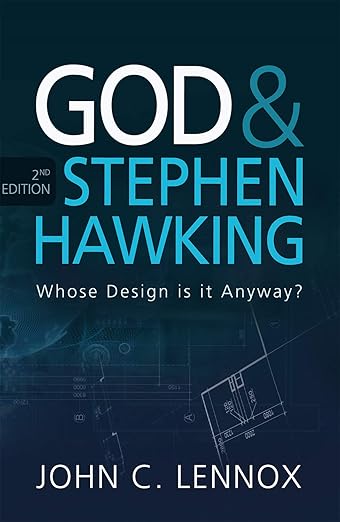
I listened to God and Stephen Hawking over two evenings, which at two hours and forty-three minutes made it one of the more concentrated listens in recent months. John C. Lennox had been on my list for a while. I had read about him more than I had read him, and his reputation as a rigorous analytic philosopher who is also a committed Christian apologist was the kind of combination I find worth engaging with regardless of my own position. The question the book asks is precise: do Hawking’s arguments in The Grand Design and Brief Answers to Big Questions actually establish that a creator God did not and could not exist?
Lennox is an Oxford mathematician and one of the more prominent voices in academic apologetics. He is not writing for people who want to be told what to think. The book’s tone is that of a scholar addressing the published claims of another scholar and asking whether the logic holds. His answer is no, and he builds to it carefully.
Our Take on God and Stephen Hawking
The central argument Lennox makes is procedural before it is theological. Hawking claims, in The Grand Design, that because there is a law like gravity, the universe can and will create itself from nothing, and that therefore God is unnecessary. Lennox’s response is not to dispute the science of gravity but to identify the philosophical gap: the law of gravity is itself something that requires explanation. Attributing the universe’s existence to a physical law does not eliminate the question of why that law exists; it restates it. One reviewer summarized this as Lennox’s strongest point: science can tell us how things came to exist, but cannot tell us why they exist.
This is a genuinely important distinction, and Lennox makes it clearly without oversimplifying the scientific framework he is engaging with. Reviewers consistently highlight his ability to cover complex ideas in an easy-to-digest fashion for the average person, and that accessibility is real without being reductive. The book is 100 pages in print, which gives it the density of an extended essay rather than a full monograph, and Lennox uses that compression to stay focused on the central argument rather than ranging into adjacent debates.
Why Listen to God and Stephen Hawking
The narration casting is worth noting. Seth Andrews is the host of The Thinking Atheist podcast and one of the more prominent secular voices in the online atheism community. His narration of a book that argues against Hawking’s anti-theism is a deliberate and interesting choice by the publisher. Andrews delivers the text with the measured quality of a professional narrator who respects the material even when it challenges his own position, and the result is a narration that does not editorialize. Listeners from both sides of the debate can trust that they are hearing Lennox’s argument as written rather than filtered through a narrator’s sympathies.
At two hours and forty-three minutes, the audiobook is genuinely accessible for listeners who want to engage with the science-religion debate but do not have the background for academic philosophy. Lennox guides his audience through the relevant points in Hawking’s arguments with clear explanations of the scientific and philosophical methods involved, and the pace is brisk enough to hold attention without skipping the substance.
What to Watch For in God and Stephen Hawking
The book is openly written from a Christian apologetics perspective, and Lennox does not pretend otherwise. His goal is not to demonstrate that science and religion are equally valid frameworks with no conflict between them, but to argue that Hawking’s specific arguments do not succeed in doing what they claim to do. Listeners who want a balanced survey of cosmological atheism and theism will find the perspective one-sided. Listeners who want a rigorous engagement with Hawking’s specific claims from a philosophically trained opponent will find exactly that.
The book is also relatively short, and Lennox acknowledges that he is not addressing the full scope of Hawking’s work or the broader science-religion question. The focus is narrow and deliberate. Some reviewers who wanted a more comprehensive treatment of the subject may feel underserved, but the book accomplishes what it sets out to do within its scope.
Who Should Listen to God and Stephen Hawking
This is particularly valuable for Christians in scientific or academic fields who have encountered Hawking’s arguments and wanted a philosophically trained response that engages the logic rather than the cultural conflict. Agnostics and skeptics who are genuinely curious about whether Hawking’s anti-theist arguments hold up to scrutiny will find Lennox a more rigorous interlocutor than most popular apologetics offers. Listeners who have already decided the question in either direction and want reinforcement of their position will find the book either satisfying or frustrating depending on which side they occupy, but they will not find it intellectually lazy.
Frequently Asked Questions
Do I need to have read Hawking’s The Grand Design to follow Lennox’s argument?
No. Lennox provides sufficient context for Hawking’s relevant claims throughout the book, including explanations of the scientific and philosophical frameworks involved. Prior familiarity with The Grand Design will enrich the engagement, but the book functions as a standalone for listeners who have not read it.
Why was Seth Andrews, a prominent secular and atheist voice, chosen to narrate a Christian apologetics book?
The publisher’s choice is not explained in the text, but Andrews delivers the narration with professional impartiality. The casting creates an interesting dynamic: listeners can observe that the argument is being delivered without endorsement from its narrator, which may actually serve the book’s credibility with skeptical audiences.
Is Lennox’s engagement with Hawking’s science accurate, or does he misrepresent the physics?
Reviewers with scientific backgrounds, including one who compared the argument to patterns observed in geology, have found the scientific engagement credible. Lennox is a mathematician by training and is careful to locate his critique at the philosophical level rather than disputing the physics directly.
What is the key logical distinction Lennox makes against Hawking’s claim that gravity explains the universe’s existence?
Lennox argues that attributing the universe’s self-creation to the law of gravity does not eliminate the question of origins but restates it, because the law of gravity itself requires explanation. Science can describe how things came to exist but cannot answer why the laws that govern that existence are themselves in place. That explanatory gap, Lennox argues, is where the question of a creator God remains live.