Quick Take
- Narration: Charles Gasparino reads his own book with the blunt, fast-talking energy of a financial journalist who has been in this industry for thirty years and is genuinely annoyed about what he has witnessed.
- Themes: ESG investing and stakeholder capitalism, corporate response to activist pressure, the financial consequences of politicized brand strategy
- Mood: Polemical and energized, more combative than analytical, with the pacing of breaking news rather than considered scholarship
- Verdict: Gasparino’s sourcing and financial journalism background give this more substance than typical culture-war commentary, but listeners looking for a balanced economic analysis will find the tone more prosecutorial than investigative.
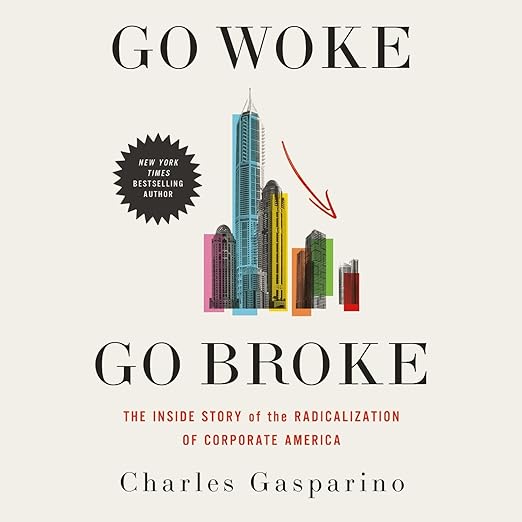
I have a particular interest in books about how large institutions make decisions under social pressure, which is why I picked up Charles Gasparino’s Go Woke, Go Broke. I have been following the ESG debate in financial journalism for several years, and I was curious how a veteran Fox Business reporter would treat it at book length. The short answer: with considerably more reporting than you might expect, and with a prosecutorial energy that makes the book move fast but occasionally obscures its own most interesting arguments.
Gasparino’s central thesis is that major American corporations, intimidated by left-wing activist pressure, embraced progressive political positions that eventually alienated large portions of their customer base, producing financial consequences in the form of boycotts, stock drops, and brand damage. He uses Anheuser-Busch, Disney, Target, and other high-profile cases as evidence, and he traces the institutional infrastructure that produced the ESG movement and stakeholder investing framework that he argues enabled this corporate politicization. He calls on thirty years of financial journalism sourcing to do this, which is where the book distinguishes itself from standard culture-war commentary.
Our Take on Go Woke, Go Broke
The most substantive section of the book is Gasparino’s account of how ESG, environmental, social, and governance investing criteria, moved from academic finance into mainstream institutional investment practice, and how that shift created both financial incentives and social pressure mechanisms for corporations to adopt progressive positions. This is genuinely interesting reporting, and it explains corporate behavior in financial terms rather than simply attributing it to cowardice or ideology. The mechanism he describes, large institutional investors using their proxy voting power and capital allocation decisions to pressure companies toward specific political commitments, is real and documented, and Gasparino’s sourcing here is stronger than his editorial framing would suggest.
The problem is that the book’s polemical voice sometimes works against its own best arguments. Gasparino’s description of the progressive movement as radical left-wing activists and his characterization of ESG as nonsense functions as partisan shorthand that will satisfy readers who already agree with him but will cause skeptical readers to discount the underlying reporting. The financial argument about whether ESG criteria produce returns competitive with non-ESG portfolios, and whether the corporate boycott dynamics he documents are economically significant at scale, is worth having. It gets partially buried under the editorial indignation.
Why Listen to Go Woke, Go Broke
Gasparino narrates himself, and his voice suits the material. He is a fast-talking, unhedged financial journalist and he sounds like one, direct, slightly pugnacious, confident in his sources. The audiobook runs ten hours, which is substantial for this genre, and the pacing sustains interest partly because Gasparino moves between specific corporate case studies efficiently. He does not dwell. Each episode is presented, analyzed briefly, and followed by another example. That structure can feel like accumulation of examples at the expense of depth, but it keeps the audio experience from feeling padded.
Reviewers who found the book valuable describe it as providing an inside look at corporate boardrooms and the mechanics of how woke policies were adopted. That is accurate to the reporting sections. Gasparino clearly has sources inside these institutions and uses them to explain decisions that otherwise look inexplicable from the outside. That insider perspective is the book’s genuine value-add over the substantial existing commentary on this topic.
What to Watch For in Go Woke, Go Broke
This is a partisan book written from a specific ideological position and published by Center Street, which is the conservative imprint of Hachette. Gasparino does not pretend otherwise, and listeners should engage with it accordingly. The financial data it presents is real, the reporting is substantive in places, but the interpretation of that data is consistently argued from a conservative economic perspective that treats ESG criteria as inherently illegitimate and activist pressure as inherently corrupting. A reader looking for a balanced accounting of the ESG debate, including the arguments in its favor and the evidence that social criteria can be integrated into investing without destroying returns, will not find that here.
One reviewer who gave it four stars noted that it covers the how of corporate woke adoption effectively but does not fully explain the why, specifically the genuine internal ideological commitments of corporate leaders who embraced these positions, as distinct from pure external pressure. That gap is real and limits the book’s explanatory reach.
Who Should Listen to Go Woke, Go Broke
Listeners interested in the financial mechanics of ESG investing and the institutional infrastructure that drove corporate political alignment will find Gasparino’s reporting genuinely informative, particularly the chapters on how large asset managers used proxy voting and capital allocation to pressure corporate boards. Conservative readers frustrated by corporate progressive signaling and looking for an account that places that frustration in a financial context will find this book validates and extends their analysis with actual journalism behind it.
Listeners who want a balanced, academically rigorous treatment of ESG as an investment framework, or who find combative political framing an obstacle to absorbing substantive information, will find the book’s editorial register more obstructive than illuminating. There is reporting worth having here, but it requires tolerance for the wrapper it comes in.
Frequently Asked Questions
Is Go Woke, Go Broke a financial analysis or a political polemic?
It is both, with the balance tilting toward polemic in its framing and editorial voice while containing genuine financial journalism in its sourcing and case studies. Gasparino’s thirty years of financial reporting gives the book more substantive content than standard culture-war commentary, but the interpretation of that content is consistently argued from a conservative ideological position.
Does Gasparino engage with the counter-argument that ESG investing can produce competitive returns?
Not seriously. The book’s thesis treats ESG criteria as inherently corrupting to corporate decision-making and investment returns, and it does not give sustained space to the financial literature arguing that integrating environmental, social, and governance factors into investment analysis can produce better risk-adjusted returns. Readers looking for an even-handed treatment of that debate will need to look elsewhere.
How does Charles Gasparino’s narration affect the audiobook experience?
Gasparino narrates with the fast, confident energy of a working broadcast journalist, which suits material that moves between corporate case studies at pace. He does not modulate his conviction, which means the audiobook has a consistent temperature throughout, engaged, slightly combative, and assured. Listeners who find that tone engaging will find the self-narration an asset; those who prefer more neutral delivery may find it tiring over ten hours.
What specific companies does the book cover in its case studies?
The most prominent cases are Anheuser-Busch, Disney, and Target, all of which experienced significant consumer backlash following progressive marketing or policy decisions. Gasparino also ranges across other Fortune 500 companies and the institutional investors and activist organizations he identifies as the pressure architecture behind corporate political alignment. The cases are specific and documented rather than hypothetical.