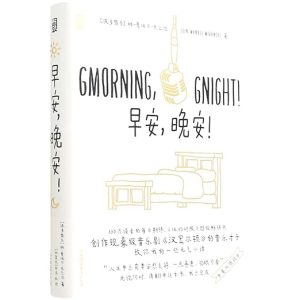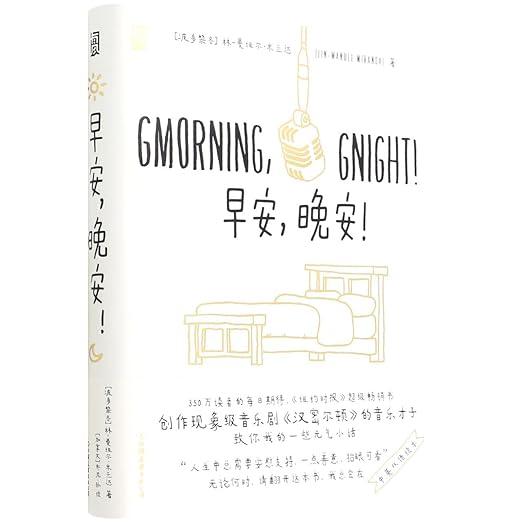
Lin-Manuel Miranda spent several years posting two short pieces of writing each day on social media: one to greet the morning, one to close the evening. The practice was consistent and public, and it reached approximately 3.5 million readers daily at its peak. Gmorning, Gnight!, performed by Miranda himself, collects those pieces into a single 46-minute audiobook. Note for prospective buyers: the synopsis associated with this title on some platforms is in Mandarin Chinese. The audiobook itself is in English. Verify the language of the specific edition you are purchasing before buying. The 46-minute runtime is the complete unabridged recording, not a truncated version; the source material is genuinely this brief, and the format is designed for it.
How Gmorning, Gnight! Holds Up
Miranda's gift is rhythm, and these pieces are built on it. He writes with an ear trained on musical theater and hip-hop: the compression of the lyric, the weight placed on specific words, the way a line can close with a word that carries more than its literal meaning. The affirmations here do not preach. They do not set goals or demand transformation. They acknowledge that mornings can be hard and evenings can be worse, and they offer something specific rather than a generic push toward positivity. The line that captures the project most precisely is the observation that you need a little kindness sometimes, and that it helps to be able to look up and find it. These are not motivational texts in the productivity-culture sense. They are acts of consistent attention toward an audience Miranda treated as worth the daily effort of composition. That underlying commitment is what keeps them from feeling like content and makes them feel like correspondence.
In the print edition, illustrated by Jonny Sun, the morning and evening pieces face each other on left and right pages, creating a visual rhythm of paired attention. In audio, that physical structure becomes sequential: Miranda reads through the morning pieces and then the evening pieces, maintaining the register shift between the two but delivering them in a linear rather than simultaneous arrangement. The result is a different experience from the book rather than a lesser one. Miranda's voice does the work that Sun's illustrations do on the page, providing warmth and framing for pieces that are brief enough to feel exposed without a container. His Broadway background means he understands projection, pause, and the specific weight of a final word in a short form.
Why Gmorning, Gnight! Works as an Audiobook
Miranda's self-narration is the structural argument for this product's existence as an audiobook. Without his voice, these pieces would simply be text. With it, they become performance, and the distinction matters. His delivery in the wry pieces, the ones that acknowledge the difficulty of the day ahead with humor rather than reassurance, is particularly well calibrated. He does not oversell the positivity or undersell the acknowledgment that things are sometimes hard. The tonal precision across a wide range of short pieces is the work of someone who has performed for large audiences long enough to know exactly how much pressure to put on a word. The 4.8 rating from nearly a thousand listeners is exceptional, and for a 46-minute product it represents genuine enthusiasm for this specific format rather than rating inflation from a long runtime that simply did not annoy anyone.
Weak Spots in Gmorning, Gnight!
The pieces vary in register within each section. Some are straightforwardly encouraging, some are wry about the difficulty of the day ahead, some are almost meditative, and some have a slight formal inventiveness that reflects Miranda's songwriter instincts. The range is managed within 46 minutes, which means transitions between tones happen quickly. Listeners who find blanket positivity uncomfortable will likely appreciate that the collection does not demand happiness; it simply offers company. The format works well as a daily practice rather than a single sequential listen. Many listeners describe returning to individual pieces on specific mornings or evenings rather than playing the recording straight through each time.
The context of origin matters for understanding what these pieces are. Miranda wrote them daily while also writing and performing Hamilton, developing his subsequent projects, and navigating the specific demands of being one of the most publicly recognized figures in American theater. The consistency of the practice across that period, maintaining a daily commitment to offering something generous to an audience when the demands on his time were extreme, is itself a kind of argument about what the pieces are for. They are not the output of someone with unlimited time for contemplation; they are the product of someone who decided that offering something small but genuine every day was worth the effort regardless of what else was happening. That context gives the audiobook a different quality than it might appear to have from the outside, where it could look like a minor product extension rather than a genuine creative practice.
The Right Listener for Gmorning, Gnight!
Recommended for Miranda fans who want his voice rather than just his words, and for listeners who have found this kind of daily affirmation useful when they can hear it rather than only read it. Also a strong choice as a gift in audio form, since the audiobook delivers Miranda's voice as a daily practice without requiring the physical book. Skip if you need substantial narrative content for the investment; 46 minutes is the complete runtime. Also skip if affirmation-based writing is unconvincing to you regardless of who performs it. Miranda's delivery is exceptional but cannot rewrite the genre's fundamental premise.