Quick Take
- Narration: Derek Perkins reads with measured authority, appropriate for an academic economic text that benefits from clear, unhurried delivery.
- Themes: IMF ideology versus development reality, the politics of global finance, insider critique of institutional power
- Mood: Analytical and occasionally incensed, the tone of someone who watched avoidable damage happen from close range
- Verdict: One of the most important economic critiques of the past three decades, more relevant than its 2002 publication date suggests.
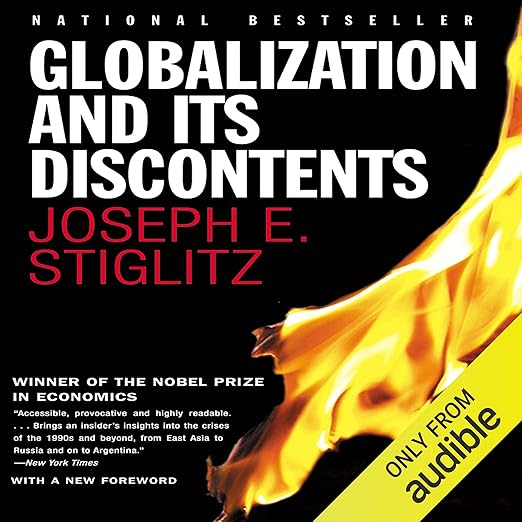
I read Joseph Stiglitz’s Globalization and Its Discontents for the first time in a university economics course, where it was treated with some ambivalence by a professor who respected the author’s credentials while remaining uncomfortable with his conclusions. I came back to the audiobook version recently, partly because the debates it documents have not gone away. The Seattle protests Stiglitz references feel less like history and more like context for arguments that are still actively contested. That a book published in 2002 requires so little updating to feel current is either a testament to Stiglitz’s prescience or an indictment of how little has changed in how global financial institutions operate. Probably both, and the tension between those two interpretations is part of what makes the book worth returning to.
Stiglitz is not an outsider making accusations from the periphery. He chaired the Council of Economic Advisers under President Clinton and served as chief economist at the World Bank. He saw from the inside how the International Monetary Fund operated during the crises of the late 1990s, including the East Asian financial crisis and the Russian economic collapse, and what he witnessed troubled him enough to write a book that would prove professionally costly to publish. The core argument is clear and damaging: the IMF consistently prioritized the interests of Wall Street and Western financial institutions over the welfare of the developing nations it was ostensibly helping, applying ideologically rigid models that caused measurable human suffering across multiple continents.
The Insider Credibility Problem
What gives this book its force is precisely what makes some readers uncomfortable with it: Stiglitz was there. He is not speculating about institutional behavior from the outside. He watched it happen in real time and from a position of institutional authority. One reviewer noted that this is neither conservative bashing nor liberal bashing but ideologue bashing, which is an accurate framing. Stiglitz is not making a partisan political argument. He is making an empirical one, and he supplies it with enough specific case studies, East Asia, Russia, Bolivia, Argentina, that the argument cannot be dismissed as abstract theory applied from a distance.
The Malaysia capital controls episode is a particularly instructive example of how ideological assumptions led institutions to recommend precisely the wrong policy response. One reviewer mentions having previously mocked the Mahathir government’s capital controls before Stiglitz’s analysis made them reconsider their confident judgment. That’s the book working as it should: making readers revisit positions they held at the time, with the benefit of documented outcomes and the analytical framework to understand why the dominant consensus got it wrong.
Derek Perkins and the Demands of Economic Prose
Economic argument at this level is not easy listening. Perkins handles the material with a calm, authoritative delivery that keeps the drier technical passages moving without losing the listener. He doesn’t try to dramatize what is essentially policy analysis, which is the correct approach. Where Stiglitz’s prose becomes more openly frustrated, and there are moments when it clearly does, Perkins allows that tone to come through without editorializing or underlining it. The result is a narration that respects both the author and the listener. The ten-hour runtime is appropriate for the scope of the argument being made, and Perkins sustains consistent quality throughout without the pacing drift that can afflict longer nonfiction recordings when narrators lose concentration.
What Has and Has Not Changed Since 2002
Stiglitz’s reform agenda, laid out in the book’s final chapters, remains largely unimplemented. The structural critique of how the IMF is governed, by whose interests, and how it enforces ideological conformity in exchange for lending, reads as freshly applicable to contemporary debates about sovereign debt, climate finance, and the terms imposed on low-income countries during the COVID-19 era. The specific crises have changed. The patterns they reveal have not. A reviewer who read this in 2009, seven years after publication, noted it remained essential knowledge for understanding emerging markets. That assessment holds more than two decades after original publication.
For listeners who find themselves bewildered by contemporary populism and its relationship to economic grievance, this book provides unusually clear documentation of the institutional decisions that produced those grievances. Stiglitz doesn’t offer a simple political villain, but he does trace specific policy choices to specific human costs in ways that make abstract debates about globalization concrete and impossible to simply dismiss as misunderstanding or ignorance.
Who Needs This Audiobook and Who Will Struggle with It
Listeners with an interest in economics, international affairs, development policy, or the history of financial institutions will find this essential listening. Stiglitz writes clearly for a general audience despite the complexity of his subject matter, and Perkins’ narration makes the most demanding passages accessible to engaged non-specialists. Listeners who want economic content presented with strict balance across all ideological positions, or who hold a more positive view of the IMF’s historical role, will find the book’s argument unsatisfying. It is, as one reviewer noted, a full-scale attack with no punches pulled. That directness is precisely what makes it matter as a document, and what ensures it will remain in print and in audio long after most economics books from the same period have been forgotten. Stiglitz’s book is, ultimately, one of the rare economics texts that functions as genuine intellectual and moral argument rather than technical literature. That ambition is what makes it worth ten hours of serious listening attention in any era.
Frequently Asked Questions
Is Globalization and Its Discontents still relevant in the mid-2020s, or has the policy landscape changed enough to date it?
Considerably relevant. The structural arguments about IMF governance, conditionality, and the prioritization of creditor interests over development outcomes apply directly to contemporary debates about sovereign debt restructuring, climate finance, and lending terms imposed on lower-income countries.
Do I need a background in economics to follow Stiglitz’s argument in audio form?
No. Stiglitz explicitly wrote for a general audience, and the audiobook benefits from Perkins’ clear, measured delivery. Some familiarity with basic economic concepts helps, but the core argument is accessible to an engaged non-specialist.
Does Stiglitz offer solutions, or is this purely a critique?
He offers a reform agenda in the later chapters, though one reviewer notes that these alternatives are not always the most fully developed part of the book. The diagnostic analysis is stronger than the prescriptive sections, which is worth knowing going in.
How does this compare to other globalization critiques from the same era, such as Naomi Klein’s No Logo or Ha-Joon Chang’s work?
Stiglitz is more institutionally focused and empirically grounded than Klein, and his insider credentials give his critique a specific authority that outsider accounts cannot match. Chang and Stiglitz share significant common ground on development economics. For a full picture of the era’s globalization debate, all three are worth reading.